

Pakistani PM meets Saudi crown prince, resolves to further strengthen bilateral ties

Saudi Crown Prince Mohammed bin Salman meets Pakistan's Prime Minister Shehbaz Sharif in his palace on the eve of 29th Ramadan, during the holy month of Ramadan, in the holy city of Makkah, Saudi Arabia, on April 7, 2024. (Saudi Press Agency)
Short Url
Updated 08 April 2024
Follow

Pakistani PM meets Saudi crown prince, resolves to further strengthen bilateral ties

  • PM Shehbaz Sharif is on a three-day visit to Saudi Arabia, his first foreign visit since assuming office last month 
  • Both leaders appreciated upward trajectory of Pakistan-Saudi Arabia relations, says Prime Minister’s Office

ISLAMABAD: Prime Minister Shehbaz Sharif met Saudi Crown Prince Mohammed bin Salman at the Al-Safa Palace in Makkah on Sunday, with both leaders resolving to further strengthen bilateral ties between Pakistan and Saudi Arabia, the Prime Minister’s Office (PMO) said. 

Sharif arrived in Saudi Arabia on a three-day official visit on Saturday, his first foreign trip as Pakistan’s chief executive since his election to the post last month. He is accompanied by his niece and Punjab chief minister, Maryam Nawaz Sharif, as well as the ministers of finance, foreign affairs, economic affairs, defense and information. 

The Pakistani premier and his delegation were invited to the palace for iftar by the Saudi crown prince, the PMO said. During the meeting, Sharif conveyed his best wishes and prayers for the health and well-being of King Salman bin Abdulaziz. The Pakistani premier was dressed in the ihram, indicating that he will perform Umrah while in Makkah.

“Both leaders appreciated the upward trajectory of longstanding fraternal relations,” the PMO said. “The two leaders reaffirmed common resolve to further strengthen bilateral ties.”
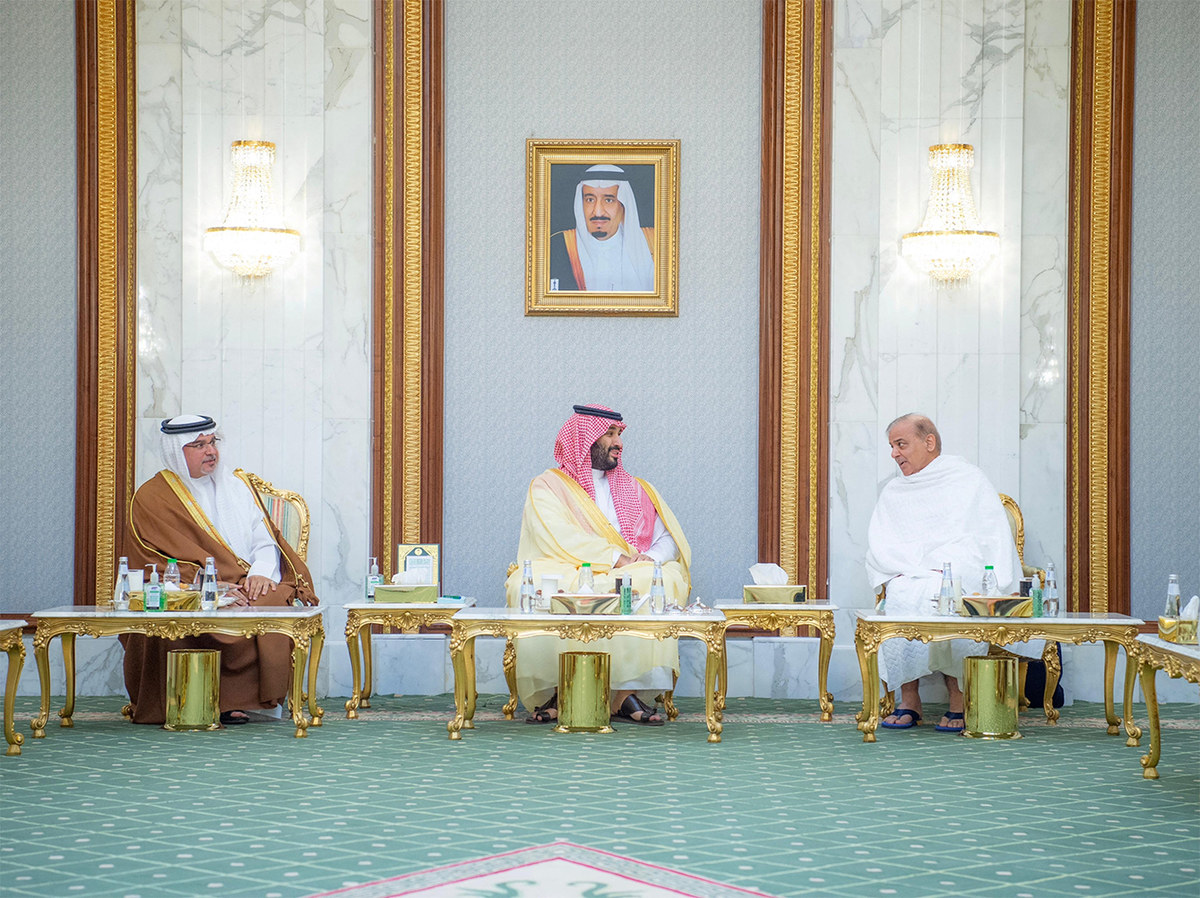


Saudi Crown Prince Mohammed bin Salman (center) meets Pakistan's Prime Minister Shehbaz Sharif (right) and Bahrain's Crown Prince and Prime Minister Sheikh Salman bin Hamad al-Khalifa in his palace on the eve of 29th Ramadan, during the holy month of Ramadan, in the holy city of Makkah, Saudi Arabia, on April 7, 2024. (Saudi Press Agency)

After iftar, Sharif held a one-on-one meeting with the Saudi crown prince, the PMO said. 
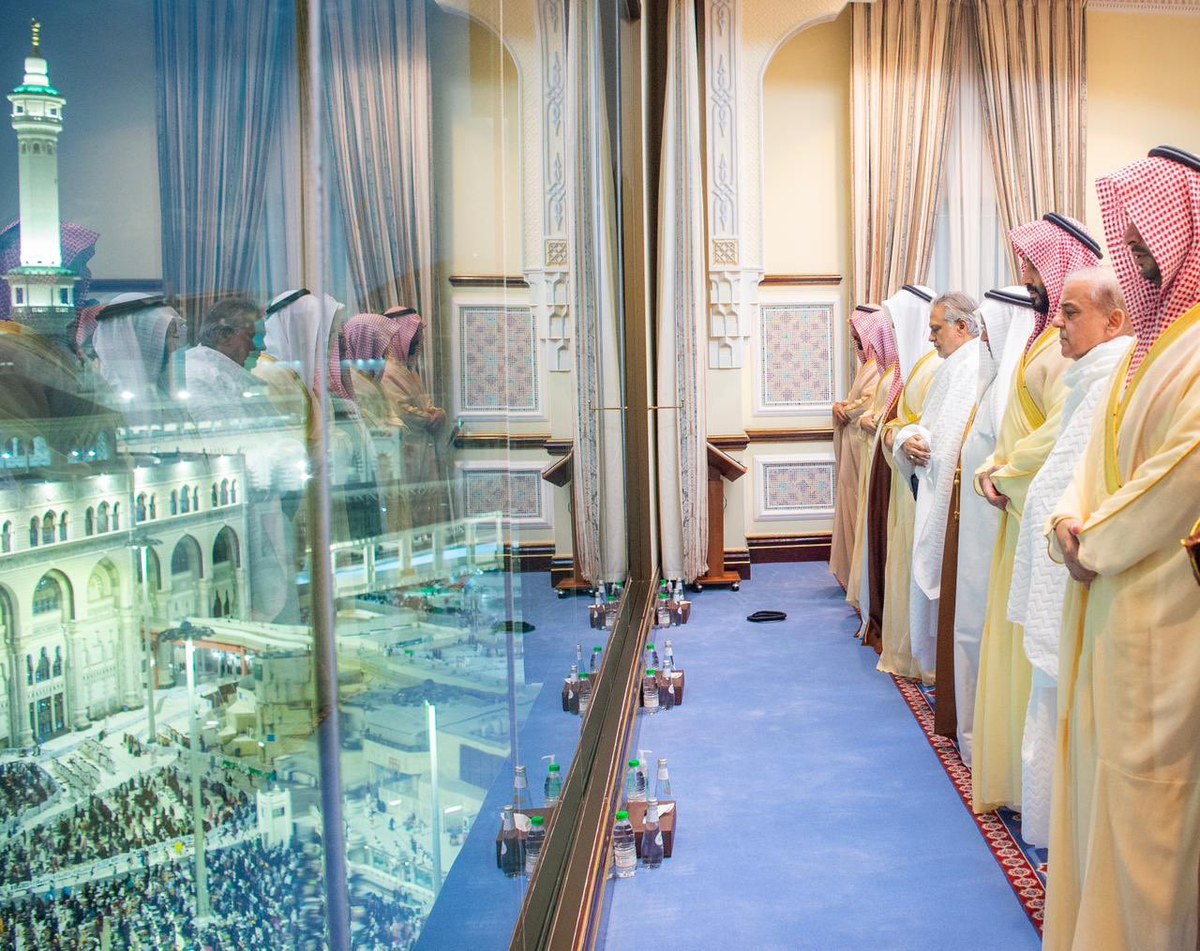


Saudi Crown Prince Mohammed bin Salman (third right) offers prayer with Pakistan's Prime Minister Shehbaz Sharif (second right) in his palace on the eve of 29th Ramadan, during the holy month of Ramadan, in the holy city of Makkah, Saudi Arabia, on April 7, 2024. (Saudi Press Agency)

Sharif last traveled to Saudi Arabia during his first term as PM in October 2022. He met the crown prince during that visit and also attended the Saudi Future Investment Initiative Summit.

Pakistan and Saudi Arabia enjoy strong trade, defense and cultural ties. The Kingdom is home to over 2.7 million Pakistani expatriates and serves as the top destination for remittances to the cash-strapped South Asian country.

Saudi Arabia has often come to cash-strapped Pakistan’s aid by regularly providing the South Asian country oil on deferred payment facilities and offering direct financial support to help stabilize its economy, shore up its foreign exchange reserves.


‘We manage dreams’: Football club nurtures underprivileged talent in Pakistan’s Islamabad

Updated 10 sec ago
Follow

‘We manage dreams’: Football club nurtures underprivileged talent in Pakistan’s Islamabad

  • POPO Football Club scouts raw talent from far-flung areas through referrals and viral videos
  • Club provides meals, training and accommodation, has sent 36 players to national teams

ISLAMABAD: Tufail Gul tightened his shoelaces and stepped onto the pitch at Islamabad’s multi-purpose F-12 ground earlier this week, weaving past defenders before burying the ball in the net. 

Not long ago, the 22-year-old was baking bread at a shop in his hometown of Pindi Gheb, about 100 kilometers from the Pakistani capital.

From a low-income family, Gul still works as a chef, an arrangement made by his club at its hostel so he can continue supporting his household, but his focus is firmly fixed on one ambition: earning a place in Pakistan’s national football team.

In Pakistan, where cricket dominates public attention and investment as a multi-billion-rupee industry, football has long existed on the margins. Despite strong grassroots followings in regions such as Balochistan and Karachi’s Lyari neighborhood, the sport has suffered from decades of administrative turmoil, limited infrastructure and scarce development pathways for young players.

Pakistan currently ranks 199th out of 210 teams in the FIFA world rankings, a reflection of these structural constraints. Against that backdrop, POPO Football Club, commonly known as POPO FC, has emerged as a rare exception, attempting to build a pipeline for underprivileged talent with little institutional support.

“POPO basically is a dream management organization where we manage the dreams of the underprivileged kids of Pakistan,” Haris bin Haroon, the club’s president, told Arab News.

“By underprivileged I mean the kids who are not financially strong or who don’t have resources to play football.”

Founded in 2013, POPO FC scouts raw talent from across the country through trials, personal referrals and viral social media videos. Over the past two years, the club has helped 36 players reach Pakistan’s Under-23, Under-19 and Under-17 national teams.

Gul is one of them.

“My parents are happy as I am playing football,” he told Arab News, adding that they are satisfied that “their son is working alongside it” and will move ahead in life.

Haroon, 37, who holds a master’s degree in management sciences and previously taught at the International Islamic University Islamabad, said the idea for the club took shape after a student’s unfulfilled football aspirations left a lasting impression on him.

Today, POPO FC operates as a residential academy, a rarity in Pakistan, offering free accommodation, meals, training and education to players with talent but no financial backing.

“At the moment, we have kids from all over Pakistan,” Haroon said, listing Panjgur, Dukki, Parachinar, Waziristan, Chitral, Mansehra, Azad Kashmir and Faisalabad.

“It is not POPO FC Islamabad, it is POPO FC Pakistan. Like Pakistan gathering to Islamabad.”

“HOLISTIC ENVIRONMENT”

The club’s intake combines structured trials with informal discovery. Players who gain attention online are often contacted directly. 

One such case was Ihsanullah Khan, a seven-year-old from Dukki in Balochistan, who was brought to Islamabad after his football skills went viral in 2019 and were featured by local and international media, including Arab News.

POPO FC aims to provide what Haroon describes as a “holistic environment,” covering not only football training but also nutrition, housing and education. Players receive tailored diets high in carbohydrates and protein for training and recovery, while schooling is treated as a core requirement rather than an afterthought.

The club is currently training 104 players, including 47 full-time residents at its hostel who attend public and private schools, universities or sit for exams privately.

“We are providing them with education, and we are trying to provide them with the best education which I can possibly do,” Haroon said. “We are trying to cover all the aspects of life.”

Among the club’s standout success stories is Abdul Samad, 15, captain of Pakistan’s Under-17 team. Originally from Swat, Samad joined POPO FC eight years ago.

“I became captain because I had leadership qualities, I knew how to manage the team, and my game was strong,” he told Arab News.

Recalling his early days, Samad said: “I would eat biscuits for all three meals and train twice a day, and that is how I reached this stage.”

Those conditions have since changed.

“Now we have full facilities, everything, including food and education,” the ninth-grader said after a match.

One of the youngest recruits is Bait Ullah, a nine-year-old from militancy-hit South Waziristan, selected on the first day of trials last year. 

Nicknamed “Nano Messi” by his peers, he has enrolled in school alongside daily training.

“Here, we play with the ball, whereas before we were mostly doing running,” he said. “I like Messi’s dribbling and passing, and when I grow up, I will become Messi.”

Living far from his family in a remote and volatile region, the sacrifice is not lost on him.

“Of course, I miss my parents, brothers, and sisters,” the nine-year-old said. “I am making this sacrifice so I can become a great footballer.”