


BAGHDAD: Iraq is using a period of relative stability to assert more control over the autonomous Kurdistan region that has long had fraught relations with federal authorities, analysts and politicians say.
Long-simmering disputes between Baghdad and Irbil, the capital of the northern region, came to a head recently after several Supreme Court rulings that the Kurds saw as an attempt to weaken the region’s autonomy.
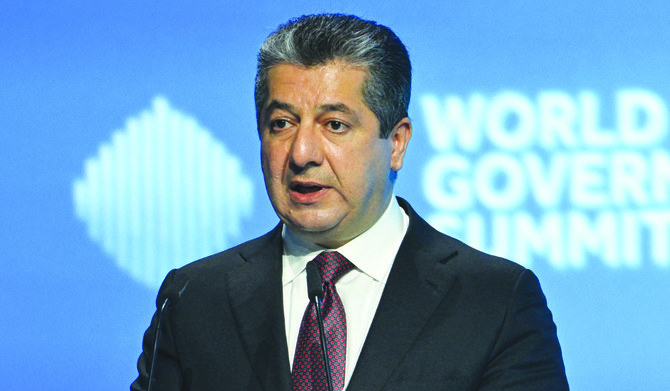
Regional Prime Minister Masrour Barzani warned last week of “conspiracies aimed at undermining and dismantling the Kurdistan region” with “internal support within Kurdistan.”
The pressure is aimed at Barzani’s Kurdistan Democratic Party or KDP, which has been locked in a never-ending rivalry with the other main party, the Patriotic Union of Kurdistan or PUK.
BACKGROUND
Regional Prime Minister Masrour Barzani warned last week of ‘conspiracies aimed at undermining and dismantling the Kurdistan region’ with ‘internal support within Kurdistan.’
Kurds in Iraq were persecuted under the Sunni Arab-dominated regime of the late dictator Saddam Hussein but the 2005 constitution formalized their autonomy after the 2003 US-led invasion that toppled Saddam.
But mending the volatile ties between the central government in Baghdad and Kurdistan has been a persistent challenge.
Consecutive federal governments have long been preoccupied with “crises and complex challenges,” said a senior official in Baghdad about years of war, the fight against the Daesh group, and anti-government protests.
“That is why they never looked into Kurdistan’s mistakes ... (such as) oil deals and exports, the region’s financial system, and several illegal decisions that have been made,” he added.
But, he added: “Now is the time to fix these mistakes.”
Despite facing the same problems as Baghdad, such as endemic corruption, fractious politics, and entrenched ruling elites, the US-backed Kurdistan region has portrayed itself as a hub of stability and economic growth in contrast to the conflicts and crises that have besieged federal Iraq.
Last year, civil servants and lawyers from the city of Sulaimaniyah, the PUK stronghold, had taken the regional and national authorities to court over unpaid salaries in Kurdistan, where officials have long accused Baghdad of not sending the necessary funds.
In February, the Federal Supreme Court in Baghdad ordered the federal government to pay public sector salaries in Kurdistan directly instead of via the regional administration under a previous long-standing arrangement.
It also demanded that Irbil hand over all “oil and non-oil revenues” to Baghdad.
In a separate case, the court ruled to reduce the number of seats in the Kurdish parliament from 111 to 100, effectively eliminating a quota reserved for Turkmen, Armenian, and Christian minorities.
In response, Barzani’s KDP, the largest party in the outgoing parliament with 45 seats against 21 for the PUK, said it would boycott legislative polls due to take place in June.
The tussle with the federal court has aggravated an already tense disagreement over oil exports.
In March 2023, the federal government won international arbitration, recognizing its right to control Kurdish oil exports through Turkiye.
The ruling led to the suspension of exports, which blocked a significant source of income for the regional administration.
Irbil later agreed in principle that sales of Kurdish oil would pass through Baghdad in exchange for 12.6 percent of Iraq’s public spending, but the agreement’s implementation has stalled.
When Prime Minister Mohammed Shia Al-Sudani first came to power in 2021, Baghdad and Irbil enjoyed better relations than they had seen in years.
But experts say that some parties that brought Al-Sudani to power are now determined to weaken the autonomous Kurdistan region.
“Some politicians desire to undermine the constitutional state of the Kurdistan region out of political vengeance,” said Ihsan Al-Shammari, a political scientist at the University of Baghdad.
Although court decisions concerning Kurdistan are “constitutional,” they are “political,” Al-Shammari said.
The recent tension undermines Irbil’s relationship with Baghdad and aims to “politically” weaken the KDP, Al-Shammari added.
Political bickering between the KDP and its main rival, the PUK, which enjoys friendlier ties with the federal government, has always shaped politics in the autonomous region.
PUK chief Bafel Jalal Talabani announced his support for the Supreme Court’s decisions — an institution he said helped “protect the political system in Iraq.”
But Sabah Sobhi, a KDP lawmaker, said the decisions undermined Iraq’s current political system.
He said some political parties wanted to replace “the federal and decentralized” system with a “centralized and authoritarian” rule.
“Disagreements among Kurds would undoubtedly” worsen the situation, Sobhi warned.



