BEIRUT: The leader of Lebanon’s Hezbollah movement said on Friday that Iran would inevitably retaliate after a strike — widely blamed on Israel — destroyed its consulate in Damascus this week, killing two generals.
“Be certain that Iran’s response to the targeting of its Damascus consulate is inevitable,” Hassan Nasrallah said in a televised speech marking Quds (Jerusalem) Day — an annual day of pro-Palestinian rallies held by Iran and its allies.
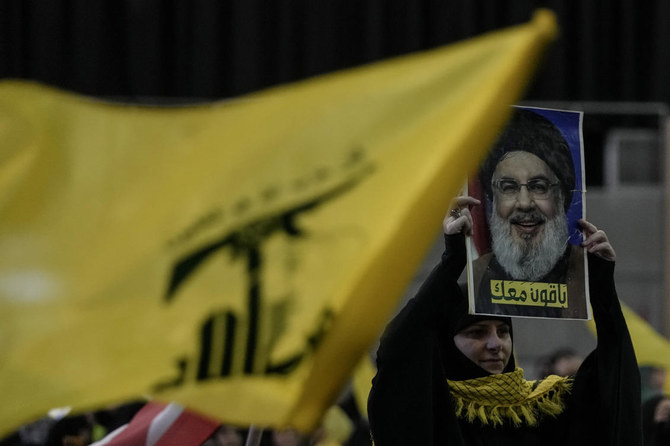
The mood on Friday afternoon was one of anticipation as people waited for Nasrallah to appear on a giant screen at a huge event held by Hezbollah for its supporters in the southern suburbs of Beirut.
Nasrallah’s call was “not to rush the Iranian response to the Israeli attack on the Iranian consulate in Damascus.”
He said: “The Iranians are planning and taking their time. Do not rush them to respond.”
Nasrallah also said the Israelis “are alert and afraid of the Iranian response, and this is part of the battle, by draining the enemy morally and materially. But everyone must prepare, arrange their affairs, and take precautions.”
Nasrallah said that the “foolishness” of Israeli Prime Minister Benjamin Netanyahu in targeting the consulate in Damascus “will open a big door to resolving this battle.”
He said the “resistance fighters on the border and the front lines are ready for any reaction.”
Nasrallah said: “We only need a call if there is any reaction. If the decision is made to fire 100 missiles at the Golan, the fighters carry out the operation within a few minutes.”
He emphasized that the “Lebanon front will not stop, as it is completely linked to the Gaza front, and when it stops in Gaza, it stops in southern Lebanon.”
The Hezbollah leader said he assumed Netanyahu was extending the war to prolong his time in office.
He said: “We see that Gaza will win, and when the war stops, this in itself is a victory for the resistance and a defeat for Israel, and the issue is only a matter of time. The whole world has come to this conclusion.”
Nasrallah added: “There indeed is suffering, and there are martyrs, but the important thing is that we continue, persevere, and follow through. The opponents must reconsider their calculations.
“Iran has not and will not negotiate on regional cases with the American side, and when it wants to negotiate, Iran will be part of a public formation.”
He said that the US was “primarily responsible for all the crimes and genocide that occurred in the region.”
According to Israeli media, as Nasrallah began his speech, sirens sounded in the settlements of Kiryat Shmona, Al-Manara, and Margaliot in the Galilee.
Hezbollah announced that it targeted “a deployment of enemy soldiers in the vicinity of the Al-Manara site with artillery shells and hit it directly.”
It also attacked “the Hadab Yaron site with artillery” fire and “spy equipment in the Israeli Zarit barracks with appropriate weapons.”
Israeli Channel 12 reported “the launching of three missiles from Lebanon toward the Baram area in the Western Galilee.”
After midnight on Thursday, Hezbollah claimed to have used a guided missile to strike “a military vehicle at the gate of the Israeli Metula site,” leaving its crew dead and wounded.
Also on Friday, Israeli artillery shelling and raids on Lebanese border villages and towns caused several casualties.
An attack on the town of Aita Al-Shaab resulted in the deaths of two Hezbollah members, one of them from the town and the other from Qana.
Seven people were hurt in an Israeli raid on the town of Kafr Hamam. Lebanon’s National News Agency said the injured suffered moderate to light injuries.
Israeli warplanes also launched raids in Kafr Kila — causing damage to military vehicles at a Lebanese military site — the town of Zibqin, and the city of Tayr Harfa.
The Israeli media reported damage after “a missile or drone landed in the Manot settlement in the Western Galilee.”


![]()

Nasrallah hints at possibly opening the Golan front, says ‘resistance fighters are ready’
Short Url
https://arab.news/2hv4g
Nasrallah hints at possibly opening the Golan front, says ‘resistance fighters are ready’
- Hezbollah chief says Iran response ‘inevitable’ after consulate strike
- He said: “The Iranians are planning and taking their time. Do not rush them to respond”


Latest updates


© 2026 SAUDI RESEARCH & PUBLISHING COMPANY, All Rights Reserved And subject to Terms of Use Agreement.