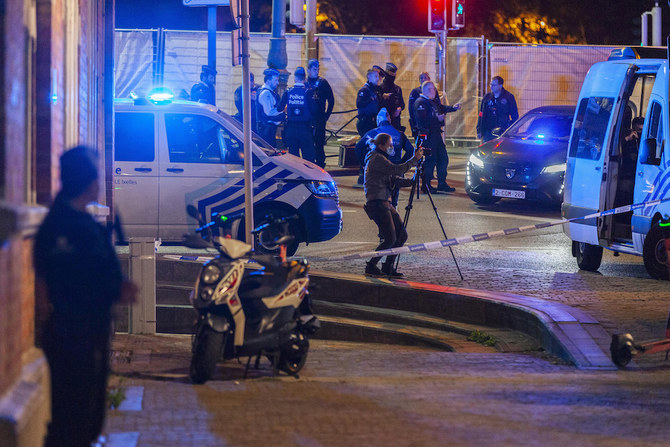
Drug gangs behind rise in shootings in EU capital Brussels, officials say

More than 100 of Europe's most dangerous criminal networks operate in Belgium, a centre for international drug trafficking as well as being the heart of EU politics, officials said on Friday, as street shooting rise in the capital. (AP/File)
Short Url
Updated 05 April 2024
Follow

Drug gangs behind rise in shootings in EU capital Brussels, officials say

  • Belgian Justice Minister Paul Van Tigchelt said drug gangs were behind this year’s rise in street shootings in Brussels, with six recorded in March alone
  • About 30 people were arrested in a large-scale operation by the country’s federal police in February 2022

BRUSSELS: More than 100 of Europe’s most dangerous criminal networks operate in Belgium, a center for international drug trafficking as well as being the heart of EU politics, officials said on Friday, as street shooting rise in the capital.
Belgian Justice Minister Paul Van Tigchelt said drug gangs were behind this year’s rise in street shootings in Brussels, with six recorded in March alone. Gangs from the French coastal town of Marseille were seeking to fill a vacuum left in Brussels after arrests of Albanian mafia members, he said.
About 30 people were arrested in a large-scale operation by the country’s federal police in February 2022, Belgian media reported.
With a major port in Antwerp, Belgium is an important drugs hub.
Local media have reported shootings in recent months that have injured passers-by in shopping and residential districts of Brussels that were not previously not associated with such crime.
The federal police declined to comment on street shooting statistics.
Van Tigchelt and Interior Minister Annelies Verlinden, spoke at a news conference as EU police agency Europol said it had identified the 821 most dangerous criminal networks in the bloc, and their 25,000 members, to help cross-border investigations.
Half of the groups were involved in drug trafficking, said Europol head Catherine De Bolle, while 86 percent of them used legal businesses to launder money.


Al-Shabab extremists are greatest threat to peace in Somalia and the region, UN experts say

Updated 5 sec ago
Follow

Al-Shabab extremists are greatest threat to peace in Somalia and the region, UN experts say

  • The UN Security Council on Tuesday voted unanimously to extend authorization for the African Union’s “support and stabilization” force in Somalia until Dec. 31, 2026

UNITED NATIONS: The Al-Shabab extremist group remains the greatest immediate threat to peace and stability in Somalia and the region, especially Kenya, UN experts said in a report released Wednesday.
Despite ongoing efforts by Somali and international forces to curb operations by Al-Qaeda-linked Al-Shabab, “the group’s ability to carry out complex, asymmetric attacks in Somalia remains undiminished,” the experts said.
They said the threat comes not only from Al-Shabab’s ability to strike — including within the capital, Mogadishu, where it attempted to assassinate the president on March 18 — but from its sophisticated extortion operations, forced recruitment and effective propaganda machine.
The UN Security Council on Tuesday voted unanimously to extend authorization for the African Union’s “support and stabilization” force in Somalia until Dec. 31, 2026. The force includes 11,826 uniformed personnel, including 680 police.
The extremist group poses a significant threat to neighboring Kenya “by conducting attacks that vary from attacks with improvised explosive devices, which predominantly target security personnel, to attacks on infrastructure, kidnappings, home raids and stealing of livestock,” the experts said.
This year, Al-Shabab averaged around six attacks a month in Kenya, mostly in Mandera and Lamu counties, which border Somalia in the northeast, the panel said.
The experts said Al-Shabab’s goal remains to remove Somalia’s government, “rid the country of foreign forces and establish a Greater Somalia, joining all ethnic Somalis across east Africa under strict Islamic rule.”
The panel of experts also investigated the Islamic State’s operations in Somalia and reported that fighters were recruited from around the world to join the extremist group, the majority from east Africa. At the end of 2024, they said the group known as ISIL-Somalia had a fighting force of over 1,000, at least 60 percent of them foreign fighters.
“Although small in terms of numbers and financial resources compared with Al-Shabab, the group’s expansion constituted a significant threat to peace and security in Somalia and the broader region,” the panel said.