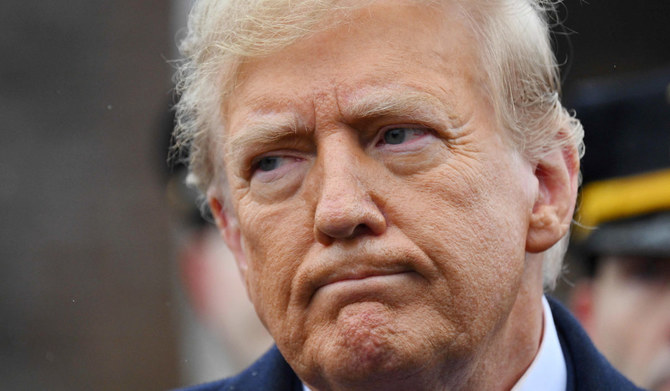

NEW YORK: Donald Trump posted a $175 million bond on Monday in his New York civil fraud case, halting collection of the more than $454 million he owes and preventing the state from seizing his assets to satisfy the debt while he appeals, according to a court filing.
A New York appellate court had given the former president 10 days to put up the money after a panel of judges agreed last month to slash the amount needed to stop the clock on enforcement.
The bond Trump is posting with the court now is essentially a placeholder, meant to guarantee payment if the judgment is upheld. If that happens, the presumptive Republican presidential nominee will have to pay the state the whole sum, which grows with daily interest.
If Trump wins, he won’t have to pay the state anything and will get back the money he has put up now.
Until the appeals court intervened to lower the required bond, New York Attorney General Letitia James had been poised to initiate efforts to collect the judgment, possibly by seizing some of Trump’s marquee properties. James, a Democrat, brought the lawsuit on the state’s behalf. Her office declined to comment Monday.
The court ruled after Trump’s lawyers complained it was “a practical impossibility” to get an underwriter to sign off on a bond for the $454 million, plus interest, that he owes.
The company that underwrote the bond is Knight Specialty Insurance, which is part of the Knight Insurance Group. The chairman of that company, billionaire Don Hankey, told The Associated Press that both cash and bond were used as collateral for Trump’s appellate bond.
Trump is fighting to overturn a judge’s Feb. 16 finding that he lied about his wealth as he fostered the real estate empire that launched him to stardom and the presidency. The trial focused on how Trump’s assets were valued on financial statements that went to bankers and insurers to get loans and deals.
Trump denies any wrongdoing, saying the statements actually lowballed his fortune, came with disclaimers and weren’t taken at face value by the institutions that lent to or insured him.
The state courts’ Appellate Division has said it would hear arguments in September. A specific date has not been set. If the schedule holds, it will fall in the final weeks of the presidential race.
Under New York law, filing an appeal generally doesn’t hold off enforcement of a judgment. But there’s an automatic pause — in legalese, a stay — if the person or entity obtains a bond guaranteeing payment of what’s owed.
Courts sometimes grant exceptions and lower the amount required for a stay, as in Trump’s case.
Trump’s lawyers had told the appeals court more than 30 bonding companies were unwilling to take a mix of cash and real estate as collateral for a $454 million-plus bond. Underwriters insisted on only cash, stocks or other liquid assets, the attorneys said.
They said most bonding companies require collateral covering 120 percent of the amount owed.
Trump recently claimed to have almost a half-billion dollars in cash — along with billions of dollars worth of real estate and other assets — but said he wanted to have some cash available for his presidential run.
Recent legal debts have taken a sizable chunk out of Trump’s cash reserves.
In addition to the $175 million he had to put up in the New York case, Trump has posted a bond and cash worth more than $97 million to cover money he owes to writer E. Jean Carroll while he appeals verdicts in a pair of federal civil trials. Juries found that he sexually assaulted her in the 1990s and defamed her when she went public with the allegation in 2019. He denies all the allegations.
In February, Trump paid the $392,638 in legal fees a judge ordered him to cover for The New York Times and three reporters after he unsuccessfully sued them over a Pulitzer Prize-winning 2018 story about his family’s wealth and tax practices.
In March, a British court ordered Trump to pay to pay legal fees of 300,000 pounds ($382,000) to a company he unsuccessfully sued over the so-called Steele dossier that contained salacious allegations about him. Trump said those claims were false.
Trump could eventually generate cash by selling some of the nearly 60 percent of stock he owns in his newly public social media company, Trump Media & Technology Group — but that would be a longer-term play. Trump’s stake could be worth billions of dollars, but a “lock-up” provision prevents insiders like him from selling their shares for six months.