

Russia seeks extradition of Ukraine security service head; Ukraine rejects demand

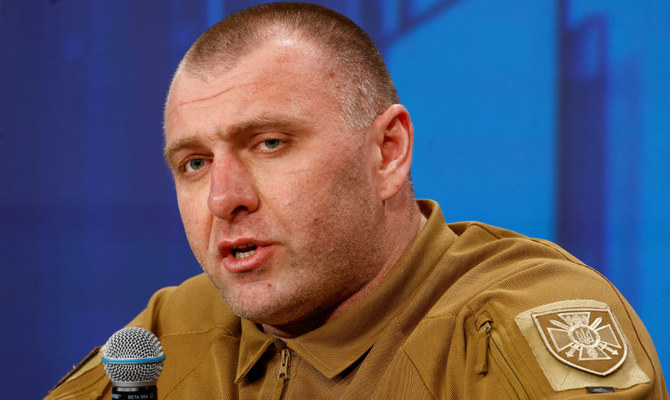
Head of the Ukraine’s State Security Service Vasyl Maliuk attends a conference amid Russia’s attack on Ukraine, in Kyiv, Ukraine. (Reuters/File)
Short Url
Updated 01 April 2024
Follow

Russia seeks extradition of Ukraine security service head; Ukraine rejects demand

  • “The Russian side demands that the Kyiv regime immediately cease all support for terrorist activity, extradite guilty parties and compensate the victims for damages,” the ministry statement says

Russia is demanding that Ukraine hand over all people connected with terrorist acts committed in Russia, including the head of the country’s SBU Security Service, the foreign ministry said on Sunday.
The SBU immediately dismissed the Russian demand as “pointless” and said the Russian ministry had “forgotten” that Kremlin leader Vladimir Putin was the subject of an international arrest warrant.
A Russian Foreign Ministry statement listed violent incidents that have occurred in Russia since the Kremlin’s forces invaded Ukraine in February 2022, including bombings that killed the daughter of a prominent nationalist and a war blogger, and an incident in which a writer was seriously hurt.
The ministry said investigation of these incidents showed that “the traces of these crimes lead to Ukraine.”
“Russia has turned over to Ukrainian authorities its demands ... for the immediate arrest and extradition of all those connected to the terrorist acts in question,” the statement said.
Among those listed in the statement to be handed over are SBU head Vasyl Maliuk, who has acknowledged his service was behind attacks on the bridge linking Crimea to the Russian mainland since the Kremlin’s February 2022 invasion of Ukraine. Russia seized control of Crimea in 2014; the bridge was built after the region was annexed.
“The Russian side demands that the Kyiv regime immediately cease all support for terrorist activity, extradite guilty parties and compensate the victims for damages,” the ministry statement said.
“Ukraine’s violation of its obligations under anti-terrorist conventions will result in it being held to account in international legal terms.”

‘POINTLESS, CYNICAL’
Ukraine’s SBU said the Russian demands “sound particularly cynical coming from the terrorist state itself. ... Therefore, any words from the Russian Foreign Ministry are pointless.”
The SBU referred to the arrest warrant against Putin issued by the International Criminal Court in connection with the transfer of Ukrainian children to Russia and said “the tribunal in The Hague is waiting for him.”
The Russian statement referred to the mass shooting this month at a concert hall outside Moscow in which 144 people died, but only in an oblique sense.
Islamic State, also known by its Arabic name Daesh, claimed responsibility for the attack, and US officials said they had intelligence showing it was carried out by the network’s Afghan branch, Islamic State Khorasan, or IS-K.
Russian investigators said last week they had found proof that the concert hall gunmen were linked to “Ukrainian nationalists.” Kyiv denies any connection with the attack.
Russian news agencies on Sunday quoted Alexander Bastrykin, the head of Russia’s Investigative Committee, the country’s most important criminal investigation body, as saying that work was proceeding to determine who was behind the attack.


Justice Department faces hurdle in seeking case against Comey as judge finds constitutional problems

Updated 4 sec ago
Follow

Justice Department faces hurdle in seeking case against Comey as judge finds constitutional problems

WASHINGTON: The Justice Department violated the constitutional rights of a close friend of James Comey and must return to him computer files that prosecutors had hoped to use for a potential criminal case against the former FBI director, a federal judge said Friday.
The ruling from US District Judge Colleen Kollar-Kotelly represents not only a stern rebuke of the conduct of Justice Department prosecutors but also imposes a dramatic hurdle to government efforts to seek a new indictment against Comey after an initial one was dismissed last month.
The order concerns computer files and communications that investigators obtained years earlier from Daniel Richman, a Comey friend and Columbia University law professor, as part of a media leak investigation that concluded without charges. The Justice Department continued to hold onto those files and conducted searches of them this fall, without a new warrant, as they prepared a case charging Comey with lying to Congress five years ago.
Richman alleged that the Justice Department violated his Fourth Amendment rights by retaining his records and by conducting new warrantless searches of the files, prompting Kollar-Kotelly to issue an order last week temporarily barring prosecutors from accessing the files as part of its investigation.
The Justice Department said the request for the return of the records was merely an attempt to impede a new prosecution of Comey, but the judge again sided with Richman in a 46-page order Friday that directed the Justice Department to give him back his files.
“When the Government violates the Fourth Amendment’s prohibition on unreasonable searches and seizures by sweeping up a broad swath of a person’s electronic files, retaining those files long after the relevant investigation has ended, and later sifting through those files without a warrant to obtain evidence against someone else, what remedy is available to the victim of the Government’s unlawful intrusion?” the judge wrote.
One answer, she said, is to require the government to return the property to the rightful owner.
The judge did, however, permit the Justice Department to file an electronic copy of Richman’s records under seal with the Eastern District of Virginia, where the Comey investigation has been based, and suggested prosecutors could try to access it later with a lawful search warrant.
The Justice Department alleges that Comey used Richman to share information with the news media about his decision-making during the FBI’s investigation into Hillary Clinton’s use of a private email server. Prosecutors charged the former FBI director in September with lying to Congress by denying that he had authorized an associate to serve as an anonymous source for the media.
That indictment was dismissed last month after a federal judge in Virginia ruled that the prosecutor who brought the case, Lindsey Halligan, was unlawfully appointed by the Trump administration. But the ruling left open the possibility that the government could try again to seek charges against Comey, a longtime foe of President Donald Trump. Comey has pleaded not guilty, denied having made a false statement and accused the Justice Department of a vindictive prosecution.
The Comey saga has a long history.
In June 2017, one month after Comey was fired as FBI director, he testified that he had given Richman a copy of a memo he had written documenting a conversation he had with Trump and had authorized him to share the contents of the memo with a reporter.
After that testimony, Richman permitted the FBI to create an image, or complete electronic copy, of all files on his computer and a hard drive attached to that computer. He authorized the FBI to conduct a search for limited purposes, the judge noted.
Then, in 2019 and 2020, the FBI and Justice Department obtained search warrants to obtain Richman’s email accounts and computer files as part of a media leak investigation that concluded in 2021 without charges. Those warrants were limited in scope, but Richman has alleged that the government collected more information than the warrants allowed, including personal medial information and sensitive correspondence.
In addition, Richman said the Justice Department violated his rights by searching his files in September, without a new warrant, as part of an entirely separate investigation.
“The Court further concludes that the Government’s retention of Petitioner Richman’s files amounts to an ongoing unreasonable seizure,” Kollar-Kotelly wrote. “Therefore, the Court agrees with Petitioner Richman that the Government has violated his Fourth Amendment right against unreasonable searches and seizures.”