

Turkish opposition ahead in battle with Erdogan for key cities

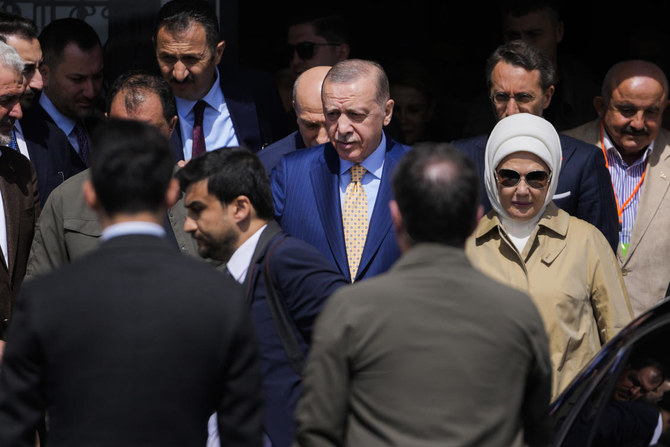
Turkish President Recep Tayyip Erdogan leaves after voting at a polling station in Istanbul, Turkey, Sunday, March 31, 2024. Turkey is holding local elections on Sunday that will decide who gets to control Istanbul and other key cities. (AP)
Short Url
Updated 31 March 2024
Follow

Turkish opposition ahead in battle with Erdogan for key cities

ISTANBUL: Turkiye’s opposition took an early lead in the battle with President Recep Tayyip Erdogan to control Istanbul and Ankara, according to partial results after elections Sunday.
Erdogan had launched an all-out personal campaign to win back Istanbul, the economic powerhouse where he was once mayor, for his ruling Justice and Development Party (AKP).
With rampant inflation and economic crisis hitting households, city mayor Ekrem Imamoglu expressed confidence of a new victory and a partial result put the CHP ahead in Istanbul and the capital Ankara.
With 49 percent of ballot boxes opened, Imamoglu led with 50.05 percent of the vote against 41.2 percent for the AKP candidate Murat Kuram. In Ankara, with 29.2 percent of ballot boxes opened, the CHP mayor Mansur Yavas led with 58.2 percent against 34.1 percent for the Erdogan-backed candidate.
The CHP was also ahead in Izmir, Turkiye’s third city, and a party stronghold.
“Based on the data we have obtained, I can say that our citizens’ faith in us has been rewarded,” Imamoglu told reporters at the CHP’s Istanbul headquarters.
“The picture we have seen now pleases us greatly, but no election is finalized before it is over,” he added.

“I would like to thank all of us, our citizens, from the bottom of my heart for fulfilling this sacred duty.”
After casting his vote with his family, Imamoglu emerged to applause and chants of “Everything will be fine,” his 2019 election slogan.
Although Erdogan dominated the campaign the veteran president’s personal role did not help overcome the widespread concerns over the country’s economy.
“Everyone is worried about the day to day,” said 43-year-old Istanbul inhabitant Guler Kaya as she voted.
“The crisis is swallowing up the middle class, we have had to change all our habits,” she said. “If Erdogan wins, it will get even worse.”
Vote change happens “when we cannot afford a living, when we cannot eat,” Ali Faik Demir, a political scientist at Galatasaray University, told AFP.
An Imamoglu victory Sunday would make him the likely main opponent to Erdogan’s ruling AKP in the next presidential election in 2028.
Erdogan has been president since 2014 and won a new term in May last year. He had called Istanbul the national “treasure” when launching his campaign to retake the city.
If Erdogan won back Istanbul and Ankara, he would have an incentive to “amend” the constitution to stand for re-election for a fourth term, warned Bayram Balci, political scientist at Sciences Po university in France.

“This election will mark the beginning of a new era for our country,” Erdogan said after casting his vote in Istanbul at midday on Sunday.
“Whoever wins Istanbul, wins Turkiye,” Erman Bakirci, a pollster from Konda Research and Consultancy, recalled Erdogan once saying.
The election was held with the country reeling from an inflation rate of 67 percent and having seen the lira currency slide from 19 to a dollar to 32 to a dollar in one year.
Armed clashes were reported in Turkiye’s Kurdish-majority southeast, leaving one dead and 12 wounded, a local official told AFP.
The pro-Kurdish DEM party said it had identified irregularities “in almost all the Kurdish provinces,” in particular through suspicious cases of proxy voting.
Observers from France were refused access to a polling station in the region, according to the lawyers’ association MLSA.
Some 61 million people were eligible to vote for mayors across Turkiye’s 81 provinces, as well as provincial council members and other local officials.
The opposition has been fractured ahead of the polls, in contrast with the local elections five years ago.
This time the CHP, has failed to rally support behind a single candidate.


94 million need cataract surgery, but access lacking: WHO

A Somali patient undergoes free cataract surgery at Al Nuur eye Hospital in Mogadishu, on February 16, 2015. (AFP)
Updated 6 sec ago
Follow

94 million need cataract surgery, but access lacking: WHO

  • Of the 94 million affected, fewer than 20 percent are blind, while the rest suffer from impaired vision

GENEVA: More than 94 million people suffer from cataracts, but half of them do not have access to the surgery needed to fix it, the World Health Organization said Wednesday.
Cataracts — the clouding of the eye’s lens that causes blurred vision and can lead to blindness — are on the rise as populations get older, with age being the main risk factor.
“Cataract surgery — a simple, 15-minute procedure — is one of the most cost-effective medical procedures, providing immediate and lasting restoration of sight,” the WHO said.
It is one of the most frequently performed surgeries undertaken in high-income countries.
However, “half of the world’s population in need of cataract surgery don’t have access to it,” said Stuart Keel, the UN health agency’s technical lead for eye care.
The situation is worst in the WHO’s Africa region, where three in four people needing cataract surgery remain untreated.
In Kenya, at the current rate, 77 percent of people needing cataract surgery are likely to die with their cataract blindness or vision impairment, said Keel.
Across all regions, women consistently experience lower access to care than men.
Of the 94 million affected, fewer than 20 percent are blind, while the rest suffer from impaired vision.

- 2030 vision -

The WHO said that over the past two decades, global cataract surgery coverage had increased by 15 percent.

In 2021, WHO member states set a target of a 30-percent increase by 2030.
However, current modelling predicts that cataract surgery coverage will rise by only about 8.4 percent this decade.
To close the gap, the WHO urged countries to integrate eye examinations into primary health care and invest in the required surgical equipment.
States should also expand the eye-care workforce, training surgeons in a standardised manner and then distributing them throughout the country, notably outside major cities.
The WHO was on Wednesday launching new guidance for countries on how to provide quality cataract surgery services.
It will also issue guidance to help support workforce development.
Keel said the main issue was capacity and financing.
“We do need money invested to get rid of this backlog, which is nearly 100 million people,” he told a press conference.
While age is the primary risk factor for cataracts, others include prolonged UV-B light exposure, tobacco use, prolonged corticosteroid use and diabetes.
Keel urged people to keep up regular eye checks as they get older, with most problems able to be either prevented or diagnosed and treated.
The cost of the new lens that goes inside the eye can be under $100.
However, out-of-pocket costs can be higher when not covered by health insurance.
“Cataract surgery is one of the most powerful tools we have to restore vision and transform lives,” said Devora Kestel, head of the WHO’s noncommunicable diseases and mental health department.
“When people regain their sight, they regain independence, dignity, and opportunity.”