

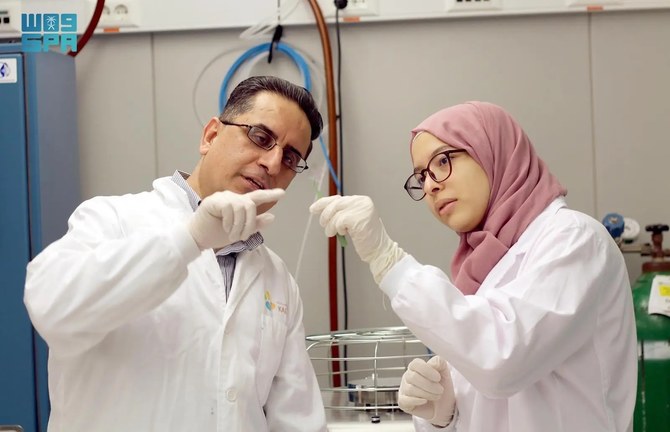
KAUST spearheading research and innovation under Vision 2030

KAUST’s advancements in science, technology, and research align with the Kingdom’s goals to diversify its economy under Saudi Vision 2030
Short Url
Updated 31 March 2024
Follow

KAUST spearheading research and innovation under Vision 2030

  • University boasts over 12,500 scientific publications

RIYADH: King Abdullah University of Science and Technology has established itself as a hub for scientific research and innovation through the formation of 12 research centers, the Saudi Press Agency reported on Sunday.

KAUST’s advancements in science, technology, and research align with the Kingdom’s goals to diversify its economy under Saudi Vision 2030, SPA added.

Since its inception in 2009, KAUST has focused on disseminating and applying scientific knowledge as broadly and effectively as possible across four strategic areas of global importance: food, water, energy, and the environment.

The university features specialist academic departments and provides research opportunities in areas ranging from physical science and engineering to biological and environmental sciences, covering critical areas including advanced membranes, clean combustion, chemical catalysis, and solar energy.

The university also boasts an impressive intellectual property portfolio, which includes 105 registered patents, 578 patents pending registration, and 708 disclosed inventions.

KAUST’s commitment to innovation since its launch is further demonstrated through its support of 35 startups and 15 licensing agreements, showcasing its role in fostering entrepreneurship and commercializing research.

According to the QS World University Rankings, the university boasts over 12,500 scientific publications.


Saudi Arabia champions AI and sustainable growth at UN tourism meeting in Kuwait

Updated 6 sec ago
Follow

Saudi Arabia champions AI and sustainable growth at UN tourism meeting in Kuwait

  • Saudi Tourism Minister says tourism today accounts for approximately 10 percent of the world economy, contributing about $10 trillion to global GDP 


KUWAIT CITY: Saudi Arabia’s Tourism Minister Ahmed Al-Khateeb has called for stronger international cooperation to build a tourism ecosystem that is integrated, resilient, and future-ready, the Saudi Press Agency reported Thursday.

In a opening address at the 52nd UN Tourism Regional Commission for the Middle East in Kuwait City, he noted that tourism is “no longer a peripheral activity but a massive engine of economic development.”

“With an estimated contribution exceeding $10 trillion to global GDP, tourism today accounts for approximately 10 percent of the world economy,” said Al-Khateeb, speaking as president of the 26th UN Tourism General Assembly. The three-day conference opened on Feb. 10 a.

He pointed to the Middle East’s exceptional recovery, which recorded a 39 percent increase in international arrivals in 2025 compared to 2019, welcoming nearly 100 million visitors last year.

The minister highlighted Saudi Arabia’s driving force behind these regional statistics, noting that the Kingdom now represents approximately 30% of the Middle East tourism market in both visitor numbers and spending.

“We are proud that Saudi tourism’s uninterrupted growth has become a driving force for regional tourism, and we look forward to continuing our close cooperation with UN Tourism to share our expertise with the world,” he said.

Focus on AI

Addressing the meeting’s central theme of Artificial Intelligence (AI), Al-Khateeb emphasized the need for responsible innovation. He described AI as a key enabler for growth but stressed that the “human touch” defining the hospitality sector must be maintained and the workforce protected.

On the sidelines of the regional commission, the minister met with counterparts from across the region to explore ways to promote regional cooperation and alignment to enhance resilience and build tourism industries that can drive inclusive economic and social development.

Al-Khateeb also met with leading investors from Kuwait to discuss investments in the Kingdom’s tourism sector and explore new opportunities to leverage Saudi Arabia’s integrated investment ecosystem, designed to enable regional and international investors to achieve sustainable, long-term value.

The 52nd UN Tourism Regional Commission for the Middle East is the first held in the region since the 26th UN Tourism General Assembly, hosted in Riyadh last November. 

That assembly resulted in the historic “Riyadh Declaration on the Future of Tourism,” which established a global consensus on sustainability, inclusive growth, and the responsible adoption of human-centric AI for the next fifty years.