

Bulgaria, Romania take first steps into Europe’s visa-free zone

1 / 3
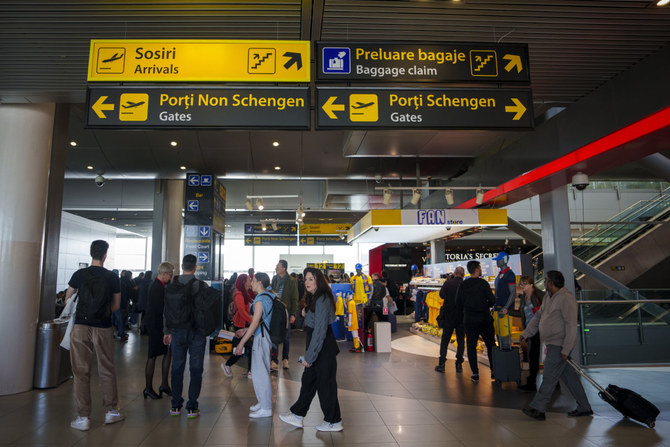
Passengers are pictured inside the Henri Coanda International Airport behind a depatures panel in Otopeni, Romania, on March 28, 2024. (AFP)
2 / 3
A man takes a picture of Non-Schengen automatic border control gates, at the Henri Coanda International Airport in Otopeni, near Bucharest, Romania, on March 28, 2024. (AP)
3 / 3
Passengers pass under a Schengen Information sign at the Henri Coanda International Airport in Otopeni, near Bucharest, Romania, on March 28, 2024. (AP Photo)
Short Url
Updated 31 March 2024
Follow

Bulgaria, Romania take first steps into Europe’s visa-free zone

  • New status will not apply to land routes, after Austria veto over fears of a potential influx of asylum seekers
  • Schengen zone will now comprise 29 members, including 25 EU member states plus Switzerland, Norway, Iceland and Liechtenstein

BUCHAREST: Bulgaria and Romania joined Europe’s vast Schengen area of free movement on Sunday, opening up travel by air and sea without border checks after a 13-year wait.
A veto by Austria, however, means the new status will not apply to land routes, after Vienna expressed concerns over a potential influx of asylum seekers.
Despite the partial membership, the lifting of controls at the two countries’ air and sea borders is of significant symbolic value.
Admission to Schengen is an “important milestone” for Bulgaria and Romania, symbolizing a “question of dignity, of belonging to the European Union,” according to foreign policy analyst Stefan Popescu.
“Any Romanian who had to walk down a lane separate from other European citizens felt being treated differently,” he told AFP.
Ivan Petrov, a 35-year-old Bulgarian marketing executive who lives in France, said he was enthusiastic about less stressful traveling and the time he would be able to save.
“This is a great success for both countries, and a historic moment for the Schengen area — the largest area of free movement in the world,” EU chief Ursula von der Leyen said in a statement Saturday.
“Together, we are building a stronger, more united Europe for all our citizens.”
With Bulgaria and Romania arriving joining Sunday, the Schengen zone will comprise 29 members — 25 of the 27 European Union member states as well as Switzerland, Norway, Iceland and Liechtenstein.
Romania’s government said Schengen rules would apply to four sea ports and 17 airports, with the country’s Otopeni airport near the capital Bucharest serving as the biggest hub for Schengen flights.
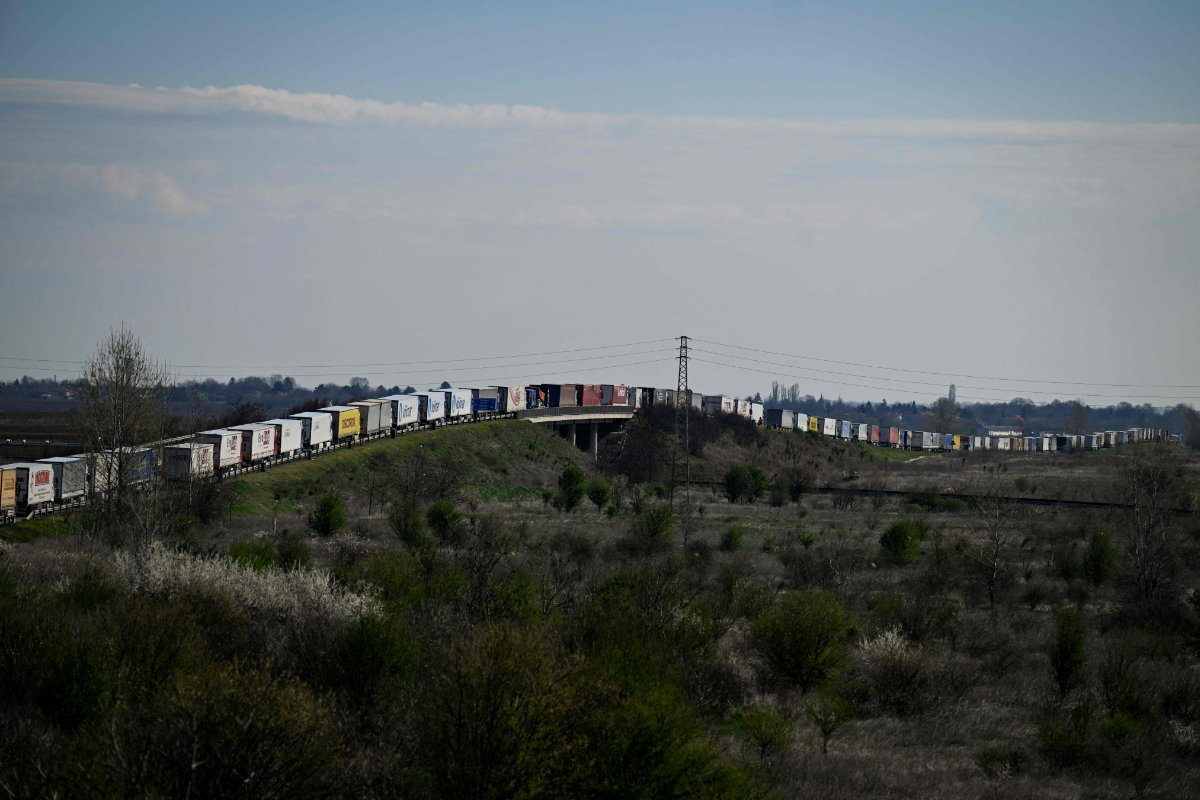


Trucks queue to enter to the Vidin-Calafat border point between Bulgaria and Romania, near Vidin, Bulgaria on March 25, 2024. Both countries will be partially integrated into Schengen area of free movement, with air and sea borders lifted from March 31 and discussions over opening the land borders ongoing. (AFP)

More staff including border police and immigration officers will be deployed to airports to “support passengers and detect those who want to take advantage to leave Romania illegally,” it added.
Random checks will also be carried out to catch people with false documents and to combat human trafficking.
Bulgaria and Romania both hope to fully integrate into Schengen by the end of the year, but Austria has so far relented only on air and sea routes.
Croatia, which joined the EU after Romania and Bulgaria, beat them to becoming Schengen’s 27th member in January 2023.
Created in 1985, the Schengen area allows more than 400 million people to travel freely without internal border controls.
While some have reason to celebrate, truck drivers, faced with endless queues at the borders with their European neighbors, feel left out.
Earlier this month, one of Romania’s main road transport unions the UNTRR called for “urgent measures” to get full Schengen integration, deploring the huge financial losses caused by the long waits.
“Romanian hauliers have lost billions of euros every year, just because of long waiting times at borders,” secretary general Radu Dinescu said.
According to the union, truckers usually wait eight to 16 hours at the border with Hungary, and from 20 to 30 hours at the Bulgarian border, with peaks of three days.
Bulgarian businesses have also voiced their anger over the slow progress.
“Only three percent of Bulgarian goods are transported by air and sea, the remaining 97 percent by land,” said Vasil Velev, president of the Bulgarian Industrial Capital Association (BICA).
“So we’re at three percent in Schengen and we don’t know when we’ll be there with the other 97 percent,” he told AFP.
Bucharest and Sofia have both said that there will be no going back.
“There is no doubt that this process is irreversible,” Romanian Interior Minister Catalin Predoiu said this month, adding it “must be completed by 2024 with the extension to land borders.”


Trump says Zelensky ‘isn’t ready’ yet to accept US-authored proposal to end Russia-Ukraine war

Updated 08 December 2025
Follow

Trump says Zelensky ‘isn’t ready’ yet to accept US-authored proposal to end Russia-Ukraine war

  • Trump said he was “disappointed” and suggested that the Ukrainian leader is holding up the talks from moving forward
  • He also claimed Russia is “fine with it” even though Putin last week had said that aspects of Trump’s proposal were unworkable

KYIV, Ukraine: President Donald Trump on Sunday claimed Ukrainian President Volodymyr Zelensky “isn’t ready” to sign off on a US-authored peace proposal aimed at ending the Russia-Ukraine war.
Trump was critical of Zelensky after US and Ukrainian negotiators completed three days of talks on Saturday aimed at trying to narrow differences on the US administration’s proposal. But in an exchange with reporters on Sunday night, Trump suggested that the Ukrainian leader is holding up the talks from moving forward.
“I’m a little bit disappointed that President Zelensky hasn’t yet read the proposal, that was as of a few hours ago. His people love it, but he hasn’t,” Trump claimed in an exchange with reporters before taking part in the Kennedy Center Honors. The president added, “Russia is, I believe, fine with it, but I’m not sure that Zelensky’s fine with it. His people love it it. But he isn’t ready.”
To be certain, Russian President Vladimir Putin hasn’t publicly expressed approval for the White House plan. In fact, Putin last week had said that aspects of Trump’s proposal were unworkable, even though the original draft heavily favored Moscow.
Trump has had a hot-and-cold relationship with Zelensky since riding into a second White House term insisting that the war was a waste of US taxpayer money. Trump has also repeatedly urged the Ukrainians to cede land to Russia to bring an end to a now nearly four-year conflict he says has cost far too many lives.
Zelensky said Saturday he had a “substantive phone call” with the American officials engaged in the talks with a Ukrainian delegation in Florida. He said he had been given an update over the phone by US and Ukrainian officials at the talks.
“Ukraine is determined to keep working in good faith with the American side to genuinely achieve peace,” Zelensky wrote on social media.
Trump’s criticism of Zelensky came as Russia on Sunday welcomed the Trump administration’s new national security strategy in comments by the Kremlin spokesman published by Russia’s Tass news agency.

Dmitry Peskov said the updated strategic document, which spells out the administration’s core foreign policy interests, was largely in line with Moscow’s vision.
“There are statements there against confrontation and in favor of dialogue and building good relations,” he said, adding that Russia hopes this would lead to “further constructive cooperation with Washington on the Ukrainian settlement.”
The document released Friday by the White House said the US wants to improve its relationship with Russia after years of Moscow being treated as a global pariah and that ending the war is a core US interest to “reestablish strategic stability with Russia.”
Speaking on Saturday at the Reagan National Defense Forum, Trump’s outgoing Ukraine envoy, Keith Kellogg, said efforts to end the war were in “the last 10 meters.”
He said a deal depended on the two outstanding issues of “terrain, primarily the Donbas,” and the Zaporizhzhia Nuclear Power Plant.
Russia controls most of Donbas, its name for the Donetsk and neighboring Luhansk regions, which, along with two southern regions, it illegally annexed three years ago. The Zaporizhzhia Nuclear Power Plant is in an area that has been under Russian control since early in Moscow’s invasion of Ukraine and is not in service. It needs reliable power to cool its six shutdown reactors and spent fuel, to avoid any catastrophic nuclear incidents.
Kellogg, who is due to leave his post in January, was not present at the talks in Florida.
Separately, officials said the leaders of the United Kingdom, France and Germany would participate in a meeting with Zelensky in London on Monday.
As the three days of talks wrapped up, Russian missile, drone and shelling attacks overnight and Sunday killed at least four people in Ukraine.
A man was killed in a drone attack on Ukraine’s northern Chernihiv region Saturday night, local officials said, while a combined missile and drone attack on infrastructure in the central city of Kremenchuk caused power and water outages. Kremenchuk is home to one of Ukraine’s biggest oil refineries and is an industrial hub.
Kyiv and its Western allies say Russia is trying to cripple the Ukrainian power grid and deny civilians access to heat, light and running water for a fourth consecutive winter, in what Ukrainian officials call “weaponizing” the cold.
Three people were killed and 10 others wounded Sunday in shelling by Russian troops in Ukraine’s Kharkiv region, according to the regional prosecutor’s office.