


MANILA: When Filipino Palestinians were evacuated from Gaza to Manila in November, they arrived with nothing. They had been forced not only to leave behind their loved ones, but their livelihoods too.
After some initial help from the Filipino government, most of the evacuees were left to their own devices until civil society groups stepped in to offer support.
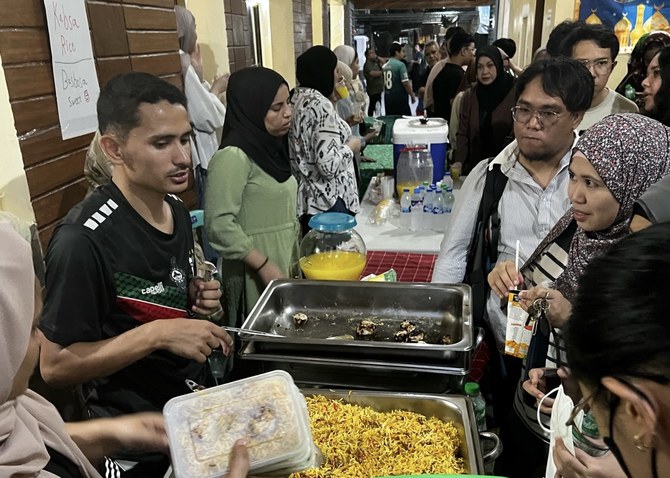
One resulting initiative, the Little Gaza Kitchen, aims to help them develop food businesses. Organized by the Moro-Palestinian Cooperation, the project launched on Friday, with more than 800 visitors queuing to try traditional Palestinian food at iftar time in the compound where the refugees are currently living in Metro Manila.
“They sold Palestinian dishes that they prepared themselves. And what we did also was to have them interact with people, to help them overcome the feeling of being useless,” Nors Maguindanao, co-founder of Moro-Palestinian Cooperation Team, told Arab News. “One way of connecting people is through food ... It’s also to make them feel that they belong.”
Visitors could sample rice dishes such as maqluba and qidreh, as well as musakhan — roast chicken baked with onions, sumac and fried pine nuts — and sweets including stuffed qatayef pancakes and syrup-soaked basbosa cake. Most of the dishes from the pop-up kitchens were immediately sold out.
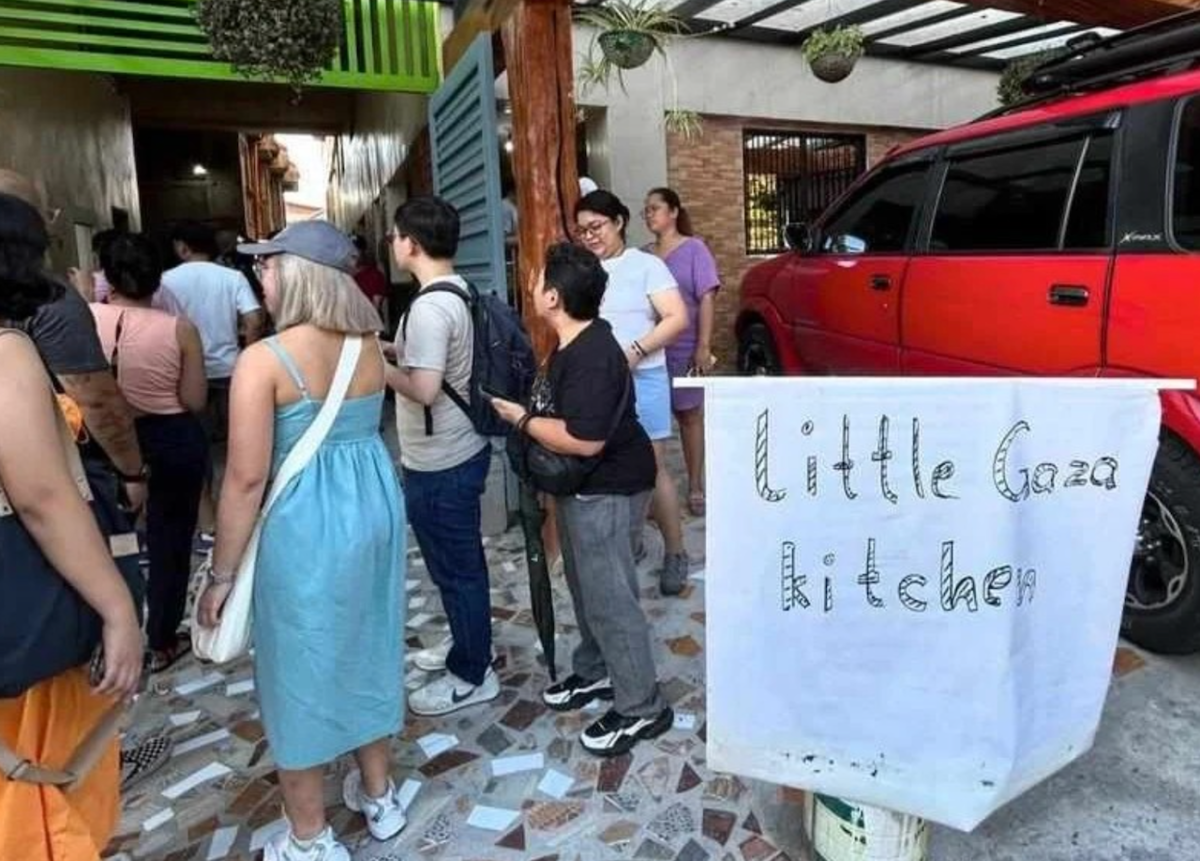
The Little Gaza Kitchen initiative kicks off in Quezon City, Metro Manila, on March 29, 2024. (Meshwe)
“We did not expect this event to be crowded, but many people came and there was a long queue outside,” Maguindanao said. “I was overwhelmed.”
Being a displaced person himself, Maguindanao can relate to the situation the Palestinian refugees are facing.
“I understand,” he said. “I’m also a refugee, from Marawi City.”
The southern Philippine city was taken over by groups affiliated with Daesh in 2017. After five months of fighting and hundreds of deaths, the Philippine army reclaimed the city, but many people were forced to flee amid widespread destruction.
He hopes the Little Gaza Kitchen will help build solidarity with the Palestinians.
Israeli attacks on the Gaza Strip, which began in October, have killed more than 32,500 and wounded 74,000 others. More than 1 million people in Gaza are at risk of imminent famine as Israel also continues to block aid to the besieged enclave.
“Our message of solidarity is that you don’t need to be a Muslim to join the cause of calling for a ceasefire in Gaza and helping these people. You just need to be a human,” Maguindanao said. “You just need to be a human to understand what is happening in Palestine.”
Toreq Obaid, an assistant professor at the Information Technology Department of the Gaza University who is married to a Filipina and was among some 170 people evacuated by the Philippine government, is beginning to acclimatize to the country and is planning to start working again.
“I feel welcome ... This is a different experience. It’s like a complete integration process. There are people helping us to stand up, to survive,” he said.
“I’ve even started to change my mindset towards operating my business here again, my call center — to start once again in the Philippines and survive. I’m just working on my documents to legalize everything, then I’ll start once again.”
But his thoughts are constantly with those who remain in his homeland.
“The rest of my family is still in Gaza — my father and brothers and sisters,” he said. “My mother passed away during the war because of the lack of medication. She was undergoing chemotherapy, and suddenly there was no chemotherapy medicine anymore.”
Obaid was praying that those who remain stay safe. He said that all the members of one of his sister’s immediate family had been shot and killed by the Israeli army and that one of his brothers had also lost his family.
“We are praying for the rest of the family to survive,” he said. “To be alive. That’s all.”


