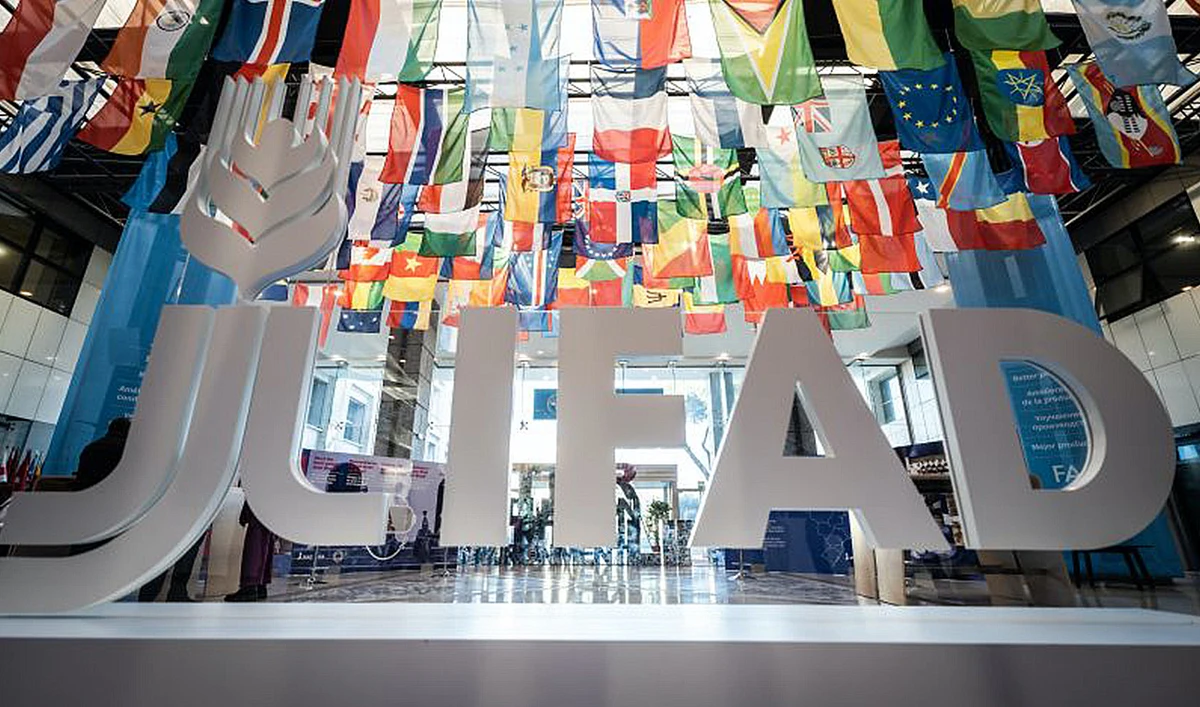
International Fund for Agricultural Development office to open in Islamabad next month, boost partnership

The undated file photo shows the logo of International Fund for Agricultural Development (IFAD) displayed at the IFAD Governing Council in Rome. (Photo courtesy: IFAD/LinkedIn)
Short Url
Updated 30 March 2024
Follow

International Fund for Agricultural Development office to open in Islamabad next month, boost partnership

  • Faced with adverse impacts of climate change, Pakistan has been making efforts to boost the national food security
  • The IFAD is a specialized UN agency that works to address poverty and hunger in rural areas of developing countries

ISLAMABAD: The opening of an International Fund for Agricultural Development (IFAD) office in Islamabad next month will boost partnership between the two sides, Pakistani state media reported on Saturday, citing officials.

The Pakistani government last year signed an agreement with the IFAD for the opening of its country office in Pakistan, which would formalize already existing cooperation between the two sides in food security, climate resilience and rural poverty reduction.

The IFAD is a specialized agency of the United Nations that works to address poverty and hunger in rural areas of developing countries. It has the biggest portfolio in Pakistan, with both sides having executed 28 projects for $2.91 billion of investments.

To review cooperation and discuss opening of IFAD Islamabad office, Pakistan’s Abmassador Ali Javed held a bilateral meeting with IFAD President Alvaro Lario at the IFAD headquarters in Rome.

“Both sides welcomed their longstanding history of excellent cooperation since 1979, and expressed satisfaction over the status of ongoing projects,” the Pakistani state-run APP news agency reported.

“In conclusion, both sides resolved to consolidate bilateral cooperation and acknowledged institutionalized cooperation through upcoming IFAD Country Office Islamabad to serve as new chapter in their partnership.”

IFAD Pakistan Country Director Fernanda Thomaz Da Rocha, who was also present on the occasion, expressed her keenness to work with her counterparts in taking forward the bilateral cooperation to a new dimension, according to the report.

She will formally operationalize IFAD country office Islamabad next month.

Faced with an economic crisis and adverse impacts of climate change, Pakistan has been making efforts to boost the national food security. Agriculture contributes 23 percent to Pakistan’s GDP and employs 37.4 percent of the labor force, but the country’s productivity is currently below par, with decreasing cultivation area, a population-production gap, and agricultural imports amounting to $10 billion.

In July last year, Pakistan established a Land Information and Management System, Center of Excellence (LIMS-CoE) to enhance modern agro-farming by utilizing over 9 million hectares of uncultivated state land, with a senior official saying that Saudi Arabia provided an initial $500 million investment to set up the facility.

It was one of the initiatives under the umbrella of the Special Investment Facilitation Council (SIFC) as part of which the federal and provincial governments had decided to introduce the initiative of corporate agriculture farming (CAF) in all provinces.

Later in the same month, Pakistan Army Chief General Asim Munir, who is a member of the SIFC, and the then prime minister, Shehbaz Sharif, inaugurated the nation’s first corporate farm as part of the initiative to modernize agricultural practices in the South Asian country.


Pakistan offers Kyrgyzstan Arabian Sea access as two states sign 15 cooperation accords

Updated 5 sec ago
Follow

Pakistan offers Kyrgyzstan Arabian Sea access as two states sign 15 cooperation accords

  • Pakistan and Kyrgyzstan sign MOUs spanning trade, energy, agriculture, ports, education, security cooperation
  • Kyrgyz president is on first visit to Pakistan in 20 years as both sides push connectivity and CASA-1000 power links

ISLAMABAD: Pakistan on Thursday offered Kyrgyzstan the shortest and most economical route to the Arabian Sea as the two countries signed 15 agreements and memoranda of understanding aimed at boosting cooperation across trade, energy, agriculture, education, customs data-sharing and port logistics.

The accords were signed during a visit to Islamabad by President Sadyr Zhaparov, the first by a Kyrgyz head of state to Pakistan in two decades, and part of Islamabad’s renewed push to link South Asia with landlocked Central Asian economies through ports, power corridors and transport routes.

For Pakistan, Kyrgyzstan offers access to hydropower through CASA-1000, a $1.2 billion regional electricity transmission project designed to carry surplus summer electricity from Kyrgyzstan and Tajikistan through Afghanistan into Pakistan. For Bishkek, Pakistan provides overland access to warm-water ports on the Arabian Sea, creating a shorter commercial route to global markets.

“President Asif Ali Zardari has reiterated Pakistan’s readiness to offer Kyrgyzstan the shortest and most economical route to the Arabian Sea,” Radio Pakistan reported after Zhaparov met the Pakistani president. 

The two leaders also discussed expanding direct flights to deepen business, tourism and people-to-people ties.

Zardari welcomed Kyrgyzstan’s completion of its segment of the CASA-1000 project and “reaffirmed Pakistan’s commitment to completing its part of the project, which is now at an advanced stage,” the state broadcaster said. 

Zhaparov thanked Islamabad for supporting Bishkek’s candidacy for a non-permanent UN Security Council seat and invited Zardari to visit Kyrgyzstan at a time of his convenience. Both sides expressed satisfaction with progress under the Quadrilateral Traffic in Transit Agreement, designed to facilitate road movement between Pakistan, Kyrgyzstan, Kazakhstan and China.

Earlier, both governments exchanged 15 sectoral cooperation documents covering commerce, mining, geosciences, power, agriculture, youth programs, the exchange of convicted persons, customs electronic data systems and a sister-city linkage between Islamabad and Bishkek.

According to APP, the MOUs were signed by ministers representing foreign affairs, commerce, economy, energy, power, railways, interior, culture, health and tourism. Agreements also covered cooperation between Pakistan’s Foreign Service Academy and the Diplomatic Academy of Kyrgyzstan, as well as collaboration between universities, youth ministries and cultural institutions.

“Our present mutual trade, comprising of about $15–16 million will be enhanced to $200 million in the next two years,” Prime Minister Shehbaz Sharif said after the agreements were signed, calling them “a framework for structured, result-oriented engagement and closer institutional linkages.”

Sharif said Pakistan was ready to serve as a maritime outlet for the landlocked Central Asian republic, offering access to Karachi, Port Qasim and Gwadar to help Kyrgyz goods reach regional and global markets.