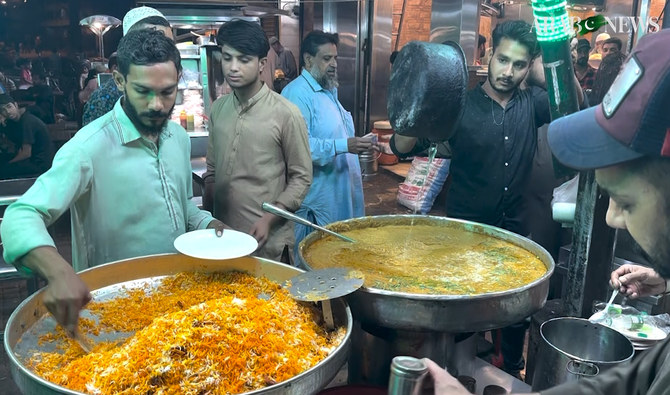

KARACHI: Jibran Salahuddin supervised his staff as they mixed a deep yellow stew in giant cauldrons in an old neighborhood in Pakistan’s culinary hub of Karachi while a large number of hungry customers gathered around the food stall.
The clients are here for a unique and unusual fusion dish called haleem-biryani, offered only during the holy fasting month of Ramadan each year.
Haleem, which traces its origins to the Arab world, is a mixture of meat, wheat and pulses that are pounded and slow-cooked in large pots until all the ingredients merge together to form a thick, dense stew.
Introduced in the Indian Subcontinent by Arab expats, haleem has evolved into a most sought-after dish in Pakistan and India with the addition of the distinct flavors of local spices. Biryani, on the other hand, originated in South Asia and is a flavorful mix of rice, beef, mutton or chicken as well as vegetables like potatoes.
While the two dishes are usually eaten separately, people in both Pakistan and India have also developed a taste for a mix of the two. In Karachi, Pakistan’s largest city, a few food vendors are selling the fusion dish to tempt foodies during Ramadan.
One of the stalls, Hajji Salahuddin Kitchen, is based in the Pan Mandi area near the Karachi City Courts and has been serving the scrumptious blend in Ramadan since 1952, according to the owners. For the rest of the year, the vendor caters food for weddings and other events.
“In India, my grandfather’s grandfather served it. In Karachi, our grandfather started this concept [in 1972]. It started, then our father, Hajji Salahuddin, took it up after our grandfather,” Jibran Salahuddin, 38, who manages the business, told Arab News at his stall.
“After Hajji Salahuddin, all of us brothers are running it.”
“Eleven months, we provide catering services ... Only one month of Ramadan, we follow our family tradition from India [to serve haleem-biryani],” the manager added.
Another stall is run by Rehan Shikra, who said the tradition of a mixed dish of biryani and haleem had been in his family for generations.
“This tradition of ours has been running from India, from Delhi. Earlier, my grandfather, great grandfather, father and everyone used to do this work. Now Mashallah, I am also doing this,” Shikra told Arab News.
“Over there [in India] also, it was this saffron biryani with haleem poured over it. Over there, this is how it was served, and after coming here, since Pakistan came into being [in 1947], you can say we’ve been doing the same work.”
“NEW TASTE”
While this unique blend has been offered in the area for the last seven decades, food bloggers and social media users have put a spotlight on the Ramadan offering, leading to an influx of customers.
Zeeshan Amin, 39, who works with a non-government organization, said he had traveled all the way from the city’s Nazimabad area, some 15 kilometers away, to eat the dish.
“I heard about it on social media and my friends had also told me about it, so we came here for the first time and the combination of haleem and biryani was very good,” Amin told Arab News.
“This fusion has created a new taste. Both are [made] of beef and very delicious.”
For 21-year-old student Muhammad Baseer, the concept of haleem-biryani seemed “very strange” initially, but his visit to Salahuddin’s stall changed his mind.
“Before, we used to say that there is no combination of haleem and biryani,” he said, “but now after we tried it, we liked it and we said that no, this is good.”
There are many who have been familiar with the fusion dish for years.
Kashif Muhammad Anwar, 39, who works at a private firm, said he had known about the dish for years and was a returning customer:
“Biryani is eaten everywhere in events, but you will not find haleem-biryani. It’s a unique combination and the taste you get with both won’t be found [elsewhere].”
Loyal customers like Anwar have helped spread the word and food bloggers have also popularized the dish.
“We receive calls from Lahore and when they ask us where our stall is located, we tell them that it is in Karachi, not in Lahore,” Shikra said, smiling.
“We tell them if you still want to come, you are most welcome, we are here to serve you.”