

Palestinian PM Mustafa forms cabinet, calls for immediate ceasefire in Gaza

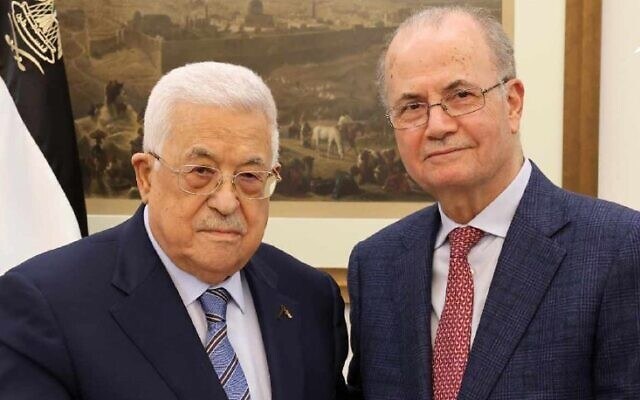
President Mahmoud Abbas, who has led the PA for nearly two decades and remains in overall control, announced the new government in a presidential decree on Thursday. None of the incoming ministers is a well-known figure. (WAFA/File)
Short Url
Updated 28 March 2024
Follow

Palestinian PM Mustafa forms cabinet, calls for immediate ceasefire in Gaza

  • He was also assigned to lead the relief and rebuilding of Gaza and performs double-duty as foreign minister, replacing Riyad Al-Maliki
  • Abbas appointed the new government in a demonstration of willingness to meet international demands for change in the administration

RAMALLAH: Palestinian Prime Minister Mohammad Mustafa formed a new cabinet on Thursday in which he will also serve as foreign minister, making an immediate ceasefire and Israeli withdrawal from Gaza a priority, Palestinian news agency WAFA reported.
Mustafa, an ally to President Mahmoud Abbas and a leading business figure, was appointed premier this month with a mandate to help reform the Palestinian Authority (PA), which exercises limited self-rule in the Israeli-occupied West Bank.
He was also assigned to lead the relief and rebuilding of Gaza, which has been shattered by more than five months of war, while he performs double-duty as foreign minister, replacing Riyad Al-Maliki who had served in the position since 2009.
Abbas, who as president remains by far the most powerful figure in the PA, appointed the new government in a demonstration of willingness to meet international demands for change in the administration.
He approved Mustafa’s cabinet with financial expert Omar Al- Bitar as finance minister, and Muhamad al Amour, who served as the president of the Palestinian Businessmen Association, as economy minister. He kept Ziad Hab Al-Reeh, former chief of the PA’s internal intelligence agency, as interior minister, WAFA said.
The new cabinet, which includes eight ministers from Gaza, will also include a state minister for “relief affairs.”
Mustafa said in a statement addressed to Abbas that the first national priority was an immediate ceasefire in Gaza and a complete Israeli withdrawal from the enclave, in addition to allowing humanitarian aid to enter in large quantities and reaching all areas, WAFA reported.
“In order to enable the launch of the recovery process and preparation for reconstruction, stop the aggression and settlement activities, and curb settlers’ terrorism in the West Bank,” Mustafa added.
Hamas, the Islamist movement that controlled Gaza until Israel’s invasion in the wake of the Oct. 7 attack on southern Israel, has criticized the appointment of Mustafa but it had no immediate reaction to the naming of his new cabinet.

STRAINED
The PA, controlled by Abbas’ Fatah political faction, has long had a strained relationship with Hamas and the two factions fought a brief war before Fatah was expelled from the territory in 2007.
However it has repeatedly condemned the Israeli invasion of the Gaza Strip and has insisted it must play a role in running Gaza after the war, a position supported by the United States.
For the moment, Israeli Prime Minister Benjamin Netanyahu has rejected PA involvement in Gaza, and for months his hard-right finance minister Bezalel Smotrich has refused to hand over tax revenues due to the Authority, which still funds health and some other services in the enclave.
For months, thousands of Palestinian public sector employees have gone unpaid or received only a part of their salary as a result of the standoff. Mustafa said the government was taking office at a time of “unprecedented financial crisis.”
He said salary arrears owed to public sector employees now totalled $745 million with another $1.3 billion owed to private sector suppliers and $3 billion more in pension arrears, while revenues in January were down 30 percent compared to before the war.


Epstein tried to build web of powerful ties across Middle East, documents show

Updated 8 sec ago
Follow

Epstein tried to build web of powerful ties across Middle East, documents show

DUBAI: The departure of the chief executive of Dubai port giant DP World is the biggest fallout in the Middle East from US Department of Justice documents which show that disgraced financier Jeffrey Epstein tried to build a powerful network of political figures and business leaders across the region.
DP World announced on Friday that Sultan Ahmed Bin Sulayem had resigned as chief executive and chair.
The decision to act was taken after Bin ​Sulayem’s name appeared in the Epstein files, two sources with direct knowledge of the matter told Reuters, and as his relationship with the late convicted sex offender faced increasing scrutiny.
In their correspondence, Bin Sulayem discussed sexual relationships with women with whom Epstein helped him connect.
In an email dated November 9, 2007, Bin Sulayem told Epstein he had met one such woman in New York, whom he does not name and with whom he said he did not have sex.
“Yes after several attempts for several months we managed to meet in NY,” he wrote, adding that there was a misunderstanding because “she wanted some BUSINESS! while i only wanted some PUSSYNESS!“
Dubai’s ruler on Friday also issued a decree appointing a new chairman for Dubai’s Ports, Customs and Free Zone Corporation, one of several roles Bin Sulayem held.
Reuters was able to independently review only some of the Epstein files relating to Bin Sulayem and was unable to ascertain what specifically led to his departure from DP World although the sources said, without providing further details, that it was related to the files.
Bin Sulayem did not respond to Reuters requests for comment on his departure. DP World declined to comment.
COOKING TOGETHER
In one email exchange, Epstein described Bin Sulayem as funny, trustworthy and a foodie. Epstein went on to ‌say that Bin Sulayem, a ‌Muslim, does not drink and prays five times a day.
An undated photograph that appears in an email and is publicly available shows ​Epstein ‌cooking with ⁠Bin Sulayem ​and the ⁠two of them looking relaxed together.
The full name of the person it was sent to by Epstein is not provided.
Bin Sulayem has not publicly commented on Epstein’s description or the emails about his relationship with him.
Being named in the file is not evidence of criminal activity. But after members of the US Congress said Bin Sulayem’s name appeared in files released by the US Department of Justice (DOJ), he faced renewed questions from some of DP World’s financial backers over his past interactions.
Bin Sulayem did not respond publicly to those concerns. The UK development finance agency, British International Investment, and Canada’s second-largest pension fund said last week they would suspend all new investment with DP World over Bin Sulayem’s alleged ties to Epstein.
“We are shocked by the allegations emerging in the Epstein
Files regarding Sultan Ahmed Bin Sulayem,” said a spokesperson for BII, without saying which allegations he was referring to. “In light of the allegations, we will not be making any new investments with DP World until the required actions have been taken by the company.”
Canadian pension fund La Caisse said it was “pausing additional capital deployment alongside the company” until DP World ⁠clarified the situation and took “the necessary actions.”
In a statement after Friday’s leadership changes at DP World, BII welcomed DP World’s decision and said it ‌looked forward to continuing “our partnership to advance the development of key African trading ports.” La Caisse said “the company took the appropriate measures” and that ‌it would “move quickly to work with DP World’s new leadership to continue our partnership on port projects around the world.”
Bin Sulayem ​did not immediately respond when asked by Reuters to comment on the actions taken by BII and ‌La Caisse. DP World declined comment.
NETWORK OF CONTACTS
The large cache of documents released by the DOJ, including text messages and emails, also shows the Middle East was no exception to Epstein’s efforts to use ‌his wealth to build relationships with prominent people in politics, finance, academia and business around the world.
Reuters was unable to ascertain how successful Epstein was in seeking to influence his contacts in the Middle East, and whether his advice was heeded. The DOJ documents reviewed by Reuters show Epstein tried to advise Qatari business leaders and political figures during the 2017-21 blockade of Qatar by Saudi Arabia, the United Arab Emirates, Bahrain and Egypt over accusations that Doha failed to curb ties with Iran and supported terrorism, which Qatar denied.
In exchanges with a Qatari businessman and ruling family member Sheikh Jabor Yousuf Jassim Al Thani, Epstein urged Qatar to “stop kicking and arguing...let the heat come down a bit.” He said “the current ‌Qatar team is very weak” and “FM is not experienced and it shows.”
Qatar’s foreign minister at the time was Sheikh Mohammed bin Abdulrahman Al Thani, who now serves as both foreign minister and prime minister. Sheikh Mohammed has not commented publicly on Epstein’s portrayal of him. Asked about the ⁠exchange, Qatar’s International Media Office, which handles media requests for ⁠the prime minister, declined to comment.
There was no response to a Reuters request for comment emailed to three companies in Qatar that Sheikh Jabor is listed as chairman of, or to a text message sent to an individual who, according to the files released by the DOJ, works in Sheikh Jabor’s office. Epstein urged Doha to forge links with Israel to stay in the good graces of Donald Trump, who was then in his first term as US president. He suggested the Gulf state either move toward recognizing Israel or pledge $1 billion to a fund for terrorism victims. Ultimately, Qatar stuck to its independent course. In 2021, the blockading countries restored ties with Doha, and ties between the Trump administration and Qatar are now strong.
DISCUSSION OF SAUDI ARAMCO IPO
Epstein discussed Saudi Aramco’s initial public offering in dozens of email exchanges. In one exchange dated September 10, 2016, with a person named as Aziza Alahmadi, and with former Norwegian diplomat Terje Roed-Larson copied in, Epstein warned that Aramco going public could expose Saudi Arabia to lawsuits and asset seizures. Saudi Aramco declined to comment on these emails.
Alahmadi could not be reached for comment and Reuters was unable to establish her role, if any, in Epstein’s activities.
In an email dated October 16, 2017, and also sent to Alahmadi, Epstein suggested selling China an option to buy a $100-billion stake in Aramco rather than pursuing a traditional IPO, saying it would provide liquidity while limiting exposure to public markets.
Saudi Aramco declined to comment to Reuters on the emails. Roed-Larsen did not immediately respond to a request for comment sent by email via his lawyer.
Epstein’s reach also extended to Egypt, the documents released by the DOJ show. Some emails show a request from ​a family member of Hosni Mubarak — the wife of his son Gamal Mubarak — that was passed on ​to Epstein asking for help in 2011, following the former president’s ouster and subsequent legal troubles. They did not say what kind of assistance was sought and Reuters was unable to establish whether Epstein had tried to intercede on the family’s behalf. Reuters emailed a request for comment to one lawyer and sent a text message to another, both of whom represented Gamal Mubarak. There was no immediate response.