

ISLAMABAD: The Pakistani government has decided to constitute an inquiry commission to investigate allegations made by six Islamabad High Court (IHC) judges about the alleged interference of intelligence agencies in judicial affairs, Law Minister Azam Nazeer Tarar said on Thursday.
The development took place shortly after Prime Minister Shehbaz Sharif met Chief Justice Qazi Faez Isa at the Supreme Court, along with Tarar and Attorney General Mansoor Usman Awan, to discuss the issue.
The six judges, out of a total of eight in the high court, sent a written request to the Supreme Judicial Council earlier this week to hold a judicial convention to discuss how intelligence agencies put judges under pressure and coerce them to issue desired verdicts.
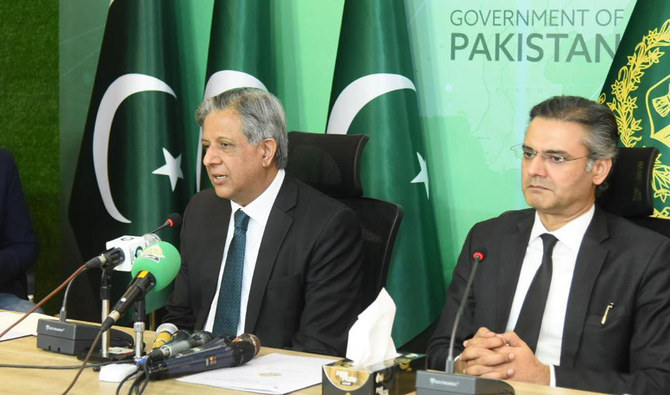
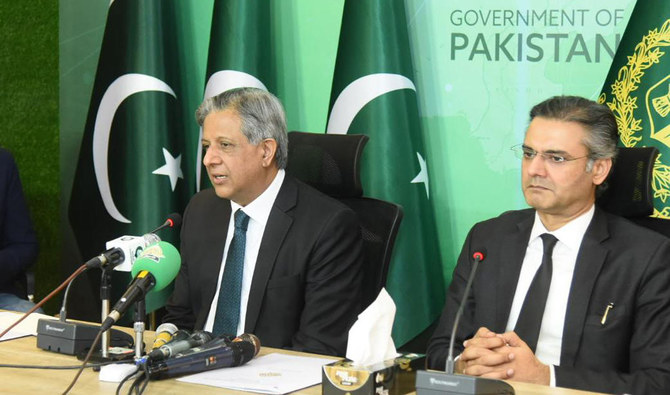
“This is decided that tomorrow is a federal cabinet meeting, and the prime minister will place this matter before it to appoint a commission of inquiry,” Tarar told reporters at a news conference with Awan by his side.

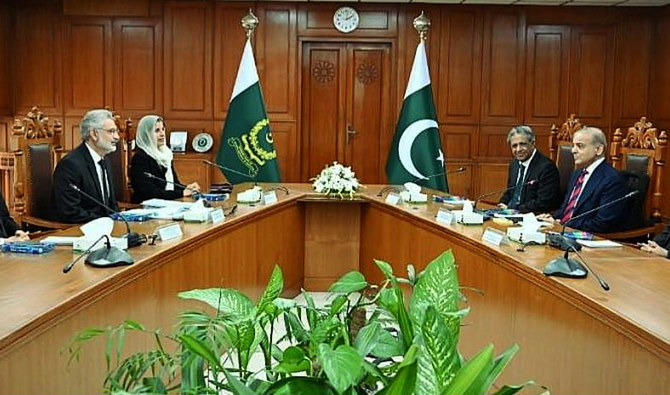
In this handout photo, taken and released by the Supreme Court of Pakistan, Prime Minister Shehbaz Sharif (1R) meets Chief Justice Qazi Faez Isa (1L) at the Supreme Court in Islamabad on March 28, 2024. (Photo courtesy: SCP)
He said PM Sharif had assured the chief justice that an investigation should be carried out on the matter.
“The prime minister said point blank that no compromise will be made on the independence of the judiciary,” Tarar said.
The minister said the commission would be notified in the next two to four days after a retired judge is nominated to probe the matter and compile a report on it. Tarar confirmed it would be a one-member commission.
He said the chief justice agreed with the idea of a commission, saying the government would undertake the investigation according to law.
“This suggestion [of the inquiry commission] has been accepted warmly [by the chief justice],” he said, dismissing reports of a constitutional crisis in the country due to the letter written by the judges.
In their letter to the Supreme Judicial Council, the IHC judges provided various examples of alleged interference in judicial matters, including a case concerning Pakistan’s imprisoned former prime minister Imran Khan.
They said that when two of the three judges on the bench deemed a plea to disqualify Khan for allegedly concealing his paternity of a daughter as not maintainable, they faced pressure from “operatives of the ISI [Inter-Services Intelligence]” through their friends and relatives.
The judges also mentioned incidents where their relatives were abducted and tortured and their homes were secretly surveilled, aiming to coerce them into delivering favorable judgments in specific cases.
Pakistan’s military has so far not commented on the allegations. However, it has consistently denied allegations it interferes in political matters.
Pakistan’s top court said in a press release that a full court meeting of the Supreme Court judges was held on Wednesday to deliberate over the issue which agreed that Justice Isa should meet the prime minister.
The meeting between Sharif and Justice Isa lasted for about an hour and a half, the press release said.
“The CJP clearly stated that interference by the Executive in the affairs and judicial workings of Judges will not be tolerated,” the Supreme Court said. “And under no circumstances can independence of the judiciary be allowed to be compromised.”
The Supreme Court said that Sharif “fully endorsed” the views expressed by the chief justice and further assured them that he will be taking “other appropriate measures” to ensure an independent judiciary.
“Thereafter, in continuation of the last meeting, the CJP again called a Full Court meeting and briefed the Judges on what had transpired at the meeting with the Prime Minister,” the statement said.
Separately, the core committee of Khan’s Pakistan Tehreek-e-Insaf (PTI) party rejected Tarar’s announcement, calling for the matter to be discussed before a larger bench of the apex court.
“Pakistan Tehreek-e-Insaf has completely rejected the establishment and investigation of a government-led inquiry commission to investigate the contents of the judges’ letter,” the PTI said in a statement.
The party expressed concern over Justice Isa’s meeting with PM Sharif, saying that the apex court’s larger bench should discuss the matter in an open court.
“The letter by the judges of the Islamabad High Court is an indictment of the federal government’s agencies,” the party added.
The PTI accused Sharif of stealing the people’s mandate in a contentious vote last month, saying that any investigation led by his government would lack credibility.


