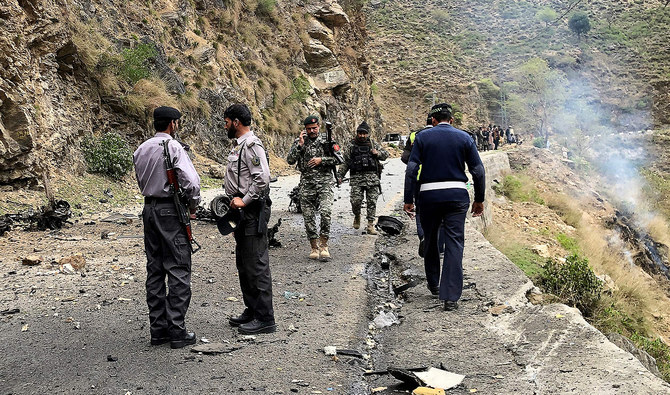
PESHAWAR: Pakistani authorities have shared with China the preliminary findings of an investigation into a deadly attack that killed five Chinese nationals and their Pakistani driver in the country’s volatile northwest, officials said Wednesday.
Authorities were doing DNA testing on the remains of a suicide bomber who rammed his explosives-laden car into a vehicle that was carrying the Chinese engineers and construction workers.
The attack took place in Shangla, a district in Khyber Pakhtunkhwa province where thousands of Chinese nationals work on the China-Pakistan Economic Corridor (CPEC), which includes a multitude of megaprojects such as road construction, power plants and agriculture. The CPEC is a lifeline for Pakistan’s cash-strapped government, currently facing one of its worst economic crises.
The five Chinese nationals were heading Tuesday to the Dasu Dam, the biggest hydropower project in Pakistan, where they worked. Their remains were transported to the capital, Islamabad, local police official Altaf Khan said, adding that the deceased had a police escort when the attack happened.
Khan said DNA testing was necessary as the bomber’s face was beyond recognition. He hoped the results of the DNA tests will help in identifying the bomber.
Pakistani officials said they shared the latest investigation developments with their Chinese counterparts. China is expected to send its own experts to the attack site to conduct an independent investigation while collaborating with Pakistani authorities.
Khan also said they have further expanded a search started a day earlier for the attacker’s possible accomplices.
The UN Security Council in a statement Wednesday condemned “in the strongest terms the heinous and cowardly terrorist attack.” The council “underlined the need to hold perpetrators, organizers, financiers and sponsors of these reprehensible acts of terrorism accountable and bring them to justice.”
No group had claimed responsibility for the attack as of Wednesday, but suspicion was likely to fall on separatists and the breakaway Gul Bahadur faction of the Pakistani Taliban, known as Tehreek-e-Taliban Pakistan or TTP, and is a separate group, but a close ally of the Afghan Taliban.
The TTP denied being behind the suicide bombing in a statement Wednesday, saying: “We are in no way related to the attack on the Chinese engineers.”
Tuesday’s attack came less than a week after Pakistani security forces killed eight Balochistan Liberation Army separatists who opened fire on a convoy carrying Chinese citizens outside the Chinese-funded Gwadar port in the volatile southwestern Balochistan province.
The Chinese foreign ministry condemned the attack and offered “deep condolences to the deceased” in a statement Wednesday.
The ministry said China has asked “Pakistan to thoroughly investigate the incident as soon as possible, hunt down the perpetrators, and bring them to justice” and added that “any attempt to undermine China-Pakistan cooperation will never succeed.”
Pakistan’s Prime Minister Shehbaz Sharif promised a swift conclusion to the investigation during a visit with the Chinese ambassador, Jiang Zaidong, on Tuesday.
Zaidong, accompanied by Pakistani officials, visited the Dasu Dam Wednesday, according to a statement by Pakistan’s government.
The statement also said Sharif presided over a high-level security meeting, attended by the country’s powerful army chief Gen. Asim Munir. In the meeting, the premier said Tuesday’s attack was “creating mistrust” between Pakistan and China and vowed to bring “the barbaric perpetrators to justice.”
The army chief seconded Sharif’s promise and said they would ensure the safety of all foreigners in the country, “especially Chinese nationals, contributing to the prosperity of Pakistan.”
Chinese laborers working on CPEC-related projects in Pakistan have come under attack in recent years.
In July 2021, at least 13 people, including nine Chinese nationals, were killed when a suicide bomber detonated the explosives in his vehicle near a bus carrying several Chinese and Pakistani engineers and laborers, prompting the Chinese companies to suspend work at the time. Pakistani authorities initially insisted it was a road accident, but China disputed the claim, saying victims were the target of a suicide attack.


Pakistan shares initial findings with China on attack that killed five Chinese nationals
https://arab.news/mjr2m
Pakistan shares initial findings with China on attack that killed five Chinese nationals

- The Chinese citizens were working on a hydropower project in Pakistan’s northwest where a suicide bomber targeted them
- Pakistani officials say they are doing DNA testing on the remains of the bomber whose face is said to be beyond recognition


Pakistan alarmed as Russia-Ukraine conflict intensifies, calls for immediate ceasefire
- Pakistan envoy urges both sides to resolve ongoing conflict through peaceful means during Security Council briefing
- Russia last Friday fired hypersonic ballistic missile capable of carrying nuclear warhead at Ukraine, drawing criticism
ISLAMABAD: Pakistan’s UN Ambassador Iftikhar Ahmad this week expressed alarm as the Russia-Ukraine conflict intensifies, calling for an immediate ceasefire and demanding both countries resolve their issues peacefully through dialogue.
The development takes place days after Russia last week fired an intermediate-range hypersonic ballistic missile at Ukraine called Oreshnik. The move drew sharp criticism as the missile is capable of carrying nuclear and conventional warheads. Russia said it fired the Oreshnik in response to what Moscow says was an attempted Ukrainian drone attack on Dec. 29 against one of Putin’s residences in northern Russia. Ukraine denies Moscow’s claims.
February 2026 will mark four years since Russia launched its full-scale invasion of Ukraine, triggering the worst armed conflict in Europe since World War II. The war has killed hundreds of thousands of people and forced millions to flee their homes.
“We are alarmed by the recent intensification in fighting with escalation in attacks from both sides, further worsening the already dire humanitarian situation,” Ahmad said on Monday during a UN Security Council briefing on the Ukraine conflict.
“Such actions not only perpetuate the conflict, but they also undermine trust, and the ongoing efforts for peace.”
The Pakistani envoy urged both sides to abide by the principles of international law and ensure civilians and civilian infrastructure are protected during the conflict. He said Pakistan’s position on resolving the issue through dialogue has not changed.
“Now, more than ever before, the overwhelming global opinion is on the side of ending this conflict through peaceful means,” Ahmad said. “This can only be achieved through a sustained, meaningful and structured dialogue.”
US President Donald Trump has been pushing both sides to strike a deal to halt the conflict, running shuttle diplomacy between Ukraine’s Volodymyr Zelensky and Russia’s Vladimir Putin in a bid to get an agreement across the line. Plans to broker peace collapsed after an initial 28-point plan, which largely adhered to Moscow’s demands, was criticized by Kyiv and Europe.
Ahmad appreciated the US for attempting to resolve the conflict through peaceful means.
“We hope that all sides would make full use of the ongoing diplomacy, demonstrate genuine political will, and engage constructively to make meaningful strides toward a peaceful and negotiated settlement of the conflict, starting with an immediate ceasefire,” he said.


