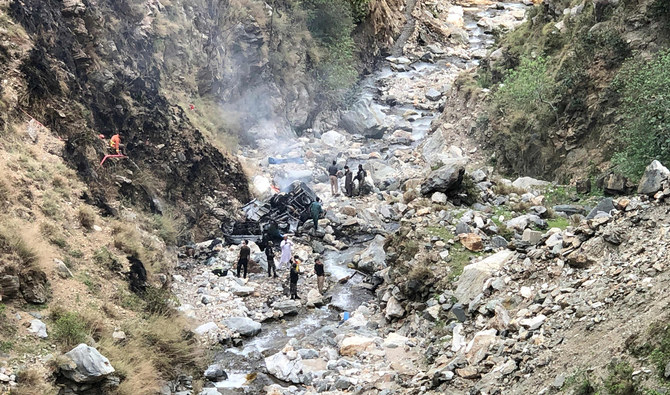
PESHAWAR: Pakistani authorities will perform DNA testing on the remains of the suicide bomber who rammed his explosive-laden car into a vehicle in the country’s northwest, killing five Chinese nationals and their local driver, officials said Wednesday.
The attack occurred in Shangla, a district in the Khyber Pakhtunkhwa province where thousands of Chinese nationals work on the China-Pakistan Economic Corridor which includes a multitude of megaprojects such as road construction, power plants and agriculture. The CPEC is a lifeline for Pakistan’s cash-strapped government, currently facing one of its worst economic crises.
The five were engineers and laborers heading Tuesday to the Dasu Dam, the biggest hydropower project in Pakistan, where they worked. Their remains were transported to the capital, Islamabad, local police official Altaf Khan said, adding that the deceased had a police escort when the attack happened.
Pakistani officials said they shared the latest investigation developments with their Chinese counterparts. China is expected to send its own experts Wednesday to the attack site to conduct an independent investigation while collaborating with Pakistani authorities.
Khan said they have further expanded a search that started a day earlier, looking for the attacker’s possible accomplices.
No group has so far claimed responsibility for the attack, but suspicion is likely to fall on separatists as well as a breakaway Gul Bahadur faction of Pakistani Taliban, known as Tehreek-e-Taliban Pakistan or TTP, and is a separate group, but a close ally of the Afghan Taliban.
The TTP denied being behind the attack in a statement Wednesday, saying: “We are in no way related to the attack on the Chinese engineers.”
Tuesday’s attack came less than a week after Pakistani security forces killed eight Balochistan Liberation Army militants who opened fire on a convoy carrying Chinese citizens outside the Chinese-funded Gwadar port in the volatile southwestern Baluchistan province.
The Chinese foreign ministry condemned the attack and offered “deep condolences to the deceased” in a statement Wednesday.
The ministry said China has asked “Pakistan to thoroughly investigate the incident as soon as possible, hunt down the perpetrators, and bring them to justice” and added that “any attempt to undermine China-Pakistan cooperation will never succeed”.
Pakistan’s Prime Minister Shehbaz Sharif promised a swift conclusion to the investigation during a visit with the Chinese ambassador, Jiang Zaidong, on Tuesday.
Chinese laborers working on CPEC-related projects in Pakistan have come under attack in recent years.
In July 2021, at least 13 people, including nine Chinese nationals, were killed when a suicide bomber detonated his vehicle near a bus carrying several Chinese and Pakistani engineers and laborers, prompting the Chinese companies to suspend work at the time. Pakistani authorities at the time initially insisted it was a road accident, but China disputed the claim, saying victims were the target of a suicide attack.


Pakistan to perform DNA testing on remains of suicide bomber who killed 5 Chinese nationals
https://arab.news/4app5
Pakistan to perform DNA testing on remains of suicide bomber who killed 5 Chinese nationals

- Attack occurred in Khyber Pakhtunkhwa where thousands of Chinese nationals work on China-Pakistan Economic Corridor
- The five Chinese were engineers and laborers heading Tuesday to Dasu Dam, the biggest hydropower project in Pakistan

Pakistan mulls 'Super App' for public services, document verification in major technology push
- Pakistan has been urging technology adoption in public, private sectors as it seeks to become a key tech player globally
- The country this month launched the Indus AI Week to harness technology for productivity, skills development and innovation
KARACHI: Pakistan is planning to launch a “Super App” to deliver public services and enable digital document verification, the country's information technology (IT) minister said on Sunday, amid a major push for technology adoption in public and private sectors.
Pakistan, a country of 240 million people, seeks to become a key participant in the global tech economy, amid growing interest from governments in the Global South to harness advanced technologies for productivity, skills development and innovation.
The country's information and communications technology (ICT) exports hit a record $437 million in Dec. last year, according to IT Minister Shaza Fatima Khawaja. This constituted a 23% increase month on month and a 26% increase year on year.
Pakistan's technology sector is also advancing in artificial intelligence (AI) and cloud computing, marked by the launch of Pakistan’s first sovereign AI cloud in November, designed to keep sensitive data domestic and support growth in the broader digital ecosystem.
“In developed countries, citizens can access all government services from a mobile phone,” Fatima said, announcing plans for the Super App at an event in Karachi where more than 7,000 students had gathered for an AI training entrance test as part of the ‘Indus AI Week.’
“We will strive to provide similar facilities in the coming years.”
Khawaja said the app will reduce the need for in-person visits to government offices such as the National Database and Registration Authority (NADRA) and the Higher Education Commission (HEC).
The Indus AI Week initiative, which ran from Feb. 9 till Feb. 15. was aimed at positioning Pakistan as a key future participant in the global AI revolution, according to the IT minister.
At the opening of the weeklong initiative, Prime Minister Shehbaz Sharif announced that Pakistan would invest $1 billion in AI by 2030 to modernize the South Asian nation’s digital economy.
“These initiatives aim to strengthen national AI infrastructure and make the best use of our human resource,” Khawaja said, urging young Pakistanis to become creators, inventors and innovators rather than just being the consumers of technology.