Russia says it’s hard to believe Daesh could have launched Moscow attack

1 / 2
People lay flowers at a makeshift memorial in Donetsk, Russian-controled Ukraine, on Mar. 23, 2024, the day after a gun attack on the Crocus City Hall in Russia’s Krasnogorsk. (AFP)
2 / 2
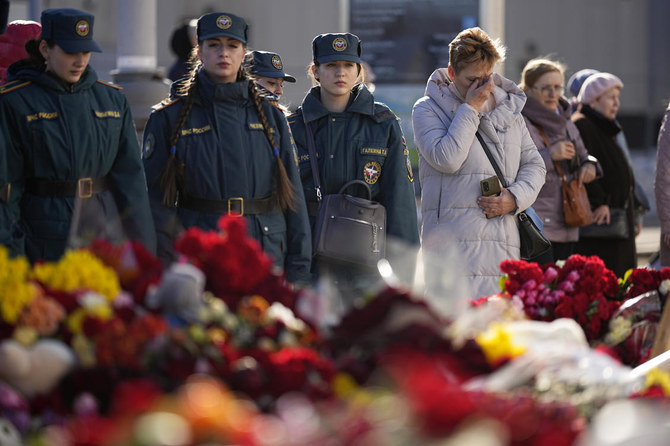
People stand at a makeshift memorial in front of the Crocus City Hall on the western outskirts of Moscow on Mar. 27, 2024. (AP)
Short Url
Updated 27 March 2024
Follow

Russia says it’s hard to believe Daesh could have launched Moscow attack

  • Zakharova doubled down on Moscow’s assertions, for which it has not yet provided evidence, that Ukraine was behind the attack on the Crocus City Hall
  • Ukraine has repeatedly denied it had anything to do with the attack

MOSCOW: Russian Foreign Ministry spokeswoman Maria Zakharova said on Wednesday that it was “extremely hard to believe” that Daesh would have had the capacity to launch an attack on a Moscow concert hall last Friday that killed at least 140 people.
At a briefing with reporters, Zakharova instead doubled down on Moscow’s assertions, for which it has not yet provided evidence, that Ukraine was behind the attack on the Crocus City Hall, the deadliest Russia has suffered in 20 years.
Daesh has claimed responsibility for the massacre and US officials say they have intelligence showing it was carried out by the network’s Afghan branch, Daesh-Khorasan.
Ukraine has repeatedly denied it had anything to do with the attack.
But Zakharova said the West had rushed to pin responsibility on Daesh, as a way of deflecting blame from Ukraine and the Western governments that support it.
“In order to ward off suspicions from the collective West, they urgently needed to come up with something, so they resorted to Daesh, pulled an ace out of their sleeve, and literally a few hours after the terrorist attack, the Anglo-Saxon media began disseminating precisely these versions,” she said.
President Vladimir Putin has said the attack was carried out by Islamist militants but has suggested it was to Ukraine’s benefit and that Kyiv may have played a role.
He has said that someone on the Ukrainian side had prepared a “window” for the gunmen to escape across the border before they were captured in western Russia on Friday night.
On Tuesday, however, Belarusian leader Alexander Lukashenko said the gunmen had initially sought to cross into his country before turning away and heading toward Ukraine once they realized that crossings into Belarus had been sealed.
The director of Russia’s FSB security agency said on Tuesday that he believed Ukraine, along with the United States and Britain, were involved in the Moscow attack.
British Foreign Secretary David Cameron responded on X, saying: “Russia’s claims about the West and Ukraine on the Crocus City Hall attack are utter nonsense.”


Uganda partially restores internet after president wins 7th term

Supporters of President Yoweri Museveni celebrate his winning the polls. (AFP)
Updated 58 min 18 sec ago
Follow

Uganda partially restores internet after president wins 7th term

  • “The internet shutdown implemented two days before the elections limited access to information, freedom ‌of association, curtailed economic activities ... it also created suspicion and mistrust on the ‍electoral process,” the team said in ‍their report

KAMPALA: Ugandan authorities have partially restored internet services late after 81-year-old President Yoweri Museveni won a seventh term to extend his rule into a fifth decade with a landslide ​victory rejected by the opposition.
Users reported being able to reconnect to the internet and some internet service providers sent out a message to customers saying the regulator had ordered them to restore services excluding social media.
“We have restored internet so that businesses that rely on internet can resume work,” David Birungi, spokesperson for Airtel Uganda, one of the country’s biggest telecom companies said. He added that the state communications regulator had ordered that social media remain shut down.
The state-run Uganda Communications Commission said it had cut off internet to ‌curb “misinformation, disinformation, ‌electoral fraud and related risks.” The opposition, however, criticized the move saying ‌it was ​to ‌cement control over the electoral process and guarantee a win for the incumbent.
The electoral body in the East African country on Saturday declared Museveni the winner of Thursday’s poll with 71.6 percent of the vote, while his rival pop star-turned-politician Bobi Wine was credited with 24 percent of the vote.
A joint report from an election observer team from the African Union and other regional blocs criticized the involvement of the military in the election and the authorities’ decision to cut off internet.
“The internet shutdown implemented two days before the elections limited access to information, freedom ‌of association, curtailed economic activities ... it also created suspicion and mistrust on the ‍electoral process,” the team said in ‍their report.

In power since 1986 and currently Africa’s third longest-ruling head of state, ‍Museveni’s latest win means he will have been in power for nearly half a century when his new term ends in 2031.

He is widely thought to be preparing his son, Muhoozi Kainerugaba, to take over from him. Kainerugaba is currently head of the military and has expressed presidential ambitions.
Wine, who was taking on ​Museveni for a second time, has rejected the results of the latest vote and alleged mass fraud during the election.
Scattered opposition protests broke out late on Saturday after results were announced, according to a witness and police.
In Magere, a suburb in Kampala’s north where Wine lives, a group of youths burned tires and erected barricades in the road prompting police to respond with tear gas.
Police spokesperson Racheal Kawala said the protests had been quashed and that arrests were made but said the number of those detained would be released later.
Wine’s whereabouts were unknown early on Sunday after he said in a post on X he had escaped a raid by the military on his home. People close to him said he remained at an undisclosed location in Uganda. Wine was briefly held under house arrest following the previous election in 2021.
Wine has said hundreds of his supporters were detained during the months leading up ‌to the vote and that others have been tortured.
Government officials have denied those allegations and say those who have been detained have violated the law and will be put through due process.