

Israeli attacks on targets in Lebanon continue

1 / 2
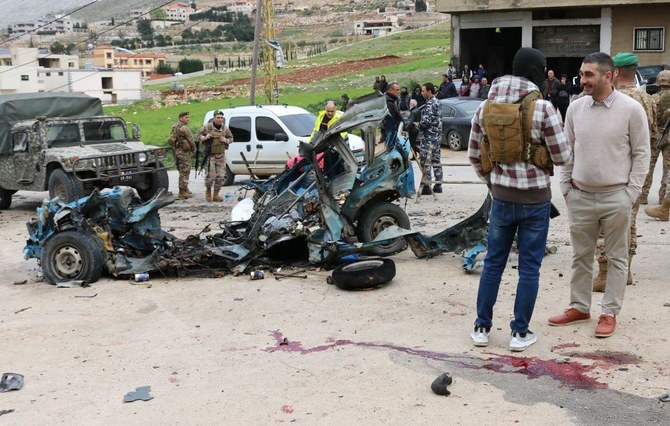
Lebanese soldiers cordon off the site of an Israeli drone attack targeting a vehicle in the town of Souairi, western Bekaa Valley, central Lebanon, Mar. 24, 2024. (AFP)
2 / 2
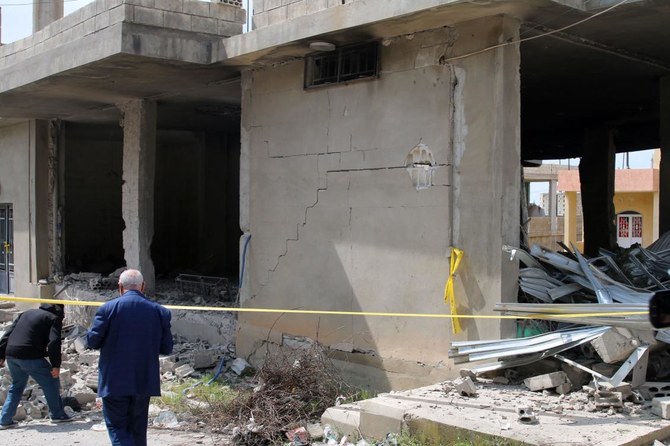
People check a damaged building hit by an overnight Israeli air strike near the city of Baalbeck, in Lebanon’s eastern Bekaa valley, Mar. 24, 2024. (AFP)
Short Url
Updated 26 March 2024
Follow

Israeli attacks on targets in Lebanon continue

  • In an Israeli raid on Baalbek-Hermel province, a drone pursued a small truck on Ras Baalbek plain, near the town of Hermel, where explosions were heard
  • Israeli Public Broadcasting Corp. said the Israeli army “launched raids on targets in Baalbek in response to the targeting of an air-control unit in Meron”

BEIRUT: Hostilities between Hezbollah and the Israeli army escalated on Tuesday as negotiations over a humanitarian truce in the Gaza Strip and the release of hostages faltered.

In an Israeli raid on the Baalbek-Hermel district, a drone pursued a small truck in the Ras Baalbek Plain, near the city of Hermel, where explosions were heard, and clouds of smoke were visible.

Eyewitnesses said the raid appeared to have targeted the vehicle and that Hezbollah had set up a security cordon in the area.

It was the first time since Israel began attacking the Baalbek area that its raids had reached the far northern Bekaa Valley.

The Israeli Public Broadcasting Corp. said the Israeli army “launched raids on targets in Baalbek in response to the targeting of an air-control unit in Meron.”

Opinion

This section contains relevant reference points, placed in (Opinion field)

Israeli media reported that “a drone penetrated the Upper Galilee region and Mount Meron and fell without alarms sounding.” The report said the army was investigating to find out why alarms were not activated.

Hezbollah said that it targeted “the Meron airbase with guided missiles in response to the Zionist enemy’s attack on the town of Souairi in the Western Bekaa on Sunday.”

The Israeli army resumed artillery shelling on Lebanese border towns, while Israeli drone flights continued in the south, the Bekaa, and the southern suburbs of Beirut.

Israeli bombardments struck Al-Mari-Hasbaya district, Maroun Al-Ras in the Bint Jbeil district, as well as Aitaroun and Aita Al-Shaab and the area between Yaroun and Rmeish.

Also, on Tuesday, there was a confrontation between residents of Rmeish and Hezbollah members, the first such face-off since tensions escalated along Lebanon’s southern border.

The residents stopped Hezbollah members trying to set up a rocket launcher on a hill near the town, then gathered in the town square, ringing church bells.

Tensions increased when three Israeli missiles hit the hill.

Rmeish has the biggest parish in the Maronite Diocese of Tyre and residents are preparing to celebrate Easter this weekend.

Sami Gemayel, the leader of the Lebanese Phalange Party, backed the town’s residents.

The Israeli attacks also hit Tair Harfa town, where a spokesperson for the Islamic Risala Scout Association’s civil defense operations room said the bombing caused “extensive harm to the civil defense main office, as well as damage to ambulances and fire engines.”

Hezbollah in turn reported targeting “two buildings in the Avivim settlement, which were being used by occupation soldiers.”

Israeli Channel 12 said that Hezbollah “targeted a wine factory in the same settlement, causing serious damage but no casualties.”

The group also fired at “an Israeli infantry unit in the vicinity of Shtoula with missiles, hitting it directly and leaving its members dead or wounded.”

In the early hours of Tuesday, Hezbollah hit “a building used by Israeli army soldiers in the Shomera settlement,” and “a deployment of soldiers in the Hanita settlement.”


First responders enter devastated Aleppo neighborhood after days of deadly fighting

Updated 12 January 2026
Follow

First responders enter devastated Aleppo neighborhood after days of deadly fighting

  • The US-backed SDF, which have played a key role in combating the Daesh group in large swaths of eastern Syria, are the largest force yet to be absorbed into Syria’s national army

ALEPPO, Syria: First responders on Sunday entered a contested neighborhood in Syria’ s northern city of Aleppo after days of deadly clashes between government forces and Kurdish-led forces. Syrian state media said the military was deployed in large numbers.
The clashes broke out Tuesday in the predominantly Kurdish neighborhoods of Sheikh Maqsoud, Achrafieh and Bani Zaid after the government and the Syrian Democratic Forces, the main Kurdish-led force in the country, failed to make progress on how to merge the SDF into the national army. Security forces captured Achrafieh and Bani Zaid.
The fighting between the two sides was the most intense since the fall of then-President Bashar Assad to insurgents in December 2024. At least 23 people were killed in five days of clashes and more than 140,000 were displaced amid shelling and drone strikes.
The US-backed SDF, which have played a key role in combating the Daesh group in large swaths of eastern Syria, are the largest force yet to be absorbed into Syria’s national army. Some of the factions that make up the army, however, were previously Turkish-backed insurgent groups that have a long history of clashing with Kurdish forces.
The Kurdish fighters have now evacuated from the Sheikh Maqsoud neighborhood to northeastern Syria, which is under the control of the SDF. However, they said in a statement they will continue to fight now that the wounded and civilians have been evacuated, in what they called a “partial ceasefire.”
The neighborhood appeared calm Sunday. The United Nations said it was trying to dispatch more convoys to the neighborhoods with food, fuel, blankets and other urgent supplies.
Government security forces brought journalists to tour the devastated area, showing them the damaged Khalid Al-Fajer Hospital and a military position belonging to the SDF’s security forces that government forces had targeted.
The SDF statement accused the government of targeting the hospital “dozens of times” before patients were evacuated. Damascus accused the Kurdish-led group of using the hospital and other civilian facilities as military positions.
On one street, Syrian Red Crescent first responders spoke to a resident surrounded by charred cars and badly damaged residential buildings.
Some residents told The Associated Press that SDF forces did not allow their cars through checkpoints to leave.
“We lived a night of horror. I still cannot believe that I am right here standing on my own two feet,” said Ahmad Shaikho. “So far the situation has been calm. There hasn’t been any gunfire.”
Syrian Civil Defense first responders have been disarming improvised mines that they say were left by the Kurdish forces as booby traps.
Residents who fled are not being allowed back into the neighborhood until all the mines are cleared. Some were reminded of the displacement during Syria’s long civil war.
“I want to go back to my home, I beg you,” said Hoda Alnasiri.