

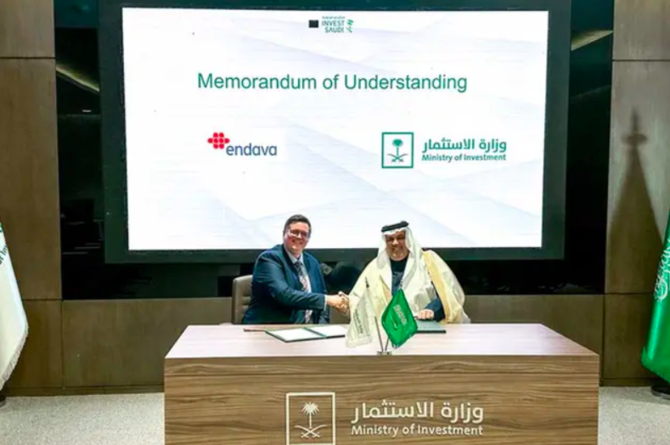
Saudi Ministry of Investment, tech firm Endava sign MoU to propel digitalization efforts 

The deal will help provide Saudi organizations a swift path to impactful digital transformation. Ministry of Investment
Short Url
Updated 26 March 2024
Follow

Saudi Ministry of Investment, tech firm Endava sign MoU to propel digitalization efforts 

RIYADH: Saudi businesses will be brought up to speed on global best practice in the digital sphere thanks to an agreement between the Kingdom and a London-based firm.

The Kingdom’s Ministry of Investment signed a memorandum of understanding with Envada to support the government’s economic vision by offering advisory, consultation, and implementation services, according to a statement.

The newly signed agreement will also help the private and public sectors adapt their digital offerings and processes, and will also help train technology professionals.

This move falls in line with the ministry’s ongoing effort to enable international firms to establish operations in the Kingdom, supporting a tech shift in line with Saudi Vision 2030.  

“We commend the ministry on the work it is doing to afford global-leading technology companies like Endava an unmissable opportunity to actively shape the digital future of Saudi Arabia at this critical inflection point in the Kingdom’s advancement,” Managing Director of MENA Endava David Boast said.  

“Our partnership with them is further validation of Endava’s unwavering commitment to Saudi Arabia and its people,” Boast added.

He went on to stress: “With our mission of making a profound and lasting positive impact on the societies and economies which we serve, such close collaboration with leading government entities is fundamental to our ambitions.”

Over the last two years, Endava has been making investments in an attempt to bolster its presence in Saudi Arabia as it engages with the Kingdom’s largest players across industries including banking, finance, energy, among others.


Saudi stock market opens its doors to foreign investors

Updated 06 January 2026
Follow

Saudi stock market opens its doors to foreign investors

RIYADH: Foreigners will be able to invest directly in Saudi Arabia’s stock market from Feb. 1, the Kingdom’s Capital Market Authority has announced.

The CMA’s board has approved a regulatory change which will mean the capital market, across all its segments, will be accessible to investors from around the world for direct participation.

According to a statement, the approved amendments aim to expand and diversify the base of those permitted to invest in the Main Market, thereby supporting investment inflows and enhancing market liquidity.

International investors' ownership in the capital market exceeded SR590 billion ($157.32 billion) by the end of the third quarter of 2025, while international investments in the main market reached approximately SR519 billion during the same period — an annual rise of 4 percent.

“The approved amendments eliminated the concept of the Qualified Foreign Investor in the Main Market, thereby allowing all categories of foreign investors to access the market without the need to meet qualification requirements,” said the CMA, adding: “It also eliminated the regulatory framework governing swap agreements, which were used as an option to enable non-resident foreign investors to obtain economic benefits only from listed securities, and the allowance of direct investment in shares listed on the Main Market.”

In July, the CMA approved measures to simplify the procedures for opening and operating investment accounts for certain categories of investors. These included natural foreign investors residing in one of the Gulf Cooperation Council countries, as well as those who had previously resided in the Kingdom or in any GCC country. 

This step represented an interim phase leading up to the decision announced today, with the aim of increasing confidence among participants in the Main Market and supporting the local economy.

Saudi Arabia, which ‌is more than halfway ‍through an economic plan ‍to reduce its dependence on oil, ‍has been trying to attract foreign investors, including by establishing exchange-traded funds with Asian partners in Japan and Hong Kong.