JERUSALEM: Prime Minister Benjamin Netanyahu on Tuesday vowed to press ahead with Israel’s offensive and blasted a UN Security Council resolution calling for a pause in the fighting, saying it had emboldened Hamas to reject a separate proposal for a ceasefire and hostage release.
As the war in Gaza grinds through a sixth month, each side has publicly insisted that its own idea of victory is in reach and rejected international efforts to stem the bloodshed.
Netanyahu has said Israel can achieve its aims of dismantling Hamas and returning scores of hostages if it expands its ground offensive to the southern city of Rafah, where over half of Gaza’s population has sought refuge, many in crowded tent camps.
Hamas has said it will hold onto the hostages until Israel agrees to a more permanent ceasefire, withdraws its forces from Gaza and releases hundreds of Palestinian prisoners, including top militants. It said late Monday that it has rejected a recent proposal that fell short of those demands — which, if fulfilled, would allow it to claim an extremely costly victory.
Netanyahu said in a statement that the announcement “proved clearly that Hamas is not interested in continuing negotiations toward a deal and served as unfortunate testimony to the damage of the Security Council decision.”
“Israel will not surrender to Hamas’ delusional demands and will continue to act to achieve all the goals of the war: releasing all the hostages, destroying Hamas’ military and governing capabilities and ensuring that Gaza will never again be a threat to Israel.”
The war has killed over 32,000 Palestinians, according to Gaza’s Health Ministry, which does not distinguish between civilians and combatants in its tally but says women and children make up about two-thirds of those killed. The fighting has left much of the Gaza Strip in ruins, displaced most its residents and driven a third of its population of 2.3 million to the brink of famine.
An Israeli strike late Monday on a residential building in Rafah where three displaced families were sheltering killed at least 16 people, including nine children and four women, according to hospital records and relatives of the deceased. An Associated Press reporter saw the bodies arrive at a hospital.
On Monday, the Security Council finally managed to pass a resolution calling for a ceasefire as the United States abstained instead of vetoing the measure, angering Israel in a major escalation of tensions between the two close allies. The resolution calls for the release of all hostages held in Gaza but did not condition the ceasefire on it.
Israeli Foreign Minister Israel Katz told Army Radio on Tuesday that the resolution had emboldened Hamas by signaling that international pressure would end the war without it having to make any concessions.
“The message delivered to Hamas yesterday … is that you don’t have to hurry,” Katz said.
The war began on Oct. 7, when Hamas-led militants stormed across the border and attacked communities in southern Israel, killing some 1,200 people, mostly civilians, and abducting around 250 others. It is still believed to be holding about 100 hostages and the remains of 30 others, after most of the rest were freed in November in exchange for the release of Palestinian prisoners.
The United States, Qatar and Egypt have spent several weeks trying to negotiate another ceasefire and hostage release, but those efforts appeared to have stalled. Hamas has informed the mediators it will stick to an earlier position, it said in its statement late Monday.
Hamas said Israel has not responded to its core demands of a “comprehensive ceasefire, an (Israeli) withdrawal from the Strip, the return of displaced people and a real prisoner exchange.”
Hamas has previously proposed a phased process in which it would release all the remaining hostages in exchange for a full Israeli withdrawal from Gaza, the opening of its borders for aid and reconstruction, and the release of hundreds of Palestinian prisoners, including top militants serving life sentences.
Netanyahu has vowed to resume Israel’s offensive after any hostage release and keep fighting until Hamas is destroyed, saying it’s the only way to prevent a repeat of the Oct. 7 attack. But he has provided few details about what would follow any such victory and has largely rejected a postwar vision outlined by the US
That approach has brought him into increasingly open conflict with President Joe Biden’s administration, which has expressed mounting concern over civilian casualties while supplying Israel with crucial military aid and backing Israel’s aim of destroying Hamas. The US had vetoed previous UN resolutions calling for a ceasefire.
The White House has urged Israel not to undertake a major ground operation in Rafah, warning that it could cause a humanitarian catastrophe. The administration was set to brief visiting Israeli officials on an alternative approach, but Netanyahu called off their visit in response to the US abstention at the UN
Israeli Defense Minister Yoav Gallant is in Washington on a separate trip, however, and is to meet with US Defense Secretary Lloyd Austin on Tuesday.
On Monday, Gallant vowed to continue the offensive until Israel’s aims are met.
“We will operate against Hamas everywhere — including in places where we have not yet been,” he said. “We have no moral right to stop the war while there are still hostages held in Gaza.”


Israel and Hamas dig in as international pressure builds for a ceasefire in Gaza

https://arab.news/cpucz
Israel and Hamas dig in as international pressure builds for a ceasefire in Gaza

- The resolution was the first since the Gaza war erupted to demand an immediate halt in the fighting


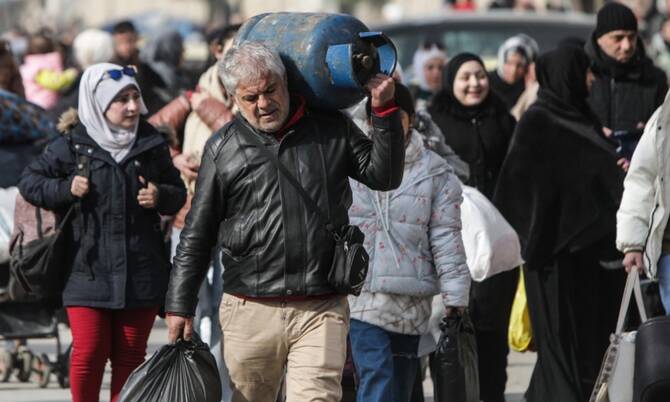
Syrian government vows to protect Kurds in Aleppo, accuses SDF of planting explosives
- Kurdish-led group targeting neighborhoods with mortars, machine guns, Ministry of Defense says
- Army declares Ashrafieh, Sheikh Maqsoud ‘closed military zone’ after hundreds of civilians evacuated
LONDON: The Syrian government on Wednesday affirmed its commitment to protect all citizens, including Kurds, as armed tensions in Aleppo between the Syrian army and the Kurdish-led Syrian Democratic Forces continued for a fourth day.
The Ministry of Defense accused the SDF of planting explosives on roads and setting booby traps in the Sheikh Maqsoud and Ashrafieh neighborhoods, and bombarding them with mortar shells and heavy machine gun fire.
The army designated the two neighborhoods a “closed military zone” after the Syrian Arab Red Crescent evacuated 850 civilians from the area.
The government said in a statement that the SDF played no role in the city’s security and military affairs.
“This confirms that the exclusive responsibility for maintaining security and protecting residents falls upon the Syrian state and its legitimate institutions, in accordance with the constitution and applicable laws,” it said.
Protecting all citizens, including Kurds, was a non-negotiable responsibility upheld without discrimination based on ethnicity or affiliation, it said.
It also rejected any portrayal of its security measures as targeting a specific community, according to the Syrian Arab News Agency.
“The authorities concerned stress that those displaced from areas of tension are exclusively civilians, all of them Kurdish citizens who left their neighborhoods out of fear of escalation,” the statement said.
“They sought refuge in areas under the control of the state and its official institutions, which clearly demonstrates the trust of Kurdish citizens in the Syrian state and its ability to provide them with protection and security and refutes claims alleging that they face threats or targeted actions.”
The government called for the withdrawal of armed groups from Aleppo.
At least three civilians and a Syrian soldier have been killed and dozens more injured in Aleppo since Tuesday. Authorities have accused the SDF of targeting medical and educational facilities.
The escalation in violence has dealt a blow to an agreement between the two sides that was meant to be implemented by the end of last year.
The Syrian government reached an agreement with the SDF in March that included plans to integrate the group’s military, territory and natural resources, including oil fields, into the new government in Damascus.