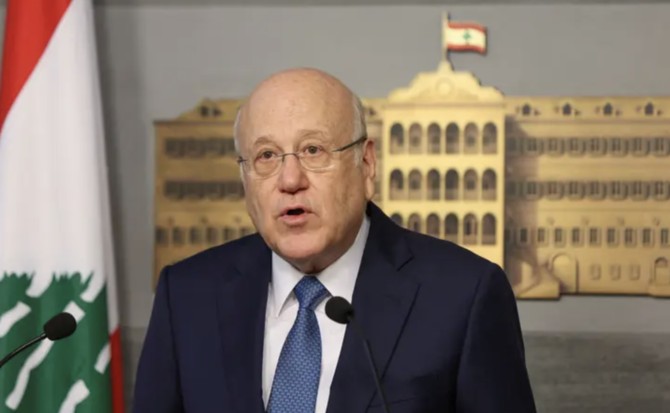
BEIRUT: Lebanon’s caretaker prime minister, Najib Mikati, said on Monday that countries should pressure Israel to stop attacking Lebanon following a UN Security Council decision calling for an immediate ceasefire in Gaza.
The Israeli military and Lebanese armed group Hezbollah have been trading fire across the southern Lebanese border in parallel with the Gaza war. Hezbollah did not immediately comment on the UN vote.
In a statement shared by his office, Mikati welcomed the move, saying it was “a first step on the path to stopping the Israeli aggression on the Gaza Strip.”
“When it comes to Lebanon, we renew our call to concerned countries to pressure the Israeli enemy to stop its continued aggression on southern Lebanon,” the statement said.
Israel’s Defense Minister Yoav Gallant said Israel could not stop its war on Hamas while there were still hostages in Gaza.
Mikati told Reuters in February that a ceasefire in Gaza would trigger indirect talks between Lebanon and Israel to reach a halt to hostilities on the southern border and to delineate the disputed border between the two countries.
Hezbollah has also said it would halt its fire into Israel if a Gaza ceasefire was reached. Israeli and US officials, however, have said a ceasefire in Gaza would not automatically extend to Lebanon


![]()

Lebanon PM calls for pressure on Israel to stop attacking south after UN vote
Short Url
https://arab.news/gegvc
Lebanon PM calls for pressure on Israel to stop attacking south after UN vote
- Mikati told Reuters in February that a ceasefire in Gaza would trigger indirect talks between Lebanon and Israel

Latest updates


© 2026 SAUDI RESEARCH & PUBLISHING COMPANY, All Rights Reserved And subject to Terms of Use Agreement.