

11 Rohingya found dead after Indonesia boat capsize: officials

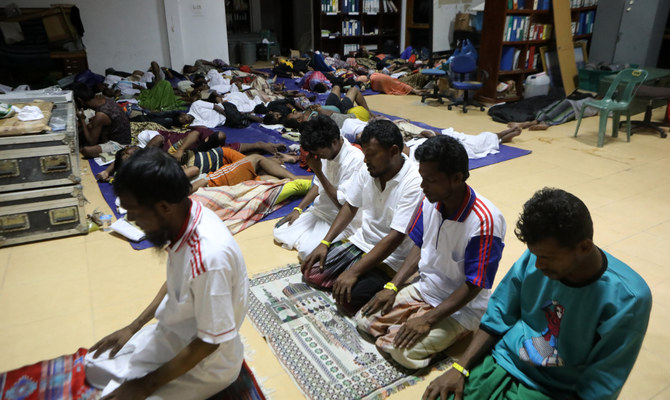
Rohingya refugees hold a morning prayer in a temporary shelter at the Indonesian Red Cross Office, after being evacuated from the sea at Meulaboh, West Aceh, Indonesia. (AP)
Short Url
Updated 25 March 2024
Follow

11 Rohingya found dead after Indonesia boat capsize: officials

  • The head of the local search and rescue operation, Muhammad Fathur Rachman said nearly half-a-dozen Rohingya were found dead at sea 14 nautical miles from shore

MEULABOH: The bodies of at least 11 Rohingya refugees have been recovered off Indonesia’s westernmost coast after their boat believed to be carrying around 150 people capsized last week, officials said Monday.

The mostly Muslim ethnic Rohingya are heavily persecuted in Myanmar, and thousands risk their lives each year on long and expensive sea journeys, often in flimsy boats, to try to reach Malaysia or Indonesia.

Indonesian rescuers called off the search for any remaining Rohingya refugees on Friday after 75 were rescued, despite reports from some survivors that dozens of people were swept away when their boat and another trying to help them capsized days earlier.

The head of the local search and rescue operation, Muhammad Fathur Rachman said nearly half-a-dozen Rohingya were found dead at sea 14 nautical miles from shore.

“Six more bodies are being evacuated right now,” he said by phone on Monday afternoon.

“They were all women. We heard about the bodies from a fisherman. The bodies will be taken to the hospital.”

Earlier on Monday, United Nations High Commissioner for Refugees officials told AFP five bodies had been recovered in recent days. On Thursday, authorities staged a dramatic rescue of 69 Rohingya who had been adrift at sea for weeks before the boat capsized, with many found clinging to the hull of the overturned vessel. Six others were rescued by fishermen on Wednesday.

From mid-November to late January, 1,752 Rohingya refugees, mostly women and children, landed in the Indonesian provinces of Aceh and North Sumatra, according to the UNHCR.

The UN agency said it was the biggest influx into the Muslim-majority country since 2015, driven by worsening conditions in squalid camps in Bangladesh and the continuing threat of violence in the Rohingya’s native Myanmar.


Nigerian president vows security reset in budget speech

Updated 6 sec ago
Follow

Nigerian president vows security reset in budget speech

  • Government plans to buy 'cutting-edge' equipment to boost the fighting capability of military


ABUJA: Nigeria’s president vowed a national security overhaul as he presented the government budget, allocating the largest share of spending to defense after criticism over the handling of the country’s myriad conflicts.
Nigeria faces a long-running insurgency in the northeast, while armed “bandit” gangs commit mass kidnappings and loot villages in the northwest, and farmers and herders clash in the center over dwindling land and resources.
President Bola Tinubu last month declared a nationwide security emergency and ordered mass recruitment of police and military personnel to combat mass abductions, which have included the kidnapping of hundreds of children at their boarding school.
He told the Senate that his government plans to increase security spending to boost the “fighting capability” of the military and other security agencies by hiring more personnel and buying “cutting-edge” equipment.
Tinubu promised to “usher in a new era of criminal justice” that would treat all violence by armed groups or individuals as terrorism, as he allocated 5.41 trillion naira ($3.7 billion) for defense and security.
Security officials and analysts say there is an increasing alliance between bandits and extremists from Nigeria’s northeast, who have in recent years established a strong presence in the northwestern and central regions.
“Under this new architecture, any armed group or gun-wielding non-state actors operating outside state authority will be regarded as terrorists,” said Tinubu, singling out, among others, bandits, militias, armed gangs, armed robbers, violent cult groups, and foreign-linked mercenaries.
He said those involved in political or sectarian violence would also be classified as terrorists.
On the economic front, Tinubu hailed his “necessary” but not “painless” reforms that have plunged Nigeria into its worst economic crisis in a generation.
He said inflation has “moderated” for eight successive months, declining to 14.45 percent in the last month from 24.23 percent in March this year.
He projected that the budget deficit will drop next year to 4.28 percent of GDP from around 6.1 percent of GDP in 2023, the year he came into office.