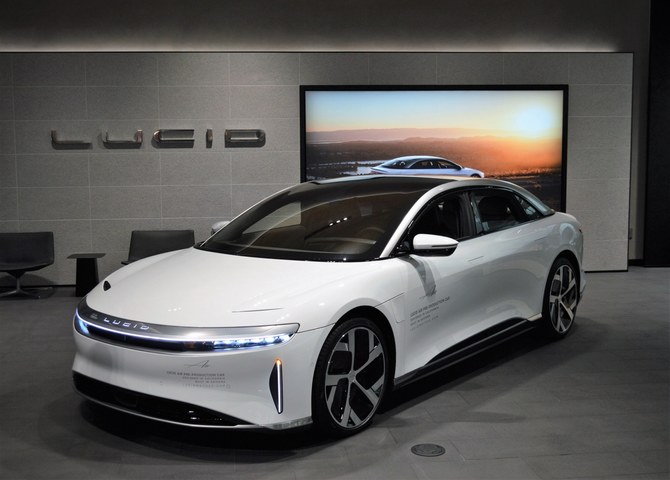
Lucid to receive $1bn from PIF affiliate via new stock

The Saudi government has a 60 percent stake in Lucid. Shutterstock
Short Url
Updated 25 March 2024
Follow

Lucid to receive $1bn from PIF affiliate via new stock

RIYADH: Electric carmaker Lucid announced an additional $1 billion investment from Saudi Arabia’s Public Investment Fund in a move which saw its shares rise 18 percent.

The money is coming via the company’s majority stockholder, Ayar Third Investment Co., an affiliate of the Kingdom’s sovereign wealth body.

It will reach California-based Lucid through a newly created series of convertible preferred stock,  which can be converted into about 280 million shares, according to a filing with the US securities regulator.

The Saudi government has a 60 percent stake in the company, and has invested billions as part of a strategy to diversify the Kingdom’s economy beyond oil.

“We are extremely pleased to receive this strong, continued support from the PIF, as we work to solidify our place as the world's leading EV technology company,” said Peter Rawlinson, CEO and chief technology officer of Lucid Group. 

He added: “We continue to invest for the long term in both our technology and our vertically integrated manufacturing capabilities, with PIF’s support a key differentiator. With their support, we remain focused upon accelerating our growth via deliveries, executing key business initiatives with relentless focus upon cost, and launching our game-changing Gravity SUV later this year.”

The investment announcement comes as the global electric vehicle market grapples with a slowdown in demand growth and a price war sparked by Tesla.

Lucid expects to make 9,000 units in 2024, compared with the 8,428 vehicles it made last year.

Lucid’s Air luxury sedans compete with Tesla’s Model S and EVs from Mercedes-Benz, BMW, Audi and Porsche, among other brands.

Lucid used its fourth-quarter 2023 financial presentation in February to reassure investors it had sufficient liquidity “at least until 2025” and forecast $1.5 billion in capital spending in 2024 as it pushes to launch its Gravity SUV line later this year.

The company had $4.8 billion in available funds at the end of 2023, including $4.3 billion in cash.

In September, Lucid opened its first plant outside the US in Saudi Arabia with an initial capacity to produce 5,000 EVs a year.

This came as Kingdom’s government pledged to buy up to 100,000 vehicles from it over 10 years.

“The car is fully built in Arizona ... then it gets de-assembled ... then the car gets shipped here as a kit, and that kit is then put back together,” Faisal Sultan, who is also Lucid’s global vice-president, told Reuters in December.

Workers in the factory in Jeddah re-attach the battery, put the trim and tires back on and re-test the vehicle, he added.

Lucid is not the only EV player in the Saudi market, as in November 2022 Crown Prince Mohammed bin Salman announced the launch of CEER, a government-owned enterprise that will design, manufacture and sell battery-powered vehicles in Saudi Arabia.

- with additional reporting from Reuters.


Arab food and beverage sector draws $22bn in foreign investment over 2 decades: Dhaman 

Updated 28 December 2025
Follow

Arab food and beverage sector draws $22bn in foreign investment over 2 decades: Dhaman 

JEDDAH: Foreign investors committed about $22 billion to the Arab region’s food and beverage sector over the past two decades, backing 516 projects that generated roughly 93,000 jobs, according to a new sectoral report. 

In its third food and beverage industry study for 2025, the Arab Investment and Export Credit Guarantee Corp., known as Dhaman, said the bulk of investment flowed to a handful of markets. Egypt, Saudi Arabia, the UAE, Morocco and Qatar attracted 421 projects — about 82 percent of the total — with capital expenditure exceeding $17 billion, or nearly four-fifths of overall investment. 

Projects in those five countries accounted for around 71,000 jobs, representing 76 percent of total employment created by foreign direct investment in the sector over the 2003–2024 period, the report said, according to figures carried by the Kuwait News Agency. 

“The US has been the region's top food and beverage investor over the past 22 years with 74 projects or 14 projects of the total, and Capex of approximately $4 billion or 18 percent of the total, creating more than 14,000 jobs,” KUNA reported. 

Investment was also concentrated among a small group of multinational players. The sector’s top 10 foreign investors accounted for roughly 15 percent of projects, 32 percent of capital expenditure and 29 percent of newly created jobs.  

Swiss food group Nestlé led in project count with 14 initiatives, while Ukrainian agribusiness firm NIBULON topped capital spending and job creation, investing $2 billion and generating around 6,000 jobs. 

At the inter-Arab investment level, the report noted that 12 Arab countries invested in 108 projects, accounting for about 21 percent of total FDI projects in the sector over the past 22 years. These initiatives, carried out by 65 companies, involved $6.5 billion in capital expenditure, representing 30 percent of total FDI, and generated nearly 28,000 jobs. 

The UAE led inter-Arab investments, accounting for 45 percent of total projects and 58 percent of total capital expenditure, the report added, according to KUNA. 

The report also noted that the UAE, Saudi Arabia, Egypt, and Qatar topped the Arab ranking as the most attractive countries for investment in the sector in 2024, followed by Oman, Bahrain, Algeria, Morocco, and Kuwait. 

Looking ahead, Dhaman expects consumer demand to continue rising. Food and non-alcoholic beverage sales across 16 Arab countries are projected to increase 8.6 percent to more than $430 billion by the end of 2025, equivalent to 4.2 percent of global sales, before exceeding $560 billion by 2029. 

Sales are expected to remain highly concentrated geographically, with Egypt, Saudi Arabia, Algeria, the UAE and Iraq accounting for about 77 percent of the regional total. By product category, meat and poultry are forecast to lead with sales of about $106 billion, followed by cereals, pasta and baked goods at roughly $63 billion. 

Average annual per capita spending on food and non-alcoholic beverages in the region is projected to rise 7.2 percent to more than $1,845 by the end of 2025, approaching the global average, and to reach about $2,255 by 2029. Household spending on these products is expected to represent 25.8 percent of total expenditure in 13 Arab countries, above the global average of 24.2 percent. 

Arab external trade in food and beverages grew more than 15 percent in 2024 to $195 billion, with exports rising 18 percent to $56 billion and imports increasing 14 percent to $139 billion. Brazil was the largest foreign supplier to the region, exporting $16.5 billion worth of products, while Saudi Arabia ranked as the top Arab exporter at $6.6 billion.