

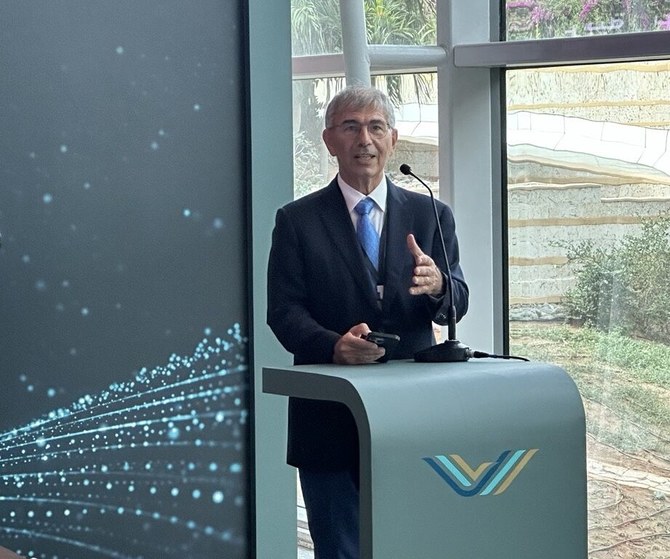

DUBAI: Leveling off in July 2023 and returning to normal on a global scale after a spike in consumption following the COVID-19 pandemic, the luxury market is currently witnessing “challenges requiring more collaborations among retailers, brands, developers, and between the private and public sector,” said Patrick Chalhoub, Chalhoub Group president, in an interview with Arab News en Franҫais.
“We recovered quickly post COVID-19 and in 2021, luxury grew at a rate of 10-15 percent compared to 2019,” he added.
In 2022, the market grew by 20 percent, while in 2023, it recorded a 15 percent growth rate during the beginning of the year, before slowing down to a more normal growth rate of 7-10 percent during the fourth quarter for an overall growth of 11 percent.
Going forward, the trend is expected to be in line with rates seen at the end of 2023, with 6-8 percent in fashion and 10-12 percent in beauty, driven by an increased interest in skin care.
The Middle East, said Chalhoub, has “one of the highest growth rates in the world” for a market that only represents 3-4 percent of the worldwide market, growing at 4-5 percent.
There is a continued appetite for luxury and a renewed interest in the jewelry and watch segment, distinct from “revenge buying,” characteristic of the 2021 and 2022 consumption patterns.
“We feel more price sensitivity and a lesser gap in prices, which existed due to currency fluctuations. Today, customers are staying aware of pricing and are much more knowledgeable,” he added.
The share of wallet in luxury consumption diminished over the past years, with spending shifting toward travel, entertainment, and hospitality, particularly in Saudi Arabia.
The conflict in Gaza further triggered a slowdown in luxury spending due to an increased focus on humanitarian affairs since October 2023 and a slower events calendar compared to the same period last year.
Despite the current market environment, an appreciation for luxury for its own value — rather than luxury as a purchasing power tool — is emerging and is being felt further during the Ramadan season, driven by sustainable consumption and well-being.
“Consumers ask about the purpose of the brand and its sustainability in an active attempt to buy with purpose,” Chalhoub said.
“It makes our business more challenging but more sustainable in the long run. Less festive, more personal shopping, reassured by the brand but not to show off,” he added.
While e-commerce is still developing at a fast rate owing to its convenience, brick-and-mortar shops, which offer personal connection and engagement with customers, are making a comeback with retailers delivering quality service and unique experiences.
This is the objective of “The Visitor,” a new travel retail concept launched by the Chalhoub Group at King Abdulaziz International Airport in Jeddah in November 2023.
“The potential in Saudi Arabia is tremendous and evolving, not only in the Jeddah airport, which presents a huge opportunity owing to the traffic and customer loyalty,” Chalhoub said.

“The Visitor,” a new travel retail concept launched by the Chalhoub Group at King Abdulaziz International Airport in Jeddah in November 2023. (Supplied)
The project, in collaboration with the Jeddah Airport Authority, offers a world-class customer experience and leverages the Chalhoub Group’s knowledge of the market, consumer proximity, and experience in operating regional duty frees, supplying travel retail, and upskilling resources to meet the demand’s requirements and the disruption brought by new technologies, like artificial intelligence.
“I am satisfied with the initial results, in terms of layout, understanding the customer, product mix and offering … The finished product will be seen by early 2025,” he added.
The Middle East is home to a large young customer base “with an ability to spend on luxury, digitally connected, eager to learn and assert itself,” Chalhoub said.
The customer experience starts with the attractiveness not only of the shopping mall and the high street but also of the digital aspects. The objective is to inspire and engage customers digitally, which requires stronger collaborations, “key to deliver the kind of experience and journey which our customers are trying to get especially in the Kingdom,” Chalhoub said.
Maintaining price competitiveness, fighting against counterfeits, and mitigating the impact of supply chain disruptions are also key.
With new malls opening in the region — Marasi in Bahrain (February 2024) and Solitaire in Riyadh (expected in 2024) and Abu Dhabi (2025) — “there is a number of projects coming to the market, offering a better customer journey, and better collaboration between the various stakeholders,” Chalhoub said.
The group has taken initiatives to create incubators and accelerators for startups, encouraging research and innovation and an entrepreneurial mindset among its teams.
“The world is changing; the consumer is more empowered … We need to be forward-looking while remembering our values as a group centered around teamwork, inclusivity, and innovation,” he added.

“Parfum d'Orient,” an exhibition tracing the story of Oriental perfumes and depicting the dialogue between heritage and contemporary works. (Paris - Supplied)
The Chalhoub Group celebrates its 70th anniversary this year, and as it witnesses changes in the region and embraces both opportunities and challenges, it continues to shape the luxury landscape by bringing international names to the region and exporting its local expertise.
“Parfum d’Orient,” an Institut du Monde Arabe exhibition in partnership with the Chalhoub Group, several French partners, Christofle and Ghawali, portrays the Arabic origin of fragrances, inspired by the souqs of Jeddah.
“A transformative exhibition, tracing the origin of some of the scents from Arabia, (such as) oud, saffron, and roses from Damascus. Beyond the olfactory (aspect), there’s a sense of pride in identifying with the sources of these products,” said Chalhoub.
The six-month exhibition, which ended in Paris on March 17, will be moving to Riyadh in October 2024 for a second phase in collaboration with the Saudi Ministry of Culture.




