

Pakistan, Saudi Fund for Development in talks on energy, health, education, infrastructure projects — official 

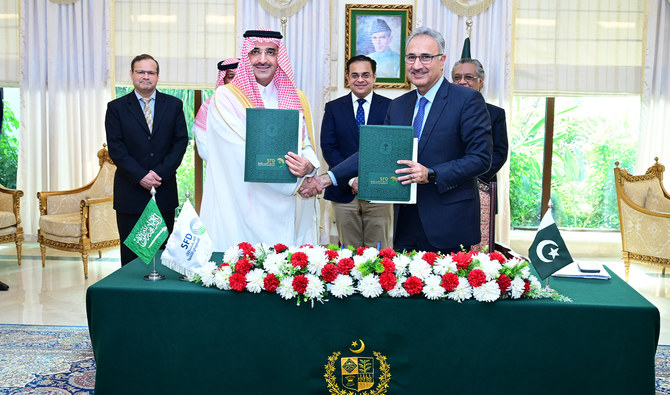
Pakistan’s Economic Affairs Division Secretary, Dr. Kazim Niaz (right), shakes hands with the CEO of Saudi Fund for Development, Sultan Bin Abdul Rehman Al-Marshad, after signing a loan agreement in Islamabad, Pakistan on March 22, 2024. (Government of Pakistan)
Short Url
Updated 25 March 2024
Follow

Pakistan, Saudi Fund for Development in talks on energy, health, education, infrastructure projects — official 

  • Pakistan and SFD last week signed loan agreements worth $107 million to finance two hydropower projects
  • Pakistan team to meet SFD officials in Riyadh on sidelines of Islamic Development Bank annual meetings in April 

ISLAMABAD: Pakistan and the Saudi Fund for Development (SFD) are in discussions to collaborate on a number of projects, including in the fields of energy, health, education and infrastructure, a top Pakistan official said on Sunday.

Pakistan’s Economic Affairs Division (EAD) Secretary Dr. Kazim Niaz and SFD Chief Executive Officer (CEO) Sultan Bin Abdul Rehman Al-Marshad signed two loan agreements worth $107 million last week to finance hydropower projects in Azad Kashmir, supporting Pakistan’s efforts toward energy sustainability and economic growth.

The SFD, a Saudi government agency, provides development assistance and financial aid to developing countries through loans and grants. In the past, the Fund has deposited money in Pakistan’s central bank to bolster foreign exchange reserves and funded various development projects in infrastructure, education, and health care.

“We already had a framework agreement with SFD. As the Saudi delegation concluded its visit [on Sunday], we have discussed a pipeline of numerous projects for future cooperation, in which they have shown keen interest,” Dr. Kazim Niaz, Pakistan’s Economic Affairs Division Secretary, told Arab News.

“These projects are in the energy, health, education and infrastructure sectors.”

Niaz did not provide more details on the projects, which he said would be shared after Saudi feedback on a list of initiatives shared by Islamabad for investment and cooperation. 

“They [Saudis] have taken these projects with them for examination and analysis,” the bureaucrat added. “Once their analysis is complete, both sides will proceed with signing.”

A Pakistani delegation will next be meeting SFD officials in Riyadh on the sidelines of the annual meetings of the Islamic Development Bank from April 27-30. 

On the loan agreements signed with SFD during its Mar. 22-24 visit to Pakistan, Niaz said they would be used to fund two hydropower projects in Azad Jammu and Kashmir (AJK).

“SFD will finance $66 million for 48MW Shounter Hydropower Project and $41 million for 22MW Jagran-IV Hydropower Project in Neelam Valley District,” he said, adding that the projects would generate 70 MW of electricity, which would be transmitted to the national grid.

SFD has been one of Pakistan’s leading development partners since its establishment in 1974. 

“They are providing assistance in energy, health, education, and infrastructure projects and have really played a significant part with their support for the floods in 2022,” Niaz said. 

“From our engagements and discussions,” the top official said, “I can say that the future of this cooperation and collaboration is very bright and encouraging.”


Islamabad says over 580 Afghan Taliban militants killed as Pakistan, Afghanistan fighting continues

Updated 8 sec ago
Follow

Islamabad says over 580 Afghan Taliban militants killed as Pakistan, Afghanistan fighting continues

  • Clashes between the two countries began on Feb. 26 when Afghan forces launched an attack on Pakistani military installations
  • Islamabad has since been pounding parts of Afghanistan where it says militant targets are present, Kabul denies the allegation

ISLAMABAD: Pakistan has killed 583 Afghan Taliban fighters, wounded more than 795 and struck 64 locations inside Afghanistan in air attacks, Information Minister Attaullah Tarar said on Sunday, as fighting between the two neighbors entered the second week.

Clashes between the two countries began on Feb. 26 when Afghan forces launched a surprise attack on Pakistani military installations along their shared border.

Afghanistan said the assault was in retaliation for Pakistan’s earlier airstrikes in February on what Islamabad described as militant camps inside Afghanistan.

“Summary of Afghan Taliban losses: 583 Killed, 795+ Injured, 242 Check posts destroyed, 38 Posts captured & destroyed, 213 tanks, armored vehicles, artillery guns destroyed,” Tarar said on X.

The statement came hours after Pakistan’s security forces successfully foiled an infiltration attempt by militants belonging to the Tehreek-e-Taliban Pakistan (TTP), also known as the Pakistani Taliban, along the Pakistan–Afghanistan border in the

Chaman sector, according to a security official. The group, estimated to comprise three to four militant formations, attempted to breach the border fence under the cover of darkness.

“Troops detected the movement in time and engaged the militants as they attempted to cut through the border fence,” said the security official, seeking anonymity. “During the exchange of fire, one foreign terrorist was killed while the remaining militants fled the area.”

Pakistan accuses Kabul of sheltering militant groups such as the TTP on its soil and facilitating attacks against Pakistan. Afghanistan denies the allegations and has urged Islamabad to address its security challenges without blaming Kabul.

Afghanistan has called for dialogue to resolve the conflict. Pakistan, however, has rejected talks with Kabul, saying its operation “Ghazab Lil Haq” — meaning Wrath for Truth — will continue until its objectives are achieved.

Since the conflict began, diplomatic efforts have intensified, with several countries and international bodies, including the European Union and the United Nations, urging restraint and calling for talks.