

Quetta’s largest, five-domed mosque sees influx of worshippers during Ramadan

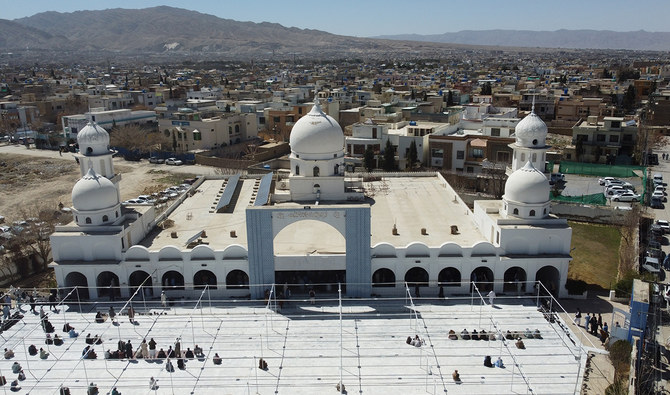
The photo taken on March 23, 2024, shows an ariel view of the grand Jamia Masjid located in Jinnah Town of Pakistan’s southwestern Quetta city. (AN Photo)
Short Url
Updated 25 March 2024
Follow

Quetta’s largest, five-domed mosque sees influx of worshippers during Ramadan

  • Built over 60,000 square feet of land, Jamia Masjid in southwestern Pakistan’s Quetta is the city’s largest mosque
  • During holy month of Ramadan, thousands of worshippers frequent the mosque to pray, seek closeness to God 

QUETTA: On a regular afternoon, the pristine white dome glistens as it basks in the rays of the sunlight. Behind it stand four smaller domes, constructed above towering minarets. Hundreds of worshippers amble into the sprawling place, eager to offer their prayers during the holy month of Ramadan in Quetta’s largest mosque. 

Located in Jinnah Town of Pakistan’s southwestern Quetta city, Jamia Masjid is built on a massive 60,000 square feet of land. The mosque sees an influx of worshippers during the holy month of Ramadan in which Muslims fast from dawn till dusk, engaging in increased religious observances. 

“Thousands of people from all across the city, even Kuchlak, (an area on Quetta’s outskirts) come here to pray and remember Allah Almighty,” Syed Bahadur, a resident of Killi Barat neighborhood in Quetta who came to offer the weekly Friday prayers, told Arab News.

“But in Ramadan, the mosque remains full of devotees.”

Jamia Masjid’s construction began in 2006 with contributions from residents of the upscale Jinnah Town area in 2006 and was completed in 2008. The five-domed mosque attracts people from all over the city who not only offer prayers at its expansive halls and courtyard but also marvel at its imposing structure. 

A giant, glistening chandelier hanging from the huge domed ceiling greets worshippers as soon as they enter Jamia Masjid’s massive prayer hall. A colorful glass artwork depicting the Grand Mosque in Makkah and Al-Masjid Al-Nabawi, the Prophet’s Mosque in Medinah, draws the attention of the worshippers to it. The prayer hall alone can accommodate 1,500 people. 

Bahadur said the mosque sees even more worshippers during the last 10 days of Ramadan when many Muslims take part in the itikaf worship. The practice involves secluding oneself in a mosque during the last ten days of the holy month to dedicate that time to worship, prayer, reflection, and seeking closeness to God.

Hassan Sheikh, one of the members of the mosque’s organizing committee, told Arab News the inspiration for the mosque’s design was sought from “impressive” mosques around the world. 

“We did seek inspiration from some impressive mosques from around the world, including some from the Gulf countries,” Sheikh said. 

Quetta’s largest mosque was not completed in a day. Bahadur recalled a time when Jamia Mosque was just a small place of worship made from mud. 

“Now, the mosque can accommodate more than 4,500 devotees for regular prayers,” Sheikh said proudly. 


Traders say Karachi plaza fire caused $54 million losses as search for bodies continues

Updated 6 sec ago
Follow

Traders say Karachi plaza fire caused $54 million losses as search for bodies continues

  • Authorities say at least 67 people died in January 17 blaze at Gul Plaza complex
  • Recovery teams search unstable debris, Sindh government announces compensation

ISLAMABAD/KARACHI: A deadly fire at a major shopping plaza in Pakistan’s largest city of Karachi has caused estimated losses of up to Rs15 billion ($53.6 million), a traders representative said this week, as authorities continue rescue and recovery operations and struggle to identify dozens of victims killed in the blaze.

The fire broke out on Jan. 17 at Gul Plaza, a densely packed commercial building in the heart of Karachi and home to over 1,200 shops, trapping workers and shoppers inside and burning for more than 24 hours before being brought under control. At least 67 people have been confirmed dead, officials say, while recovery teams remain at the site amid fears of further structural collapse.

Tanveer Pasta, president of the Gul Plaza Market Association, said all shops in the plaza were destroyed, estimating total losses at up to Rs15 billion ($53.6 million).

“There were big importers sitting here,” he told Arab News on Thursday. “Just three days before this fire, 31 [shipping] containers were unloaded.”

Earlier this week, the Sindh government had announced compensation of Rs10 million ($35,720) for each person killed in the fire and said affected shopkeepers would also receive financial assistance.

Karachi Mayor Murtaza Wahab said the city administration remained focused on rescue operations and on handing over victims’ remains to their families as quickly as possible. His remarks came after he visited the homes of several victims, according to a statement from his office.

“Rescue personnel of the Karachi Metropolitan Corporation are still engaged in the rescue operation, while the administration is making every effort to hand over [remains] of the victims, loved ones to their families at the earliest,” Wahab was quoted as saying.

Identification has been significantly slowed by the condition of the bodies recovered from the site, Karachi Police Surgeon Dr. Summaiya Syed said.

Most remains were found in fragments, she said, complicating forensic identification and prolonging the process for families waiting for confirmation.

Relatives of more than a dozen missing persons have remained near the destroyed plaza and at hospitals even after providing DNA samples. Some families have criticized what they describe as the slow pace of recovery and identification.

Wahab said the provincial government had committed to supporting affected families and rehabilitating victims.

“The Sindh government would also not sit back until the victims are fully rehabilitated and that all possible support would be provided [to them],” he said.

Authorities have not yet confirmed the cause of the fire. Police have said preliminary indications point to a possible electrical short circuit, though officials stress conclusions will only be drawn after investigations are completed.

Deadly fires are a recurring problem in Karachi, a city of more than 20 million people, where overcrowded markets, aging infrastructure, illegal construction and weak enforcement of safety regulations frequently contribute to disasters. Officials say a blaze of this scale is rare.