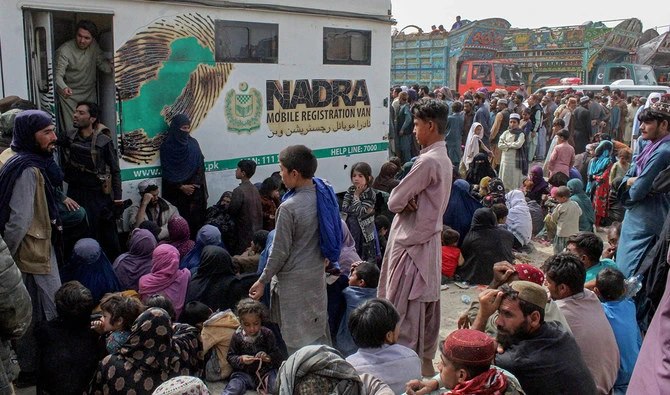
- Pakistan issued these cards to Afghan nationals in 2017 as part of their registration to stay in the country
- In the first phase of the expulsion drive starting last November, Pakistan mainly targeted unregistered Afghans
ISLAMABAD: The Pakistani government has started mapping Afghan nationals across the country to expel them after the Eid Al-Fitr festival next month, a government official confirmed on Saturday, adding the campaign would mainly target those who hold Pakistan-issued Afghan citizen cards.
Pakistan has already expelled around half a million undocumented Afghan refugees since last November despite criticism from the United Nations and international rights organizations that objected to its deportation drive against refugees.
The decision was made amid a surge in deadly suicide bombings that were claimed by banned militant outfits like the Tehreek-e-Taliban Pakistan whose leaders were said to have taken a sanctuary in neighboring Afghanistan. The caretaker administration of Pakistan also accused Afghan nationals residing in the country of perpetrating violent acts against its citizens and security forces.
Speaking to Arab News, a senior government functionary confirmed the second phase of the expulsion operation would begin next month in which the government would ask refugees holding citizen cards to leave Pakistan.
“All the four provinces along with the federal government have been working on a strategy to expel those holding the Afghan citizen cards from next month,” Fazale Rabi, director repatriation at the Commissionerate for Afghan Refugees, told Arab News.
He said the Pakistani government issued the Afghan Citizen Cards to the refugees in 2017-18 to register them as legal migrants, “but this was only one time registration to have the data of the refugees in the country.”
Rabi said the government issued the cards to around 690,000 Afghans during the registration drive, adding the ongoing mapping would reveal how many of them were still residing in the country.
Pakistan is home to more than 4 million Afghan migrants and refugees, about 1.7 million of them undocumented, according to the interior ministry. These people poured into the country in millions to escape wars, factional fighting and economic crises following the Soviet invasion in 1979.
In the first phase of the expulsion that began last year, the government promised not to act against or deport Afghan nationals with citizen cards or proof of registration (PoR) documents, saying they had the legal status to be in the country.
The PoR is an identity card for Afghan refugees that entitles them to remain in Pakistan legally and is issued by the country’s National Database and Registration Authority (NADRA). PoRs are issued to Afghan refugees after they get themselves registered with the United Nations High Commissioner for Refugees (UNHCR).
Rabi said that around 1.4 million Afghan refugees in Pakistan were in possession of PoR cards and had been living in refugee camps setup mainly in Khyber Pakhtunkhwa and Balochistan provinces.
“Peace and stability are returning to Afghanistan after decades of wars, so these Afghan citizens should go back to take part in rebuilding and reconstruction of their country,” Rabi said.
Islamabad has often accused the Afghan nationals of carrying out militant violence, smuggling and other crimes in its territory, though the Taliban administration in Kabul has dismissed such claims while rights groups have asked Pakistan to reconsider its position over refugee expulsion.
Pakistan’s interior ministry confirmed the planned operation, saying it was the continuation of the same operation against undocumented and illegal immigrants that would intensify from next month after the authorities temporarily shifted their focus to the February 8 general elections.
“This is an ongoing campaign against the illegal immigrants including Afghans that would be stepped up after the Eid,” Muhammad Rafiullah, a spokesperson for the interior ministry, told Arab News.
“The interior ministry is in touch with the provincial home departments to chalk out a repatriation plan for illegal foreigners,” he noted.