

UN secretary-general ‘deeply troubled’ by situation in Rafah

1 / 3
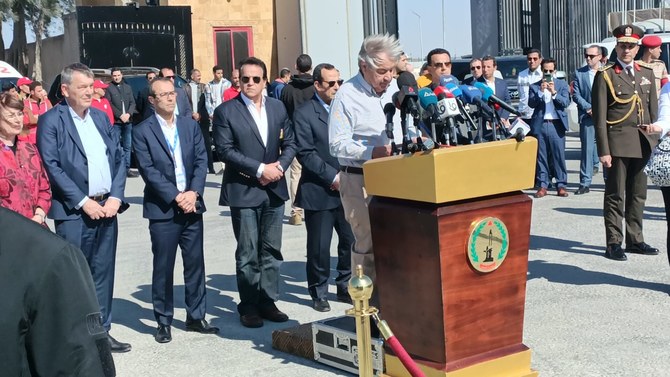
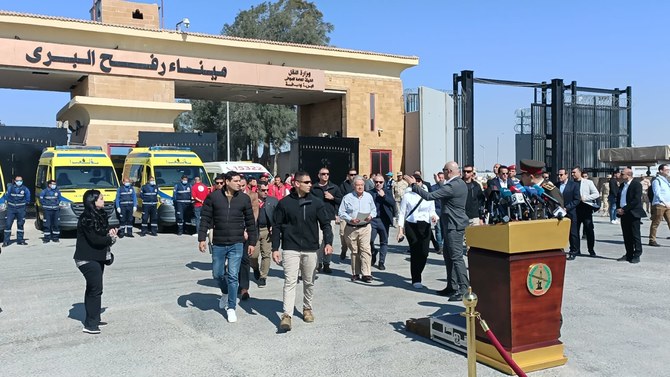
United Nations Secretary-General Antonio Guterres in Rafah, amid the ongoing conflict between Israel and Hamas, in Egypt March 23, 2024. (AN Photo/Nadia Al Faour)
2 / 3
United Nations Secretary-General Antonio Guterres in Rafah, amid the ongoing conflict between Israel and Hamas, in Egypt March 23, 2024. (AN Photo/Nadia Al Faour)
3 / 3
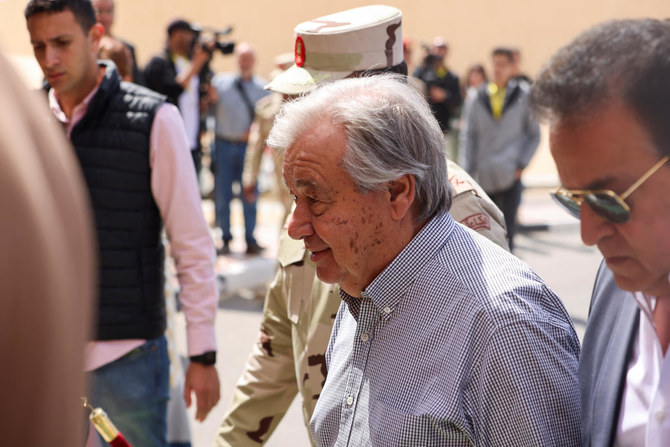
United Nations Secretary-General Antonio Guterres walks at Al Arish airport, amid the ongoing conflict between Israel and the Palestinian Islamist group Hamas, in Egypt March 23, 2024. (Reuters)
Short Url
Updated 23 March 2024
Follow

UN secretary-general ‘deeply troubled’ by situation in Rafah

  • Speaking at the border, he urged the world to remind Gazans they are not alone
  • Guterres also called for funding and support of UNRWA

RAFAH: UN Secretary-General Antonio Guterres visited Egypt’s border with the Gazan city of Rafah on Saturday to reiterate pleas for an immediate ceasefire in the Gaza Strip. 

His visit comes after the UN Security Council’s failure to pass a resolution to halt the Israeli offensive on Gaza, which is now entering its sixth month with a death toll nearing 32,000. 

Speaking at the border, he urged the world to remind Gazans they are not alone.

“I am deeply troubled to know during this holy month of Ramadan that there are those who will not be able to have a proper iftar,” Guterres said. 

He added that it is “a moral outrage” that there are thousands of aid trucks parked on the Egyptian side of the border awaiting access, while people in Gaza are facing starvation. 

“While nothing justifies the actions of October 7, nothing justifies the collective punishment of the Palestinian people,” Guterres said. “There are hardships, houses demolished, entire families and generations wiped out, while hunger stalks the population.” 

He urged people to “stand on the right side of history,” adding, “It is time to silence the guns. We need a ceasefire. I will not give up. We should not give up, for the sake of humanity.” 

Guterres also called for funding and support of the UN Relief and Works Agency for Palestine Refugees in the Near East. 

Prior to his press conference at the crossing, the secretary-general was received by Sinai governor Mohamad Shusha at El-Arish airport. 

Shusha said that some 7,000 trucks are currently waiting in North Sinai to deliver aid to Gaza, but that inspection procedures demanded by Israel have held up the flow of aid.

Guterres also visited Palestinian evacuees from Gaza receiving treatment at Arish General Hospital in Sinai and said he was “moved” by their spirit.


Israel’s Netanyahu hopes to ‘taper’ Israel off US military aid in next decade

Updated 57 min 55 sec ago
Follow

Israel’s Netanyahu hopes to ‘taper’ Israel off US military aid in next decade

  • Netanyahu has said Israel should not be reliant on foreign military aid but has stopped short of declaring a firm timeline for when Israel ‌would be ‌fully independent from ‌the ⁠US

JERUSALEM: Israeli Prime Minister Benjamin Netanyahu said in an interview published on Friday that he hopes to “taper ​off” Israeli dependence on American military aid in the next decade.
Netanyahu has said Israel should not be reliant on foreign military aid but has stopped short of declaring a firm timeline for when Israel ‌would be ‌fully independent from ‌the ⁠US
“I ​want ‌to taper off the military within the next 10 years,” Netanyahu told the Economist. Asked if that meant a tapering “down to zero,” he said, “Yes.”
Netanyahu said he told President Donald Trump ⁠during a recent visit that Israel “very deeply” appreciates “the ‌military aid that America has ‍given us ‍over the years, but here too ‍we’ve come of age and we’ve developed incredible capacities.”
In December, Netanyahu said Israel would spend 350 billion shekels ($110 billion) on ​developing an independent arms industry to reduce dependency on other countries.
In ⁠2016, the US and Israeli governments signed a memorandum of understanding for the 10 years through September 2028 that provides $38 billion in military aid, $33 billion in grants to buy military equipment and $5 billion for missile defense systems.
Israeli defense exports rose 13 percent last year, with major contracts signed for Israeli defense ‌technology including its advanced multi-layered aerial defense systems.