

Pakistan condemns deadly suicide bombing in Afghanistan, calls militant violence ‘shared concern’

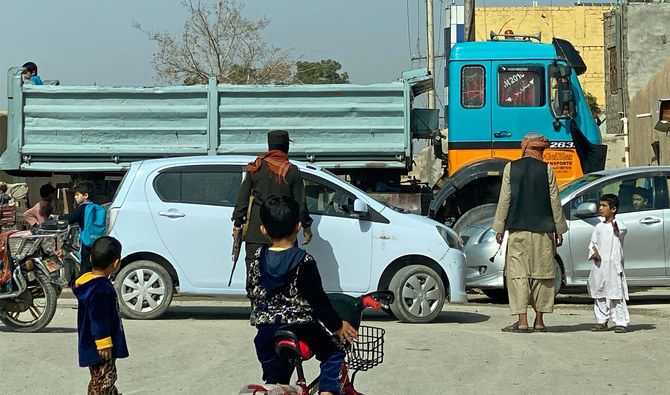
An Afghan security personnel checks a vehicle near the site of a suicide bomb attack in Kandahar on March 21, 2024. (AFP)
Short Url
Updated 22 March 2024
Follow

Pakistan condemns deadly suicide bombing in Afghanistan, calls militant violence ‘shared concern’

  • The attack in the Taliban heartland of Kandahar killed about 20 people after a suicide bomber targeted a bank
  • The attack was claimed by Daesh that has posed significant security challenges to Taliban government in Kabul

ISLAMABAD: Pakistan on Friday condemned a suicide bombing that killed at least 20 people in the Taliban heartland of Kandahar in neighboring Afghanistan a day earlier, calling such violent incidents a “shared concern” for both countries.

The suicide attack targeted people going to a bank in the southern Afghan city, many of them government employees, to collect their salaries.

The death toll was shared by hospital authorities with the media, though it was denied by Taliban officials who said only three people had died while dozens of others had suffered injuries.

The attack was later claimed by Daesh which has posed a significant security challenge to the Taliban administration in Kabul.

“Pakistan strongly condemns the terrorist attack that took place in Kandahar on 21 March 2024 and resulted in the loss of valuable lives and injuries to many others,” the foreign office said in a statement.

“Terrorism is a shared concern that both countries need to address through collective efforts,” it added.

Relations between the Pakistani and Afghan administrations have hit a low following deadly suicide attacks in Pakistan which have been claimed by a banned militant network, Tehreek-e-Taliban Pakistan (TTP), whose leaders are believed to have found a sanctuary in Afghanistan.

Pakistan recently launched airstrikes against TTP hideouts along its border with Afghanistan after an attack in its northwestern region killed seven soldiers, including two army officers.

Pakistan’s defense minister Khawaja Muhammad Asif said earlier this week his country did not seek armed conflict with Afghanistan, though he noted that cross-border militancy had reached an unacceptably high level.


Pakistani student launches ‘Urdu ChatGPT’ AI model

Updated 5 sec ago
Follow

Pakistani student launches ‘Urdu ChatGPT’ AI model

  • Developer says “Qalb” is largest large language model built exclusively for Urdu
  • Project highlights push to localize artificial intelligence for non-English users

ISLAMABAD: A Pakistani student studying in the United States has launched an artificial intelligence model designed exclusively for the Urdu language, a development its creator says could help bridge longstanding gaps in access to advanced digital tools for millions of speakers worldwide.

The project, called Qalb, is positioned as an Urdu-first large language model at a time when most generative AI systems are primarily trained on English and other widely used global languages. Supporters of language-specific models argue they can improve accuracy, cultural relevance and accessibility for users in education, business and public services.

Urdu is spoken by more than 230 million people globally, including in Pakistan, India and diaspora communities, but remains under-represented in advanced AI systems. Efforts to localize artificial intelligence have increasingly been seen as critical for widening participation in digital economies, particularly in developing countries.

“Qalb is now recognized as the world’s largest Large Language Model created exclusively for the Urdu language,” Taimoor Hassan, the project’s developer, was quoted this month in a report in state-run news agency APP. 

“Trained on a massive dataset of 1.97 billion tokens and benchmarked across seven-plus international evaluation frameworks, Qalb outperforms existing Urdu-focused AI models on key real-world performance indicators, setting a new standard for natural language processing in Pakistan,” Hassan said.

“This is a development model and in the next phase we would soon launch App for mobile and web so that people could use and benefit from Qalb ChatGPT.”

Hassan completed his undergraduate degree in computer science at FAAST University’s Peshawar campus and is currently studying for a master’s degree in computer science and software engineering at Auburn University in the United States. According to APP, he is a serial entrepreneur who has previously launched and exited multiple startups and has represented Pakistan at international technology forums.

“I had the opportunity to contribute in a small way to a much bigger mission for the country,” Hassan said.

“Together with my undergraduate roommates and teammates, Jawad Ahmed and Muhammad Awais, we are committed to continuously fine-tuning localized models for niche industries, which we believe can become a major breakthrough for Pakistan.”

Both collaborators are also graduates of FAAST University Peshawar Campus and are currently studying in Germany, APP reported.

The team behind Qalb said the model is intended to support local businesses, startups, educational platforms and voice-based digital services, arguing that meaningful innovation is no longer limited to large technology firms.

“Technology is no longer locked behind big budgets or big teams. With the right mindset, even a small group can build products that educate, automate, and serve millions,” Hassan told APP.