BRUSSELS: French President Emmanuel Macron vowed on Friday to keep pressing for a Gaza ceasefire at the UN Security Council, moments after China and Russia vetoed a US-backed draft resolution.
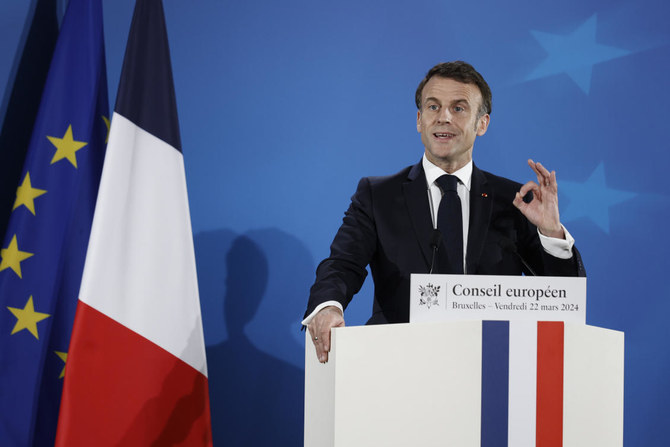
“The Security Council must call for an immediate ceasefire and humanitarian access,” Macron told reporters in Brussels, promising to resume work on an alternative French resolution “along with our US, European and Arab partners.”
The United States, Israel’s main ally, which has vetoed previous ceasefire calls, had put forward its own resolution.
For the first time the US supported “the imperative of an immediate and sustained ceasefire,” as well as condemning the October 7 attack by Hamas.
But Russia and China exercised their vetoes, while Algeria also voted against and Guyana abstained. The other 11 Security Council members voted in favor, including permanent members France and Britain.
Macron said he believed Paris was in a position to build a consensus — now that it could count on Washington’s backing.
“What’s important to note is that the United States has changed its position, and shown its will to defend, very clearly now, a ceasefire,” Macron said.
“For a long time, the Americans were reticent. That reticence is now gone. There is an alignment on the basis of our text,” Macron said.
France has been working on its proposal with Jordan, the United Arab Emirates and several other European countries, he said. He was hopeful its diplomatic outreach in the region “may persuade China and Russia not to use their veto.”
More than 1,160 people, mostly civilians, died on October 7 when militants infiltrated Israel in the country’s deadliest ever attack, according to Israeli official figures.
Israel vowed to eradicate Hamas, which controls the Gaza Strip. Some 32,000 people, mostly civilians, have died, according to the Gaza health ministry, and the United Nations has warned of imminent famine in the territory.


![]()

France to keep pushing for Gaza ceasefire at UN: Macron
Short Url
https://arab.news/wepv4
France to keep pushing for Gaza ceasefire at UN: Macron
- “The Security Council must call for an immediate ceasefire and humanitarian access,” Macron told reporters in Brussels
- Macron said he believed Paris was in a position to build a consensus — now that it could count on Washington’s backing


Latest updates


© 2026 SAUDI RESEARCH & PUBLISHING COMPANY, All Rights Reserved And subject to Terms of Use Agreement.