Salman Rushdie: AI only poses threat to unoriginal writers

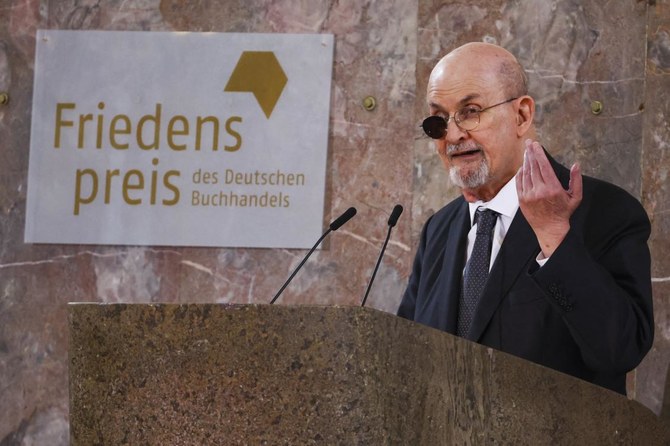
Rushdie said that generative AI writing tools could be a threat to more formulaic writers, however. (AFP/File)
Short Url
Updated 22 March 2024
Follow

Salman Rushdie: AI only poses threat to unoriginal writers

  • Technology lacks originality and humor to pose seriuous challenge, author said

PARIS: Artificial intelligence tools may pose a threat to writers of thrillers and science fiction, but lack the originality and humor to challenge serious novelists, Salman Rushdie wrote in a French journal published Thursday.
In an article translated into French for literary journal La Nouvelle Revue Francaise (NRF), Rushdie said he tested ChatGPT by asking it to write 200 words in his style.
He describes the results as “a bunch of nonsense.”
“No reader who had read a single page of mine could think I was the author. Rather reassuring,” he said, according to a translation of the article by AFP.
The Booker Prize-winning author of “The Satanic Verses” and “Midnight’s Children” said that generative AI writing tools could be a threat to more formulaic writers, however.
“The trouble is that these creatures learn very quickly,” he said, adding that this could be worrying for writers of genre literature like thrillers and science fiction, where originality is less important.
The threat could be particularly acute for film and TV writers.
“Given that Hollywood is constantly creating new versions of the same film, artificial intelligence could be used to draft screenplays,” he said.
His judgment of ChatGPT’s skills was harsh, finding it had “no originality” and was seemingly “completely devoid of any sense of humor.”
Rushdie spent many years in hiding after a death threat was issued by Iran in 1989 over the “The Satanic Verses,” which was claimed to be anti-Islamic.
He lost the use of an eye after being stabbed in August 2022 during a literary conference in the New York area by an US citizen of Lebanese origin.


Paris exhibition marks 200 years of Le Figaro and the enduring power of the press

Updated 17 January 2026
Follow

Paris exhibition marks 200 years of Le Figaro and the enduring power of the press

  • The exhibition celebrated the bicentennial of Le Figaro, offering visitors a rare opportunity to step inside the newspaper’s vast historical archive

PARIS: One of France’s most influential newspapers marked a major milestone this month with a landmark exhibition beneath the soaring glass nave of the Grand Palais, tracing two centuries of journalism, literature and political debate.
Titled 1826–2026: 200 years of freedom, the exhibition celebrated the bicentennial of Le Figaro, offering visitors a rare opportunity to step inside the newspaper’s vast historical archive. Held over three days in mid-January, the free exhibition drew large crowds eager to explore how the title has both chronicled and shaped modern French history.
More than 300 original items were displayed, including historic front pages, photographs, illustrations and handwritten manuscripts. Together, they charted Le Figaro’s evolution from a 19th-century satirical publication into a leading national daily, reflecting eras of revolution, war, cultural change and technological disruption.
The exhibition unfolded across a series of thematic spaces, guiding visitors through defining moments in the paper’s past — from its literary golden age to its role in political debate and its transition into the digital era. Particular attention was paid to the newspaper’s long association with prominent writers and intellectuals, underscoring the close relationship between journalism and cultural life in France.
Beyond the displays, the program extended into live journalism. Public editorial meetings, panel discussions and film screenings invited audiences to engage directly with editors, writers and media figures, turning the exhibition into a forum for debate about the future of the press and freedom of expression.
Hosted at the Grand Palais, the setting itself reinforced the exhibition’s ambition: to place journalism firmly within the country’s cultural heritage. While the exhibition has now concluded, the bicentennial celebrations continue through special publications and broadcasts, reaffirming Le Figaro’s place in France’s public life — and the enduring relevance of a free and questioning press in an age of rapid change.