

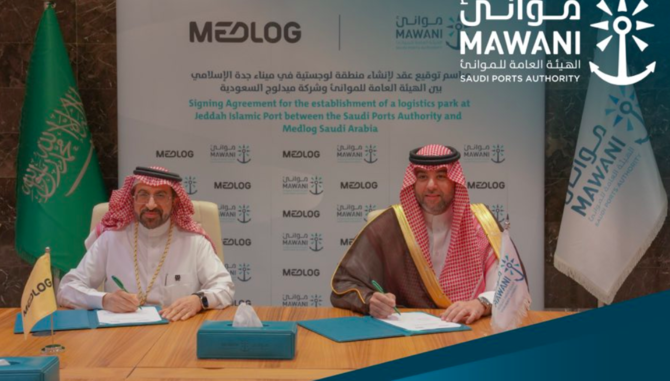
Saudi Arabia’s Jeddah Islamic Port to get $46m integrated logistics zone 

The new undertaking will contribute to increasing the operational efficiency of the port, enhancing commercial movement, and ensuring robust supply chains. Mawani
Short Url
Updated 20 March 2024
Follow

Saudi Arabia’s Jeddah Islamic Port to get $46m integrated logistics zone 

RIYADH: Jeddah will soon get an integrated logistics zone, as the Saudi Ports Authority and MEDLOG have signed an agreement for the project.   

The government agency, known as Mawani, has joined with the logistics arm of the Mediterranean Shipping Co. to develop the integrated zone, which will have an investment value of up to SR175 million ($46.6 million), according to a statement.  

The project includes an integrated services site to maintain and inspect containers, and will also provide 400 direct and indirect job opportunities as well as qualify national staff in the logistics services sector.

In addition, the zone will contribute to preserving the safety of the port environment through the use of alternative energy in an attempt to reduce carbon emissions.

The new undertaking will contribute to increasing the operational efficiency of the facility, enhancing commercial movement, and ensuring robust supply chains.  

This falls in line with the objectives of the National Transport and Logistics Strategy, which is to consolidate the Kingdom’s position as a global supply chain management center and the meeting point of three continents.   

The region also aims to raise the level of logistical services provided on the Red Sea coast.  

Additionally, it will work on providing comprehensive and integrated services, thereby facilitating the needs of beneficiaries as well as meeting the requirements of the local market in terms of transporting and handling goods with high operational capabilities.

In December it was announced that King Abdulaziz Port in Dammam was also set to receive an integrated logistics zone as Mawani and MEDLOG laid the foundation stone for the project. 

The new undertaking was set to be built with an investment value exceeding SR150 million, the Saudi Press Agency reported at the time. 

Speaking in December Omar Hariri, chairman of Mawani, said laying the foundation stone of the new logistics zone aligned with the authority’s goal to develop a sustainable and prosperous maritime sector.

The SPA report also added that the new zone will be built in an area of over 100,000 sq. m., with a capacity of handling 300,000 containers per year.

Given its sustained efforts, Saudi Arabia achieved significant progress on the World Bank’s Logistics Performance Index, jumping 17 places to reach the 38th position in 2023.


UAE non-oil business growth at 1-year high in February: PMI report

Updated 04 March 2026
Follow

UAE non-oil business growth at 1-year high in February: PMI report

RIYADH: The growth of the non-oil private sector in the UAE ticked up to a 12-month high in February, driven by rapid increases in business activity and new work orders, an economic tracker showed.

In its latest Purchasing Managers’ Index report, S&P Global revealed that the UAE’s PMI rose to 55 in February from 54.9 in January.

Any PMI reading above 50 indicates expansion, while a reading below 50 reflects contraction.

The upturn of the non-oil private sector in the UAE aligns with the broader trend observed in the Gulf Cooperation Council region, where countries, including Saudi Arabia, are pursuing economic diversification efforts to reduce reliance on crude revenues.

In January, the Kingdom’s PMI stood at 56.3, the highest in the region, while Kuwait recorded a reading of 54.5.

“The UAE PMI signalled the strongest growth in non-oil business conditions for a year in February, with output increasing rapidly in response to strong inflows of new work. So far, the data points to an encouraging picture for the domestic economy in the first quarter of this year,” said David Owen, senior economist at S&P Global Market Intelligence.

According to the report, stronger output among non-oil sectors was driven by higher demand, successful contract wins, and growth in key sectors including construction, real estate, logistics, and technology.

Additional factors that contributed to this growth include rising tourist arrivals, the expansion of e-commerce channels, and growing demand for AI-related products.

While international orders also contributed to the expansion of the non-oil sector, the increase in export sales remained modest, suggesting that sales growth was mainly driven by domestic demand.

The analysis highlighted that employment numbers rose modestly in February, marking the largest uplift since last November.

UAE non-oil businesses successfully increased their inventories of purchased inputs for the second month running, supported by another rapid improvement in supplier delivery times.

Regarding the future outlook, non-oil firms in the UAE expressed optimism, although the level of confidence declined from the recent high in January.

“The outlook is positive, as demand has continued to pressure business capacity, suggesting additional expansions in output and employment may be necessary,” added Owen.

In the same report, S&P Global revealed that Dubai’s PMI slipped to 54.6 in February from 55.9 observed in January.

Rates of output and new order growth lost momentum, but remained sharp overall, with firms highlighting increased opportunities and new projects.

The release highlighted that demand was also lifted by various factors, including marketing activities, AI adoption, population growth and increased tourism.