

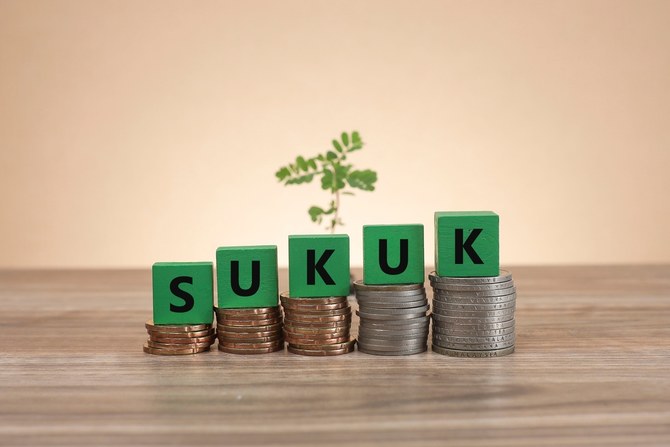
Saudi Arabia closes its March sukuk issuance at $1.18bn

The first tranche offered in March was valued at SR203 million and is set to mature in 2029. Shutterstock
Short Url
Updated 20 March 2024
Follow

Saudi Arabia closes its March sukuk issuance at $1.18bn

RIYADH: Saudi Arabia concluded its riyal-denominated sukuk issuance above the $1 billion mark for the fourth consecutive month in March, government data showed. 

The Kingdom’s National Debt Management Center revealed three tranches of the Shariah-compliant debt product were closed at SR4.44 billion ($1.18 billion). 

It was in November that Saudi Arabia’s sukuk issuance dropped below the $1 billion mark at SR2.66 billion.

In December, it rebounded to SR10.53 billion, while in January and February, it amounted to SR8.82 billion and SR7.87 billion, respectively. 

The first tranche offered in March was valued at SR203 million and is set to mature in 2029, while the second allotment, worth SR3.69 billion, is due in 2034.

The third, valued at SR540 million, will mature in 2039. 

Earlier this month, NDMC revealed that it concluded its second government sukuk savings round for March, with a total volume of requests reaching SR959 million, allocated to 37,000 applicants. 

In a statement, the insitution added that the financial product, also known as Sah, offers a return of 5.64 percent, which will have a maturity date in March 2025. 

Sah, introduced by the Ministry of Finance and NDMC, aims to increase the fund ratios among individuals by motivating them to allocate a portion of their income to savings periodically. 

In January, a report released by credit rating agency S&P Global noted that sukuk issuance worldwide is expected to total between $160 billion and $170 billion in 2024, driven by higher financing needs in Islamic nations. 

Fueled by tighter conditions in Saudi Arabia’s banking system and Indonesia’s lower fiscal deficit, global Islamic bond issuance had declined by 6.1 percent to $168.4 billion in 2023 compared to the previous year. 

The US-based agency further noted that sustainable sukuk issuance will also rise in 2024, on the back of the successful UN Climate Change Conference, also known as COP28, which concluded in the UAE in 2023. 

Last month, another report released by Fitch Ratings said that the environmental, social, and governance market for the Shariah-compliant debt products is expected to cross 7.5 percent of global outstanding Islamic bonds in the coming years.

The report added that the growth of the ESG sukuk market will be driven by issuers’ diversification plans and governments’ sustainable initiatives. 


Saudi Arabia leads outcome-based education to prepare future-ready generations: Harvard Business Review

A Harvard sign is seen at the Harvard University campus in Boston, Massachusetts, on May 27, 2025. (AFP)
Updated 10 February 2026
Follow

Saudi Arabia leads outcome-based education to prepare future-ready generations: Harvard Business Review

  • The Riyadh-based school group developed a strategy that links every classroom activity to measurable student competencies, aiming to graduate learners equipped for the digital economy and real-world contexts

RIYADH: Saudi Arabia’s education system is undergoing a sweeping transformation aligned with Vision 2030, shifting from traditional, input-focused methods to outcome-based education designed to equip students with future-ready skills, Harvard Business Review Arabic reported.

The transformation is being adopted and spearheaded by institutions such as Al-Nobala Private Schools, which introduced the Kingdom’s first national “learning outcomes framework,” aimed at preparing a generation of leaders and innovators for an AI-driven future, the report said.

Al-Nobala has leveraged international expertise to localize advanced learning methodologies.

The Riyadh-based school group developed a strategy that links every classroom activity to measurable student competencies, aiming to graduate learners equipped for the digital economy and real-world contexts. The school’s group approach combines traditional values with 21st-century skills such as critical thinking, communication, innovation and digital fluency.

According to the report, the shift addresses the growing gap between outdated models built for low-tech, resource-constrained environments and today’s dynamic world, where learners must navigate real-time information, virtual platforms, and smart technologies.

“This is not just about teaching content, it’s about creating impact,” the report noted, citing how Al-Nobala’s model prepares students to thrive in an AI-driven world while aligning with national priorities.

The report noted that Saudi Arabia’s Ministry of Education has paved the way for this shift by transitioning from a centralized controller to a strategic enabler, allowing schools such as Al-Nobala to tailor their curriculum to meet evolving market and societal needs. This is part of the long-term goal to place the Kingdom among the top 20 global education systems.

Al-Nobala’s work, the report stated, has succeeded in serving the broader national effort to link education outcomes directly to labor market demands, helping to fulfill the Vision 2030 pillar of building a vibrant society with a thriving economy driven by knowledge and innovation.

Last February, Yousef bin Abdullah Al-Benyan, Saudi Arabia’s minister of education, said that the Kingdom was making “an unprecedented investment in education,” with spending aligned to the needs of growth and development. He said that in 2025, education received the second-largest share of the state budget, totaling $53.5 billion.