

Hundreds of Jewish creatives condemn Jonathan Glazer’s Oscars speech for ‘likening Israel to Nazis’

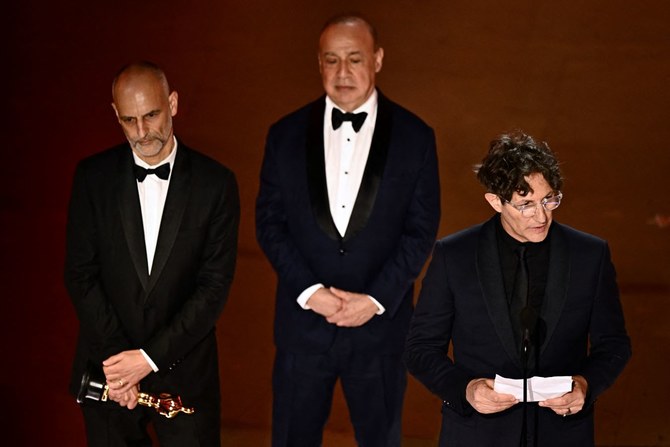
While accepting the award for best international feature, filmmaker Jonathan Glazer (right) connected his Holocaust film with the attack on Gaza. (AFP)
Short Url
Updated 20 March 2024
Follow

Hundreds of Jewish creatives condemn Jonathan Glazer’s Oscars speech for ‘likening Israel to Nazis’

  • The Zone of Interest scooped an Oscar for best international feature
  • More than 450 Jewish creatives, executives, and Hollywood professionals signed an open letter denouncing the speech

LONDON: At least 450 Jewish figures in Hollywood condemned on Monday the Oscars acceptance speech of British filmmaker Jonathan Glazer for comparing Israel’s onslaught on Gaza to the Nazi treatment of Jews.

Glazer, whose film “The Zone of Interest” scooped the award for best international feature, said as he accepted the prize at the ceremony earlier this month that his film showed “where dehumanization leads at its worst.”

He added: “We stand here as men who refute their Jewishness and the Holocaust being hijacked by an occupation which has led to conflict for so many innocent people. Whether the victims of October the 7th in Israel or the ongoing attack on Gaza, all the victims of this dehumanization, how do we resist?”

The statement prompted more than 450 Jewish creatives, executives, and Hollywood professionals, including actress Debra Messing and director Eli Roth, to denounce the Jewish director’s speech in an open letter shared by Variety.

The letter said: “We refute our Jewishness being hijacked for the purpose of drawing a moral equivalence between a Nazi regime that sought to exterminate a race of people, and an Israeli nation that seeks to avert its own extermination.”

While highlighting that “every civilian death in Gaza is tragic,” the signatories defended Israel’s conduct in Gaza as “targeting Hamas.”

The letter also claimed Glazer’s statement “gives credence to the modern blood libel that fuels a growing anti-Jewish hatred around the world.”

Co-produced between the UK and Poland, “The Zone of Interest” is a historical drama that explores the horrors of the Holocaust through the life of the Auschwitz commandant Rudolf Hoss, who lived with his wife in a home close to the Nazi concentration camp.

On Oct. 7, Hamas carried out a surprise attack in southern Israel, killing 1,200 people and taking 240 others hostage. In retaliation, Israel launched a relentless bombing campaign across the Gaza Strip, killing so far more than 31,000 Palestinians, of whom at least 12,300 are children, according to Gaza’s health authority.

Israel’s ongoing offensive in Gaza has been condemned globally by humanitarian and rights organizations, including Amnesty International and UN agencies, as well as several governments.


Gabon cuts off Facebook, TikTok after protests

Updated 18 February 2026
Follow

Gabon cuts off Facebook, TikTok after protests

Libreville, Gabon: Facebook and TikTok were no longer available in Gabon on Wednesday, AFP journalists said, after regulators said they were suspending social media over national security concerns amid anti-government protests.
Gabon’s media regulator on Tuesday announced the suspension of social media platforms until further notice, saying that online posts were stoking conflict.
The High Authority for Communication imposed “the immediate suspension of social media platforms in Gabon,” its spokesman Jean-Claude Mendome said in a televised statement.
He said “inappropriate, defamatory, hateful, and insulting content” was undermining “human dignity, public morality, the honor of citizens, social cohesion, the stability of the Republic’s institutions, and national security.”
The communications body spokesman also cited the “spread of false information,” “cyberbullying” and “unauthorized disclosure of personal data” as reasons for the decision.
“These actions are likely, in the case of Gabon, to generate social conflict, destabilize the institutions of the Republic, and seriously jeopardize national unity, democratic progress, and achievements,” he added.
The regulator did not specify any social media platforms that would be included in the ban.
But it said “freedom of expression, including freedom of comment and criticism,” remained “a fundamental right enshrined in Gabon.”

‘Climate of fear’

Less than a year after being elected, Gabonese President Brice Oligui Nguema has faced his first wave of social unrest, with teachers on strike and other civil servants threatening to do the same.
School teachers began striking over pay and conditions in December and protests over similar demands have since spread to other public sectors — health, higher education and broadcasting.
Opposition leader Alain-Claude Billie-By-Nze said the social media crackdown imposed “a climate of fear and repression” in the central African state.
In an overnight post on Facebook, he called on civil groups “and all Gabonese people dedicated to freedom to mobilize and block this liberty-destroying excess.”
The last action by teachers took place in 2022 under then president Ali Bongo, whose family ruled the small central African country for 55 years.
Oligui overthrew Bongo in a military coup a few months later and acted on some of the teachers’ concerns, buying calm during the two-year transition period that led up to the presidential election in April 2025.
He won that election with a huge majority, generating high expectations with promises that he would turn the country around and improve living standards.
A wage freeze decided a decade ago by the Bongo government has left teachers struggling to cope with the rising cost of living.
Authorities last month arrested two prominent figures from the teachers’ protest movement, leaving teachers and parents afraid to discuss the strike in public.