

UN rights office: Israel’s Gaza aid restrictions may amount to war crime

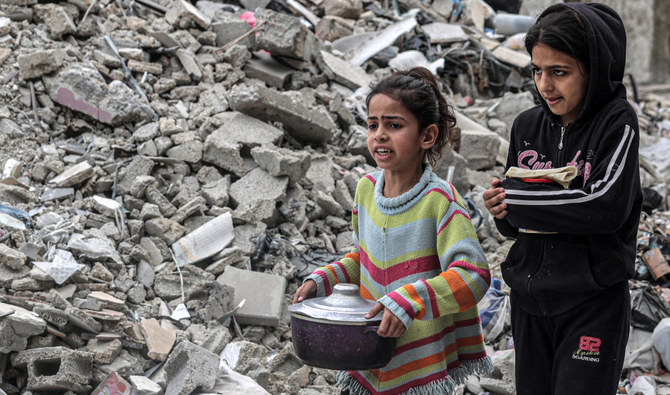
One in three children under age 2 in northern Gaza is now acutely malnourished and famine is looming. (AFP)
Short Url
Updated 19 March 2024
Follow

UN rights office: Israel’s Gaza aid restrictions may amount to war crime

  • The UN body warns Israel's limits risk using starvation as a war tactic
  • Oxfam also accused Israel of intentionally preventing the delivery of aid into Gaza

GENEVA: The United Nations human rights office said on Tuesday that Israel’s restrictions on the entry of humanitarian aid into Gaza could amount to a war crime.
“The extent of Israel’s continued restrictions on entry of aid into Gaza, together with the manner in which it continues to conduct hostilities, may amount to the use of starvation as a method of war, which is a war crime,” said UN Human Rights Office spokesperson Jeremy Laurence.
Anti-poverty charity Oxfam also accused Israel of intentionally preventing the delivery of aid into Gaza during its war with Hamas, in violation of international humanitarian law.

The nongovernmental organization said on Monday in a report that Israel continued to “systematically and deliberately block and undermine any meaningful international humanitarian response” in the Palestinian territory.

It alleged that Israel was defying an order by the International Court of Justice in January to boost aid in Gaza, and was failing its legal responsibility to protect people in land it occupies.

“The ICJ order should have shocked Israeli leaders to change course, but since then conditions in Gaza have actually worsened,” said Oxfam Middle East and North Africa director Sally Abi Khalil.

“Israeli authorities are not only failing to facilitate the international aid effort but are actively hindering it. We believe that Israel is failing to take all measures within its power to prevent genocide.”

Oxfam said that “unjustifiably inefficient” inspection rules were causing aid trucks trying to get into Gaza to be stuck in queues for 20 days on average.

It said that Israeli authorities arbitrarily reject “dual-use” items — civilian goods that also have potential military use such as backup generators and torches.

“The list of rejected items is overwhelming and ever changing,” Oxfam said.

It recalled that water bags and water testing kits in an Oxfam shipment were rejected with no reason provided, before later being permitted entry.

The group also denounced “attacks on aid workers, humanitarian facilities and aid convoys” and “access restrictions” for relief staff, particularly to northern Gaza.

Israel has denied obstructing the entry of humanitarian aid into the Gaza Strip.


Iraq starts investigations into Daesh detainees moved from Syria

Updated 3 sec ago
Follow

Iraq starts investigations into Daesh detainees moved from Syria

BAGHDAD: Iraq’s judiciary announced on Monday it has begun its investigations into more than 1,300 Daesh group detainees who were transferred from Syria as part of a US operation.
“Investigation proceedings have started with 1,387 members of the Daesh terrorist organization who were recently transferred from the Syrian territory,” the judiciary’s media office said in a statement, using the Arabic acronym for Daesh.
“Under the supervision of the head of Iraq’s Supreme Judicial Council, several judges specializing in counterterrorism started the investigation.”
Those detainees are among 7,000 IS suspects, previously held by Syrian Kurdish fighters, whom the US military said it would transfer to Iraq after Syrian government forces recaptured Kurdish-held territory.
They include Syrians, Iraqis and Europeans, among other nationalities, according to several Iraqi security sources.
In 2014, Daesh swept across Syria and Iraq, committing massacres and forcing women and girls into sexual slavery.
Backed by US-led forces, Iraq proclaimed the defeat of Daesh in the country in 2017, and the Kurdish-led Syrian Democratic Forces (SDF) ultimately beat back the group in Syria two years later.
The SDF went on to jail thousands of suspected extremists and detain tens of thousands of their relatives in camps.
Last month, the United States said the purpose of its alliance with Kurdish forces in Syria had largely expired, as Damascus pressed an offensive to take back territory long held by the SDF.
In Iraq, where many prisons are packed with Daesh suspects, courts have handed down hundreds of death sentences and life terms to people convicted of terrorism offenses, including many foreign fighters.
Iraq’s judiciary said its investigation procedures “will comply with national laws and international standards.”