

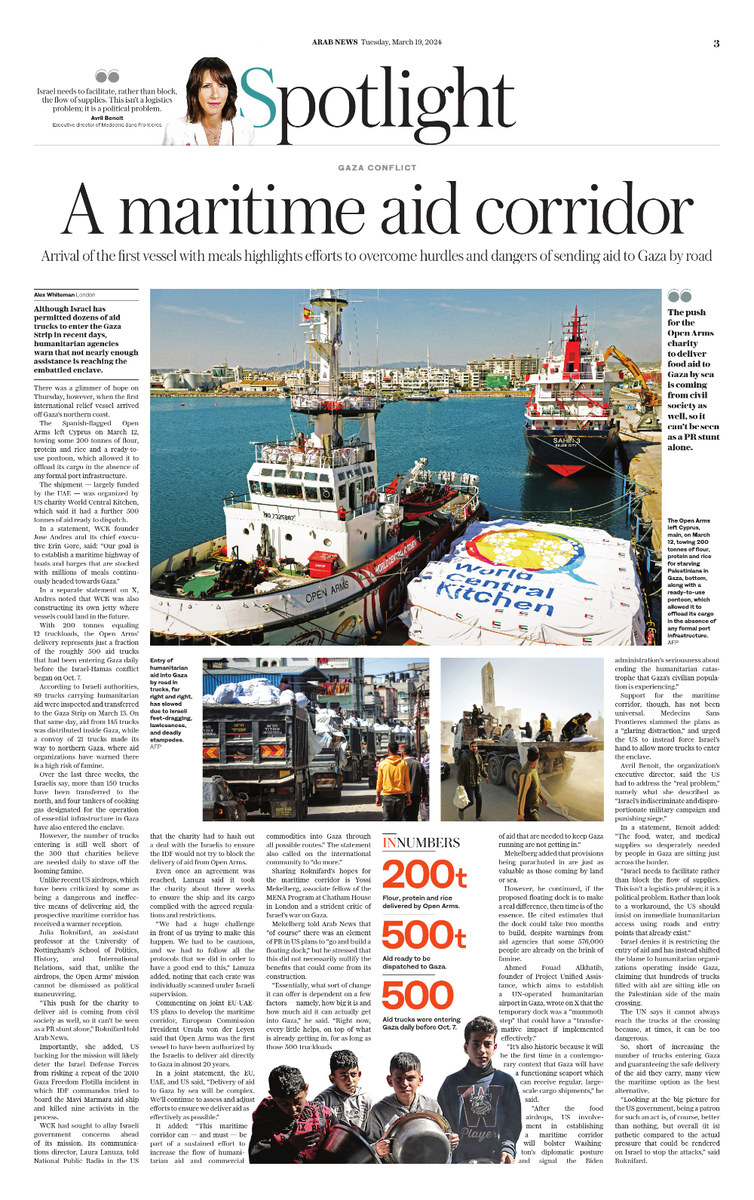
Could a ‘maritime highway of boats and barges’ end Gaza’s siege?

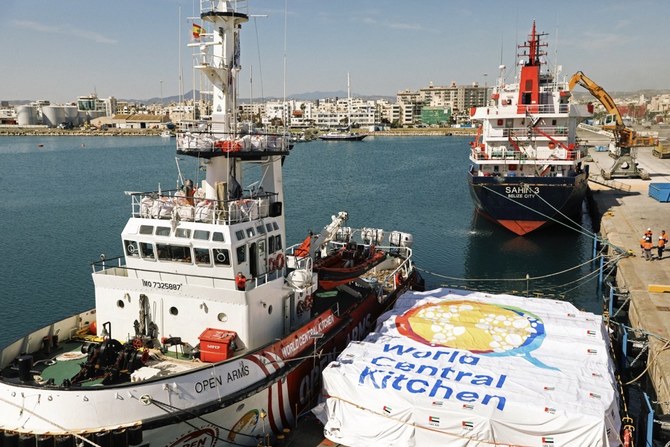
Open Arms vessel with the humanitarian food aid at the Cypriot port of Larnaca. (AFP)
Short Url
Updated 18 March 2024
Follow

Could a ‘maritime highway of boats and barges’ end Gaza’s siege?

  • Arrival of first vessel with meals highlights efforts to overcome hurdles to sending aid by road
  • Some experts say provisions dropped onto the enclave are just as valuable as those coming by land or sea

LONDON: Although Israel has permitted dozens of aid trucks to enter the Gaza Strip in recent days, humanitarian agencies warn that not nearly enough assistance is reaching the embattled enclave.

There was a glimmer of hope on Thursday, however, when the first international relief vessel arrived off Gaza’s northern coast.

The Spanish-flagged Open Arms left Cyprus on March 12, towing some 200 tons of flour, protein and rice and a ready-to-use pontoon, which allowed it to offload its cargo in the absence of any formal port infrastructure.

The shipment — largely funded by the UAE — was organized by US charity World Central Kitchen (WCK), which said it had a further 500 tons of aid ready to dispatch.
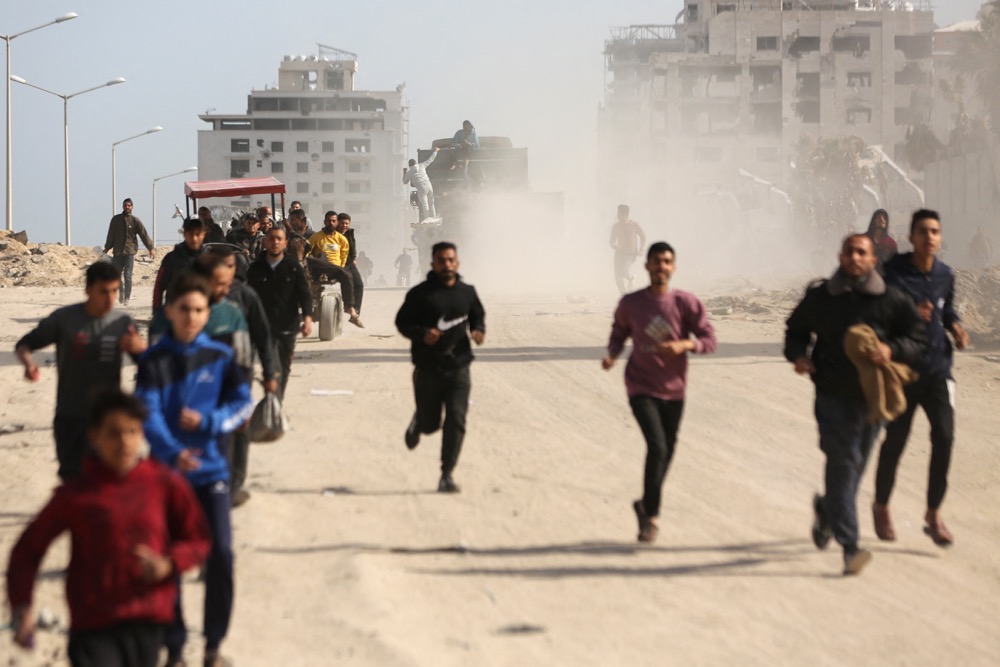


Entry of humanitarian aid into Gaza by road in trucks has slowed due to Israeli feet-dragging, lawlessness, and deadly stampedes. (AFP)

In a statement, WCK founder Jose Andres and its chief executive Erin Gore, said: “Our goal is to establish a maritime highway of boats and barges that are stocked with millions of meals continuously headed towards Gaza.”

In a separate statement on X, Andres noted that WCK was also constructing its own jetty where vessels could land in the future.

With 200 tons equaling 12 truckloads, the Open Arms’ delivery represents just a fraction of the roughly 500 aid trucks that had been entering Gaza daily before the Israel-Hamas conflict began on Oct. 7.

According to Israeli authorities, 89 trucks carrying humanitarian aid were inspected and transferred to the Gaza Strip on March 13. On that same day, aid from 145 trucks was distributed inside Gaza, while a convoy of 21 trucks made its way to northern Gaza, where aid organizations have warned there is a high risk of famine.

Over the last three weeks, the Israelis say, more than 150 trucks have been transferred to the north, and four tankers of cooking gas designated for the operation of essential infrastructure in Gaza have also entered the enclave.

However, the number of trucks entering is still well short of the 300 that charities believe are needed daily to stave off the looming famine.

Unlike recent US airdrops, which have been criticized by some as being a dangerous and ineffective means of delivering aid, the prospective maritime corridor has received a warmer reception.

Julia Roknifard, an assistant professor at the University of Nottingham’s School of Politics, History, and International Relations, said that, unlike the airdrops, the Open Arms’ mission cannot be dismissed as political maneuvering.

“This push for the charity to deliver aid is coming from civil society as well, so it can’t be seen as a PR stunt alone,” Roknifard told Arab News.
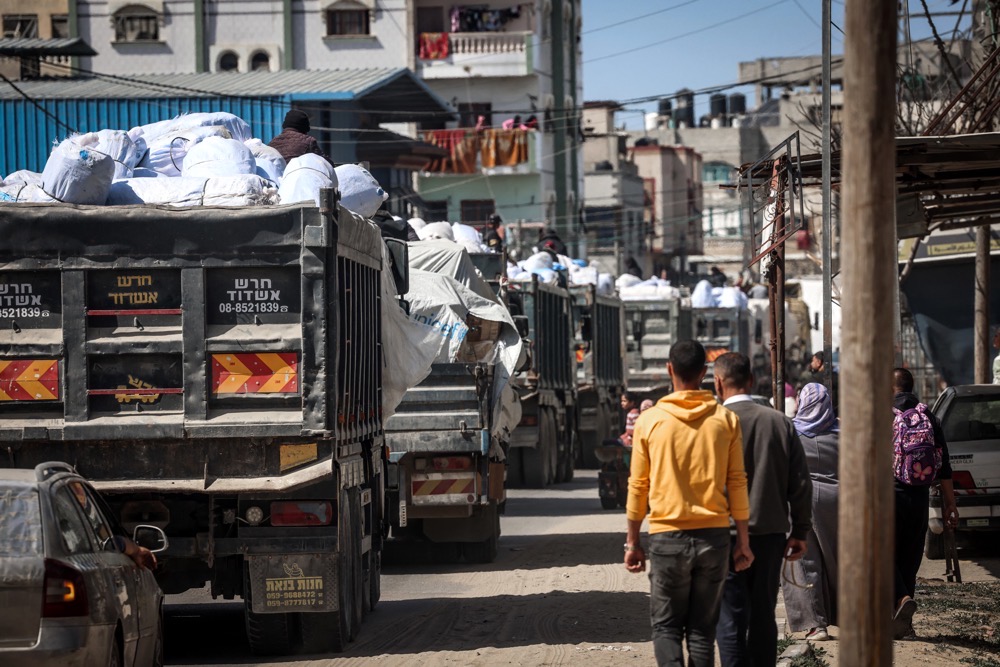


With 200 tons equaling 12 truckloads, the Open Arms’ delivery represents just a fraction of the roughly 500 aid trucks that had been entering Gaza daily before the Israel-Hamas conflict began on Oct. 7. (AFP)

Importantly, she added, US backing for the mission will likely deter the Israel Defense Forces from risking a repeat of the 2010 Gaza Freedom Flotilla incident in which IDF commandos tried to board the Mavi Marmara aid ship and killed nine activists in the process.

WCK had sought to allay Israeli government concerns ahead of its mission. Its communications director, Laura Lanuza, told National Public Radio in the US that the charity had to hash out a deal with the Israelis to ensure the IDF would not try to block the delivery of aid from Open Arms.

Even once an agreement was reached, Lanuza said it took the charity about three weeks to ensure the ship and its cargo complied with the agreed regulations and restrictions.

“We had a huge challenge in front of us trying to make this happen. We had to be cautious, and we had to follow all the protocols that we did in order to have a good end to this,” Lanuza added, noting that each crate was individually scanned under Israeli supervision.

Commenting on joint EU-UAE-US plans to develop the maritime corridor, European Commission President Ursula von der Leyen said that Open Arms was the first vessel to have been authorized by the Israelis to deliver aid directly to Gaza in almost 20 years.

INNUMBERS

• 200 Tons of flour, protein and rice delivered by Open Arms.

• 500 Tons of aid ready to be dispatched to Gaza.

• 500 Aid trucks were entering Gaza daily Oct. 7.

In a joint statement, the EU, UAE, and US said, “Delivery of aid to Gaza by sea will be complex. We’ll continue to assess and adjust efforts to ensure we deliver aid as effectively as possible.”

It added: “This maritime corridor can — and must — be part of a sustained effort to increase the flow of humanitarian aid and commercial commodities into Gaza through all possible routes.” The statement also called on the international community to “do more.”

Sharing Roknifard’s hopes for the maritime corridor is Yossi Mekelberg, associate fellow of the MENA Program at Chatham House in London and a strident critic of Israel’s war on Gaza.

Mekelberg told Arab News that “of course” there was an element of PR in US plans to “go and build a floating dock,” but he stressed that this did not necessarily nullify the benefits that could come from its construction.
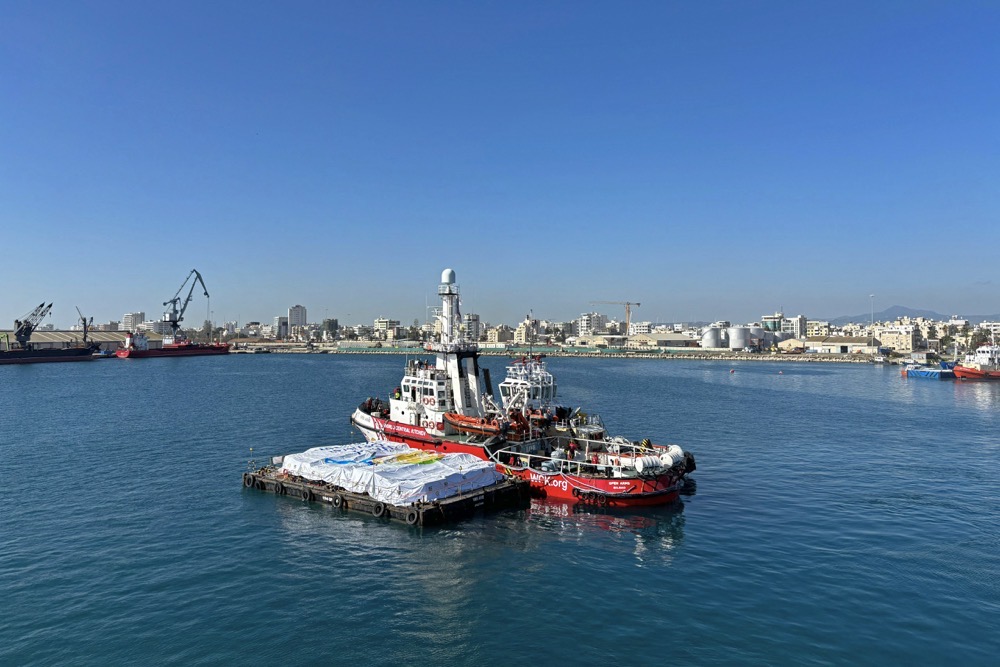


The shipment — largely funded by the UAE — was organized by US charity World Central Kitchen. (AFP)

“Essentially, what sort of change it can offer is dependent on a few factors — namely, how big it is and how much aid it can actually get into Gaza,” he said. “Right now, every little helps, on top of what is already getting in, for as long as those 500 truckloads of aid that are needed to keep Gaza running are not getting in.”

Mekelberg added that provisions being parachuted in are just as valuable as those coming by land or sea.

However, he continued, if the proposed floating dock is to make a real difference, then time is of the essence. He cited estimates that the dock could take two months to build, despite warnings from aid agencies that some 576,000 people are already on the brink of famine.

Ahmed Fouad Alkhatib, founder of Project Unified Assistance, which aims to establish a UN-operated humanitarian airport in Gaza, wrote on X that the temporary dock was a “mammoth step” that could have a “transformative impact if implemented effectively.”

“It’s also historic because it will be the first time in a contemporary context that Gaza will have a functioning seaport which can receive regular, large-scale cargo shipments,” he said.

“After the food airdrops, US involvement in establishing a maritime corridor will bolster Washington’s diplomatic posture and signal the Biden administration’s seriousness about ending the humanitarian catastrophe that Gaza’s civilian population is experiencing.”

Support for the maritime corridor, though, has not been universal. Medecins Sans Frontieres slammed the plans as a “glaring distraction,” and urged the US to instead force Israel’s hand to allow more trucks to enter the enclave.

Avril Benoit, the organization’s executive director, said the US had to address the “real problem,” namely what he described as “Israel’s indiscriminate and disproportionate military campaign and punishing siege.”

In a statement, Benoit added: “The food, water, and medical supplies so desperately needed by people in Gaza are sitting just across the border.
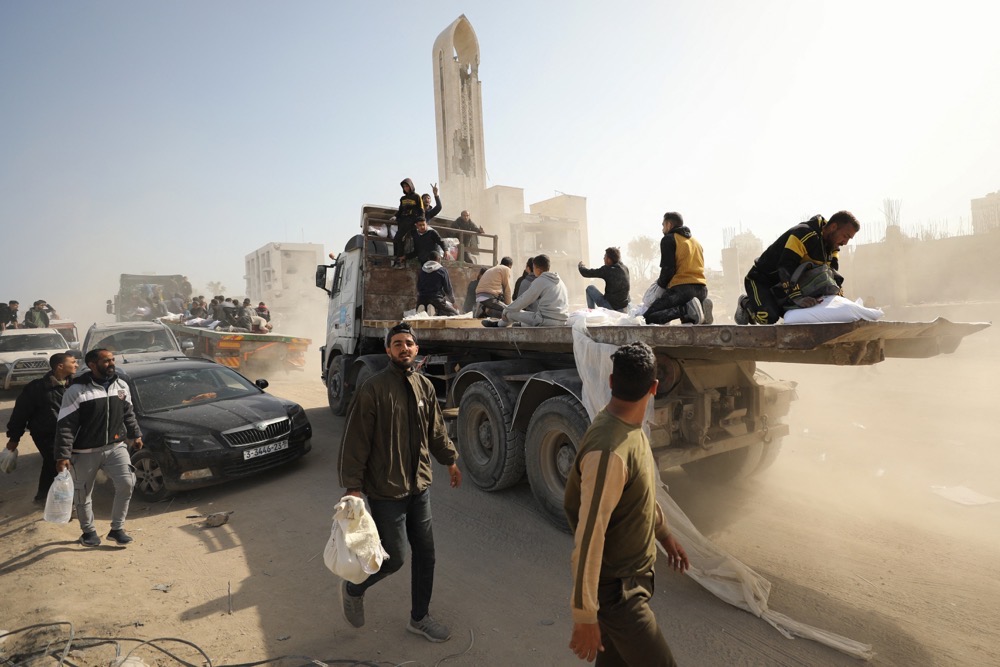


According to Israeli authorities, 89 trucks carrying humanitarian aid were inspected and transferred to the Gaza Strip on March 13. (AFP)

“Israel needs to facilitate rather than block the flow of supplies. This isn’t a logistics problem; it is a political problem. Rather than look to a workaround, the US should insist on immediate humanitarian access using roads and entry points that already exist.”

Israel denies it is restricting the entry of aid and has instead shifted the blame to humanitarian organizations operating inside Gaza, claiming that hundreds of trucks filled with aid are sitting idle on the Palestinian side of the main crossing.

The UN says it cannot always reach the trucks at the crossing because, at times, it can be too dangerous.

So, short of increasing the number of trucks entering Gaza and guaranteeing the safe delivery of the aid they carry, many view the maritime option as the best alternative.

“Looking at the big picture for the US government, being a patron for such an act is, of course, better than nothing, but overall (it is) pathetic compared to the actual pressure that could be rendered on Israel to stop the attacks,” said Roknifard.
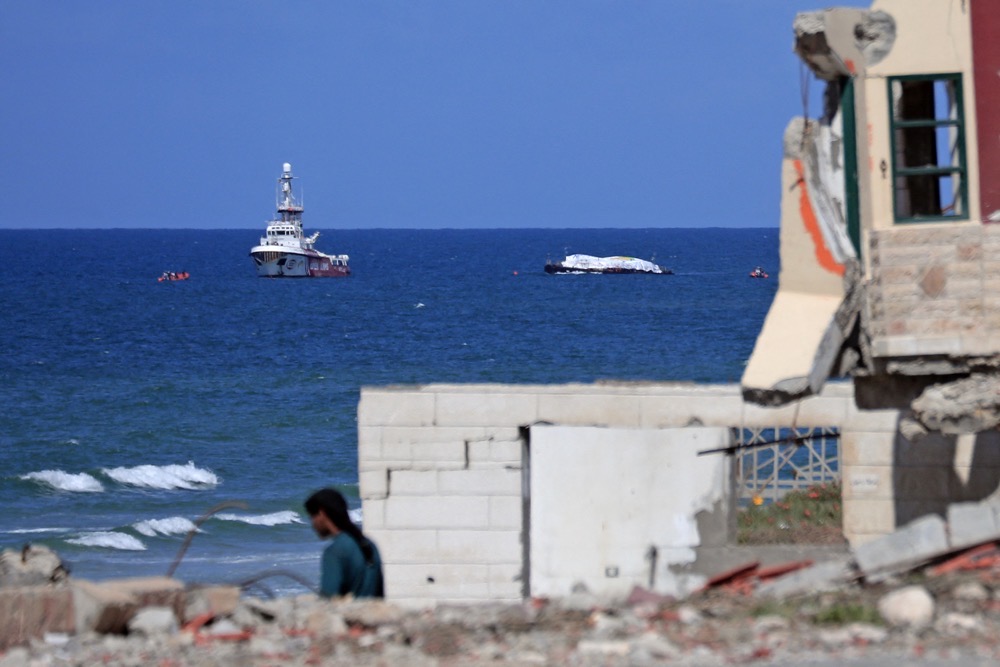


The Spanish-flagged Open Arms left Cyprus on March 12. (AFP)

Roknifard believes the US should use its leverage to “twist Israel’s arm” and force Israeli Prime Minister Benjamin Netanyahu and his coalition partners to allow sufficient aid to arrive by road.

Such a move is unlikely, however, given the upcoming US presidential election, which Roknifard said presents a “major roadblock” to the necessary “political will.”

Although this still seems “like a pretty lame excuse for not doing the real thing,” Roknifard said the maritime corridor was at least better than dropping aid from the air.


Analysis: The risks of carving up Yemen

Updated 5 sec ago
Follow

Analysis: The risks of carving up Yemen

  • Yemen’s government and regional powers warn unilateral moves in the south could push country toward breaking point
  • Analysts say the STC’s rapid expansion risks provoking rival Yemeni factions, deepening instability

RIYADH: Concern is mounting that Yemen is sliding toward a de-facto partition, with rival authorities consolidating control over separate regions.

In the south, the Southern Transitional Council has expanded its footprint, while Iran-backed Houthi forces remain firmly entrenched in the north.

Those fears have intensified in recent weeks, driven by the STC’s latest military operation and the widening Red Sea conflict. Together, they raise a central question: Will Yemen’s decade-long war end in reconciliation, or fracture into competing statelets?

On Dec. 23, Rashad Al-Alimi, head of the Presidential Leadership Council, the executive body of Yemen’s internationally recognized government, warned that unilateral actions by the STC were pushing the country toward a dangerous tipping point.

Rashad Mohammed Al-Alimi, president of the Presidential Leadership Council of Yemen, speaks during the United Nations General Assembly at UN headquarters on September 25, 2025 in New York City. (AFP)

Speaking to Yemeni diplomats, Al-Alimi said the group’s actions threatened internal stability and undermined the security of neighboring states, according to the state-run SABA news agency.

“These actions reached a dangerous stage this week,” he said at the time, citing pressure on state institutions to endorse the division of the country and adopt political positions beyond their authority.

Such steps, he added, jeopardize the unity of decision-making and the state’s legal standing.

Al-Alimi stressed that “under no circumstances can partnership in governance turn into rebellion against the state or an attempt to impose reality by force.”

The STC has expanded control in Hadramout and Al-Mahra, moves widely seen as advancing its longstanding push for autonomy. (AFP file photo)

He also warned that the STC’s moves could complicate regional security commitments and international efforts to protect maritime corridors, energy supplies and commercial shipping in the Arabian Sea, the Red Sea and the Gulf of Aden.

Saudi Arabia echoed those concerns. On Dec. 25, the Kingdom said recent STC military movements were carried out unilaterally, resulting in an “unjustified escalation” that harmed the interests of Yemenis, the Southern cause and the coalition’s efforts.

In a statement carried by the Saudi Press Agency, the foreign ministry said Riyadh has consistently prioritized Yemen’s unity and spared no effort to pursue peaceful solutions in the affected governorates, Hadramout and Al-Mahra.

Within that framework, the statement said, Saudi Arabia worked with the UAE, Al-Alimi and the Yemeni government to contain the situation.

A joint Saudi-Emirati military team was dispatched to Aden to arrange the return of STC forces to their previous positions outside the two governorates and to hand over camps to the Nation Shield Forces and local authorities under coalition supervision.

Saudi Defense Minister Prince Khalid bin Salman said on Saturday that in response to the request of Yemen’s legitimate government, the Kingdom has “brought together brotherly countries to participate in a coalition supporting legitimacy” to restore “the Yemeni state’s control over all of its territory.”

In a post on X, Prince Khalid urged the STC to respond to Saudi-Emirati mediation efforts and withdraw from the two southern governorates and “hand them over peacefully to the forces of the National Shield and local authorities.”

“The southern issue will remain present in any comprehensive political settlement and must be resolved through consensus, honouring commitments and building trust among all Yemenis, not through adventurism that serves only the enemy of all,” he added.

For his part, UN chief Antonio Guterres said that a resumption of fighting in Yemen could reverberate across the Red Sea, the Gulf of Aden, and the Horn of Africa.

“Unilateral actions will not clear a path to peace,” he said on Dec. 17. “They deepen divisions, harden positions, and raise the risk of wider escalation and further fragmentation.”

Until recently, Yemen’s battle lines had largely stayed frozen. Major frontlines had been stable since a nationwide ceasefire in 2022. Although the truce formally expired after six months, large-scale fighting did not resume.

But that balance shifted on Dec. 2, when the STC launched a military offensive in the south and clashed with Yemeni government units and tribal-aligned forces.

Within days, the group seized control of two non-Houthi governorates that together account for nearly half of Yemen’s territory — Wadi Hadramout and Al-Mahra.

Hadramout borders Saudi Arabia and holds an estimated 80 percent of Yemen’s oil reserves, while Al-Mahra borders Oman. Both regions had largely escaped direct clashes between government forces and the Houthis for more than a decade.

The offensive was a turning point. By extending its authority over most of the territory that once formed South Yemen — an independent state until unification in 1990 — the STC, despite being part of the internationally recognized government, appeared to move closer to its longstanding goal of independence.

The latest development has deepened concerns in the region that Yemen’s conflict is hardening into a divided reality that may be difficult to reverse.

“With every crisis, calls for secession between southern and northern Yemen resurface,” a seasoned analyst of Middle East politics told Arab News. “The current phase is decisive, as the STC is taking concrete steps to prepare for the separation of the south.”

In response, the analyst said, the PLC has warned against the creation of a parallel authority and the division of the country.

That position, he added, has found open support among politicians and officials affiliated with the STC, particularly in Hadramout and Al-Mahra, who have aligned themselves behind STC President Aidarous Al-Zubaidi, who also serves as a vice president of the PLC.

The analyst noted that some observers see parallels with the Houthis’ consolidation of power in northern Yemen, arguing that the STC’s approach risks repeating the same model of domination.

“This requires a political proposal that reassures the rest of Yemenis, as well as the most important neighbor, Saudi Arabia,” the analyst said, noting that Yemen’s fate has historically not been determined without Riyadh’s involvement.

Some Yemeni media outlets have reported that the STC’s secessionist moves were coordinated with the Houthis under an alleged arrangement that would leave the south to the STC and the north, including Sanaa, to the Iran-aligned group.

“While such claims remain unverified, analysts broadly agree that Yemen is heading toward deeper division — a prospect widely feared across the country,” the analyst said.

Rather than signaling an end to the conflict, he added, partition could lead to renewed flare-ups and the emergence of new actors, “particularly given that STC-controlled areas such as Hadramout and Al-Mahra are oil-rich regions holding the bulk of Yemen’s natural resources,” which is “likely to intensify competition rather than stabilize the country.”

In a widely discussed recent column, Abdulrahman Al-Rashed, former general manager of Al Arabiya and former editor-in-chief of Asharq Al-Awsat, used the term “geographic determinism” to describe what he said continues to shape Yemen’s trajectory.

“Forces in the south, and likewise in the north, cannot succeed in their political projects without the major northern neighbor — even if they succeed temporarily,” he said. “This has been true since the 1960s and remains so today.”

Even the Houthis, he argued, operate within structural limits despite Iranian backing. “They are an Iranian proxy with an ideological project, not a national Yemeni component,” Al-Rashed wrote, adding that the militia has begun to realize that its reliance on Tehran could threaten its survival.

Strategically, he added, geography and demography favor long-term regional influence. More than two million Yemenis live in Saudi Arabia — a vital economic and social lifeline that will shape Yemen’s future for decades.

The STC’s rise, he warned, threatens not only to divide Yemen, but also to fragment the south itself, which has experienced multiple state entities over the past century.

“Its rapid, unilateral expansion, particularly into Hadrami areas, risks provoking rival southern forces and deepening instability, mirroring the dynamics that empowered the Houthis,” Al-Rashed said.

Al-Rashed said the STC’s vision of restoring an independent southern state can succeed only under two conditions: broad Yemeni acceptance through an inclusive political project; and Saudi support.

“Without that,” he wrote, “the Transitional Council will not go far or last long and may ultimately undermine the very idea of southern unity that depends on its relationship with Riyadh.”

Yemen has endured decades of civil war. The Houthis control much of the populous northwest, including the capital, Sanaa.

The conflict has killed thousands and triggered one of the world’s gravest humanitarian crises, according to the UN, leaving an estimated 21 million people, nearly half the population, dependent on aid and more than 4.5 million displaced.

Amid the political turmoil, the Houthis and the Yemeni government reached an agreement on Dec. 23 to conduct a large-scale prisoner exchange, a rare humanitarian step aimed at de-escalation.

Abdulqader Hasan Yahya Al-Murtadha, head of the Houthi National Committee for Prisoners’ Affairs, said the deal included the release of 1,700 Houthi detainees in exchange for 1,200 prisoners held by the other side.

Saudi Arabia and the European Union welcomed the prisoner exchange deal reached in Muscat, Oman, and hailed the role of the UN special envoy for Yemen and the International Committee of the Red Cross.

While the Houthi war with the Yemeni government and rival factions has largely stalled, it has drawn renewed international attention since October 2023, when the militia escalated attacks on Israel and commercial shipping in the Red Sea in response to the war in Gaza.

In response, the US and Israel carried out strikes in Sanaa, reportedly killing dozens of civilians and political figures as they sought to curb Houthi attacks. This added yet another layer of volatility to an already fractured country.