

A Russia-NATO conflict is just one step from WW3, Putin warns the West

1 / 3
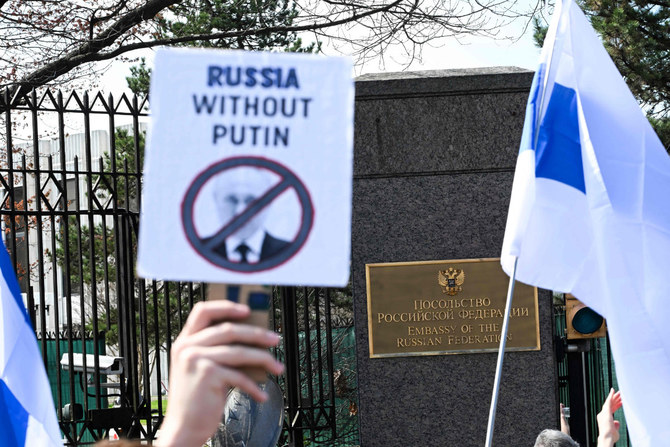
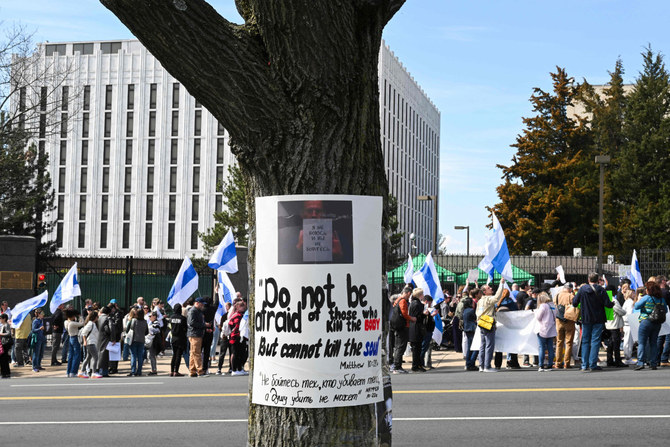
People take part in an anti-Putin rally as voters queue outside the Russian embassy in Washington, DC, on March 17, 2024. (AFP)
2 / 3
People take part in an anti-Putin rally as voters queue outside the Russian embassy in Washington, DC, on March 17, 2024. (AFP)
3 / 3
People take part in an anti-Putin rally as voters queue outside the Russian embassy in Washington, DC, on March 17, 2024. (AFP)
Short Url
Updated 18 March 2024
Follow

A Russia-NATO conflict is just one step from WW3, Putin warns the West

  • Russian ruler issues warning as he claims NATO personnel are already in Ukraine
  • Tells Macron to stop seeking to aggravate the war in Ukraine

MOSCOW: Russian President Vladimir Putin warned the West on Monday that a direct conflict between Russia and the US-led NATO military alliance would mean the planet was one step away from World War Three but said hardly anyone wanted such a scenario.

The Ukraine war has triggered the deepest crisis in Moscow’s relations with the West since the 1962 Cuban Missile Crisis. Putin has often warned of the risks of nuclear war but says he has never felt the need to use nuclear weapons in Ukraine.
French President Emmanuel Macron last month said he could not rule out the deployment of ground troops in Ukraine in the future, with many Western countries distancing themselves from that while others, especially in eastern Europe, expressed support.
Asked by Reuters about Macron's remarks and the risks and possibility of a conflict between Russia and NATO, Putin quipped: “Everything is possible in the modern world.”
“It is clear to everyone, that this will be one step away from a full-scale World War Three. I think hardly anyone is interested in this,” Putin told reporters after winning the biggest-ever landslide in post-Soviet Russian history.
Putin added, though, that NATO military personnel were present already in Ukraine, saying that Russia had picked up both English and French being spoken on the battlefield.
“There is nothing good in this, first of all for them, because they are dying there and in large numbers,” he said.

Buffer zone
Ahead of the March 15-17 Russian election, Ukraine stepped up attacks against Russia, shelling border regions and even used proxies to try to pierce Russia’s borders.
Asked if he considered it necessary to take Ukraine’s Kharkiv region, Putin said if the attacks continued, Russia would create a buffer zone out of more Ukrainian territory to defend Russian territory.
“I do not exclude that, bearing in mind the tragic events taking place today, we will be forced at some point, when we deem it appropriate, to create a certain ‘sanitary zone’ in the territories today under the Kyiv regime,” Putin said.
He declined to give any further details but said such a zone might have to be big enough to preclude foreign-made armaments from reaching Russian territory.
Putin ordered a full-scale invasion of Ukraine in February 2022, triggering a major European war after eight years of conflict in eastern Ukraine between Ukrainian forces on one side and pro-Russian Ukrainians and Russian proxies on the other.
Putin said he wished Macron would stop seeking to aggravate the war in Ukraine and play a role in finding peace: “It seems that France could play a role. All is not lost yet.”
“I’ve been saying it over and over again and I’ll say it again. We are for peace talks, but not just because the enemy is running out of bullets,” Putin said.
“If they really, seriously, want to build peaceful, good-neighborly relations between the two states in the long term, and not simply take a break for rearmament for 1.5-2 years.”

US democracy
Putin dismissed US and Western criticism of the election, which the White House said was not free and fair, saying US elections were not democratic and criticizing the use of state power against Donald Trump.
“The whole world is laughing at what is happening there,” Putin said of the United States. “It is just a catastrophe — it is not democracy — what on earth is it?“
When asked about the fate of opposition leader Alexei Navalny, who died in unexplained circumstances at a Russian prison in the Arctic on Feb. 16, Putin said he had simply “passed away” using Navalny’s name for one of the first times in public.
Putin said he had agreed several days before Navalny’s death to swap him. Reuters reported in February that a prisoner exchange deal had been agreed for Navalny shortly before his death.
“I said: ‘I am agreed’,” Putin said about his approval of the prisoner swap. “I had one condition — we exchange him but he never returns.”
Navalny’s widow, Yulia, has accused Putin of killing her husband. Kremlin spokesman Dmitry Peskov told reporters that claim was simply wrong.


Australian state parliament reconvenes to push through stricter gun laws after Bondi mass shooting

Updated 7 sec ago
Follow

Australian state parliament reconvenes to push through stricter gun laws after Bondi mass shooting

  • The state parliament was recalled for two days from Monday to debate the firearm legislation, which would cap the number of firearms a person can own at four

SYDNEY: Australia’s New South Wales state parliament was recalled on Monday to vote on proposed new laws that would ​impose major curbs on firearm ownership, ban the display of terror symbols and restrict protests, following a mass shooting at Bondi Beach.
The state parliament was recalled for two days from Monday to debate the firearm legislation, which would cap the number of firearms a person can own at four, or up to 10 for certain groups, such as farmers.
There is currently no limit to firearm ownership if the reason can be justified to police, and there are more than 50 people in the state who own more than 100 guns, the Australian Broadcasting Corp. ‌said in a ‌report, citing police data.
One of the alleged Bondi gunmen, ‌Sajid ⁠Akram, ​50, was ‌shot dead by police and owned six firearms. His 24-year-old son Naveed Akram has been charged with 59 offenses, including murder and terrorism, according to police.
Fifteen people were killed and dozens injured in the mass shooting at a Jewish Hanukkah celebration at Sydney’s Bondi Beach on December 14. The attack has shocked the nation and sparked calls for tougher gun laws and heightened efforts to stop antisemitism.
The proposed legislation would also give police more powers to remove face coverings during protests or rallies. The state government has ⁠vowed to ban the chant “globalize the intifada” which it says encourages violence in the community.
Jewish leaders on Sunday called for ‌a royal commission, the most powerful type of Australian government ‍inquiry, to be set up to investigate the ‍attack at Bondi.
The opposition Liberal Party leader Sussan Ley backed those calls on Monday, and ‍told a news conference that she has called on Prime Minister Anthony Albanese to meet with her to review the terms of reference for a royal commission.

ALBANESE APPROVAL DIPS
Albanese has faced mounting criticism from opponents who argue his government has not done enough to curb a rise in antisemitism. He was booed by ​sections of the crowd during a memorial event in Bondi attended by tens of thousands of people on Sunday, one week after the shooting.
Albanese’s government has ⁠said it has consistently denounced antisemitism and highlighted legislation passed over the last two years to criminalize hate speech and doxxing. It also expelled Iran’s ambassador earlier this year after accusing Tehran of directing antisemitic attacks in Sydney and Melbourne.
“You’ve seen us crack down on hate speech. You’ve seen us criminalize doxxing. You’ve seen us be very clear about counterterrorism laws banning Nazi salutes and so forth,” Foreign Minister Penny Wong told ABC Radio on Monday.
A poll conducted for the Sydney Morning Herald newspaper among 1,010 voters released on Monday found Albanese’s approval rating slumped 15 points to -9 from +6 at the beginning of December, the lowest since his resounding election win in May.
Authorities on Monday started clearing flowers, candles, letters and other items placed by the public at Bondi Beach.
The tributes would be preserved ‌for display at the Sydney Jewish Museum and the Australian Jewish Historical Society, authorities said.
Thirteen people remain in hospital, including four in critical but stable condition, health officials said.