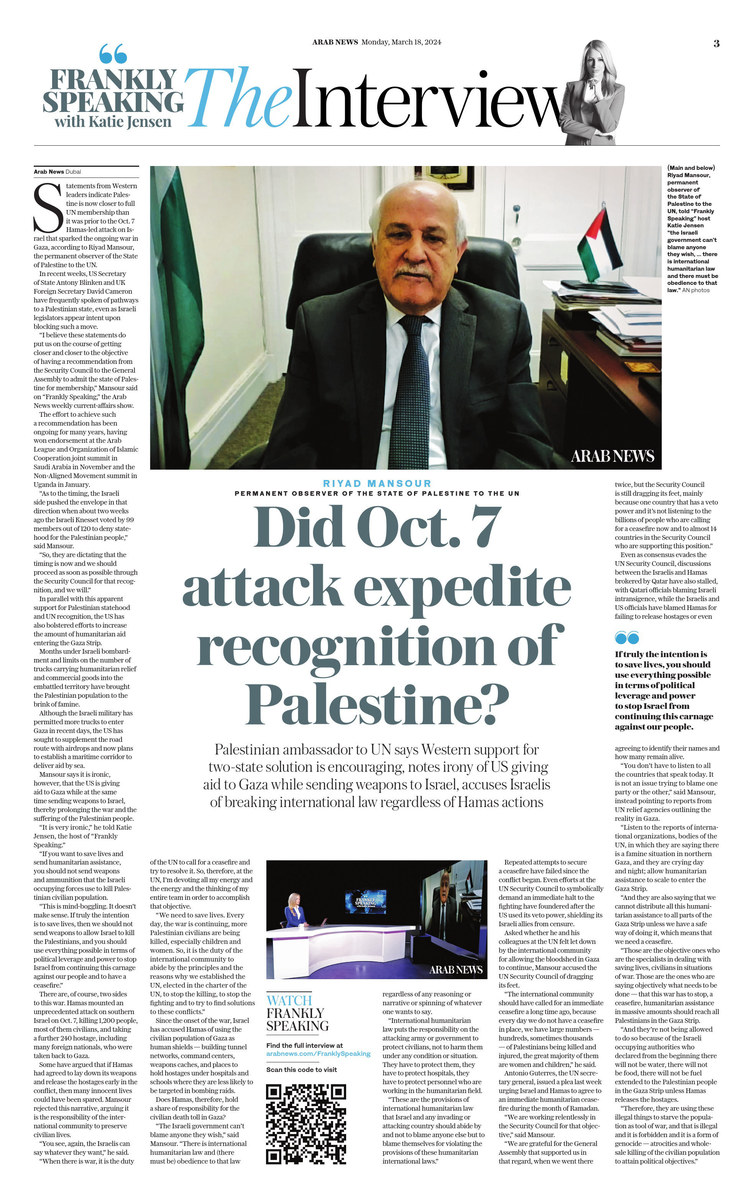
DUBAI: Statements from Western leaders indicate Palestine is now closer to full UN membership than it was prior to the Oct. 7 Hamas-led attack on Israel that sparked the ongoing war in Gaza, according to Riyad Mansour, the permanent observer of the State of Palestine to the UN.
In recent weeks, US Secretary of State Antony Blinken and UK Foreign Secretary David Cameron have frequently spoken of pathways to a Palestinian state, even as Israeli legislators appear intent upon blocking such a move.
“I believe these statements do put us on the course of getting closer and closer to the objective of having a recommendation from the Security Council to the General Assembly to admit the state of Palestine for membership,” Mansour said on “Frankly Speaking,” the Arab News weekly current affairs show.
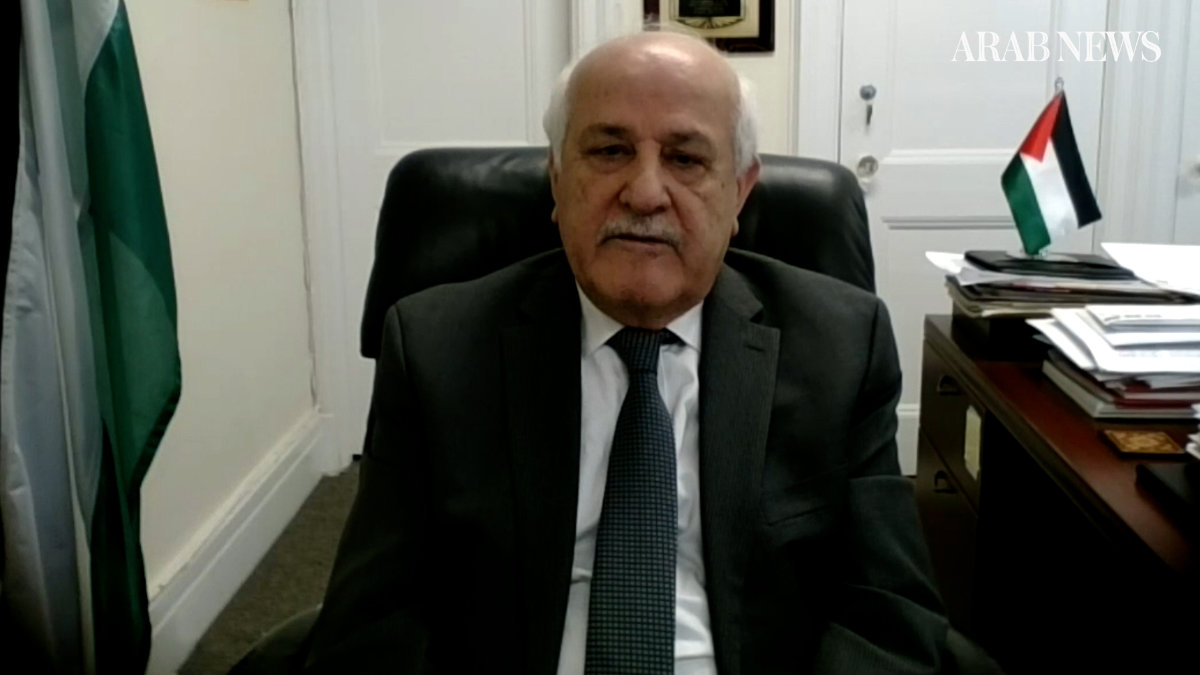
Riyad Mansour, permanent observer of the State of Palestine to the UN, said “the Israeli government can’t blame anyone they wish, ... there is international humanitarian law and there must be obedience to that law.” (AN photo)
The effort to achieve such a recommendation has been ongoing for many years, having won endorsement at the Arab League and Organization of Islamic Cooperation joint summit in Saudi Arabia in November and the Non-Aligned Movement summit in Uganda in January.
“As to the timing, the Israeli side pushed the envelope in that direction when about two weeks ago the Israeli Knesset voted by 99 members out of 120 to deny statehood for the Palestinian people.
“So, they are dictating that the timing is now, and we should proceed as soon as possible through the Security Council for that recognition, and we will,” Mansour added.
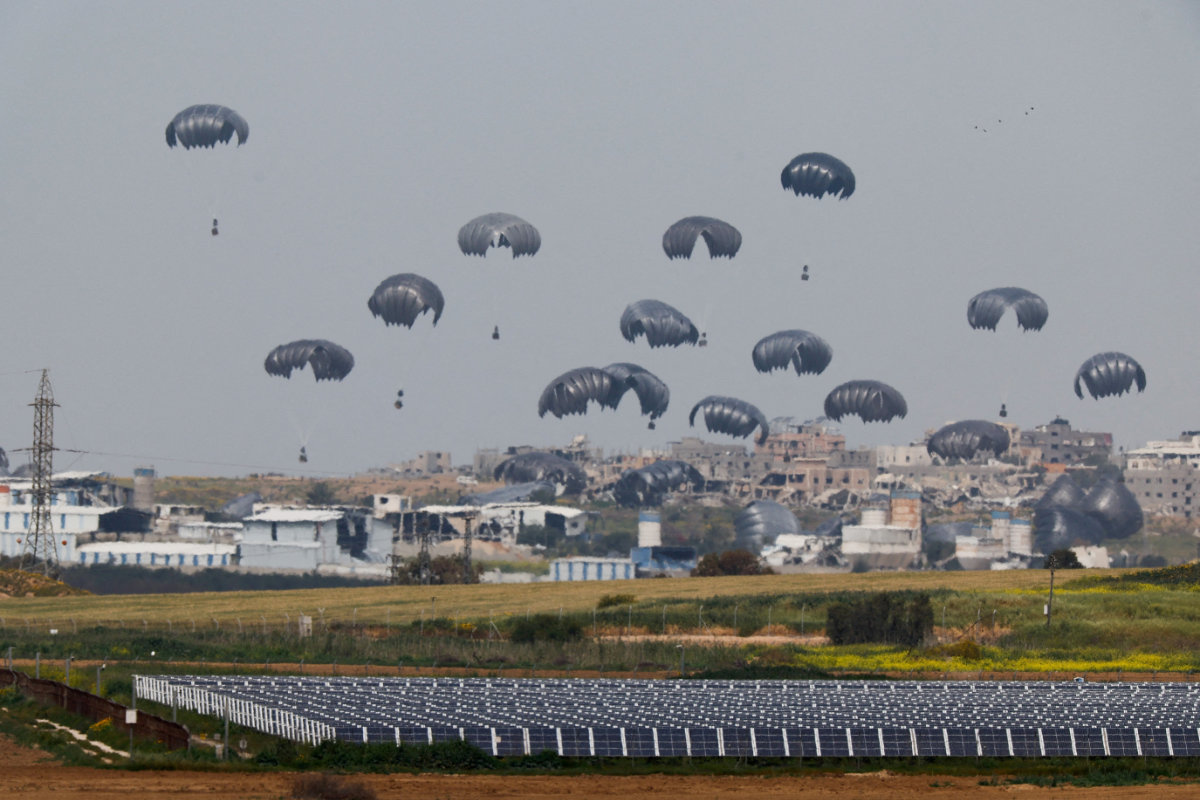
Humanitarian aid falls through the sky towards the Gaza Strip after being dropped from an aircraft on March 17, 2024. (REUTERS)
In parallel with the apparent support for Palestinian statehood and UN recognition, the US has also bolstered efforts to increase the amount of humanitarian aid entering the Gaza Strip.
Months under Israeli bombardment and limits on the number of trucks carrying humanitarian relief and commercial goods into the embattled territory have brought the Palestinian population to the brink of famine.
Although the Israeli military has permitted more trucks to enter Gaza in recent days, the US has sought to supplement the road route with airdrops and now plans to establish a maritime corridor to deliver aid by sea.
Opinion
This section contains relevant reference points, placed in (Opinion field)
Mansour noted that it was ironic, however, that the US was giving aid to Gaza while at the same time sending weapons to Israel, thereby prolonging the war and the suffering of the Palestinian people.
He told “Frankly Speaking” show host Katie Jensen: “It is very ironic. If you want to save lives and send humanitarian assistance, you should not send weapons and ammunition that the Israeli occupying forces use to kill the Palestinian civilian population.
“This is mind-boggling. It doesn’t make sense. If truly the intention is to save lives, then we should not send weapons to allow Israel to kill the Palestinians, and you should use everything possible in terms of political leverage and power to stop Israel from continuing this carnage against our people and to have a ceasefire.”

Riyad Mansour, permanent observer of the State of Palestine to the UN, told “Frankly Speaking” host Katie Jensen “the Israeli government can’t blame anyone they wish, ... there is international humanitarian law and there must be obedience to that law.” (AN photo)
There are, of course, two sides to the war.
Hamas mounted an unprecedented attack on southern Israel on Oct. 7, killing 1,200 people, most of them civilians, and taking a further 240 hostage, including many foreign nationals, who were taken back to Gaza.
Some have argued that if Hamas had agreed to lay down its weapons and release the hostages early in the conflict, then many innocent lives could have been spared. But Mansour has rejected such narrative, arguing that it was the responsibility of the international community to preserve civilian lives.
He said: “You see, again, the Israelis can say whatever they want. When there is war, it is the duty of the UN to call for a ceasefire and try to resolve it.
“So, therefore, at the UN, I’m devoting all my energy and the energy and the thinking of my entire team in order to accomplish that objective.
“We need to save lives. Every day, the war is continuing, more Palestinian civilians are being killed, especially children and women.
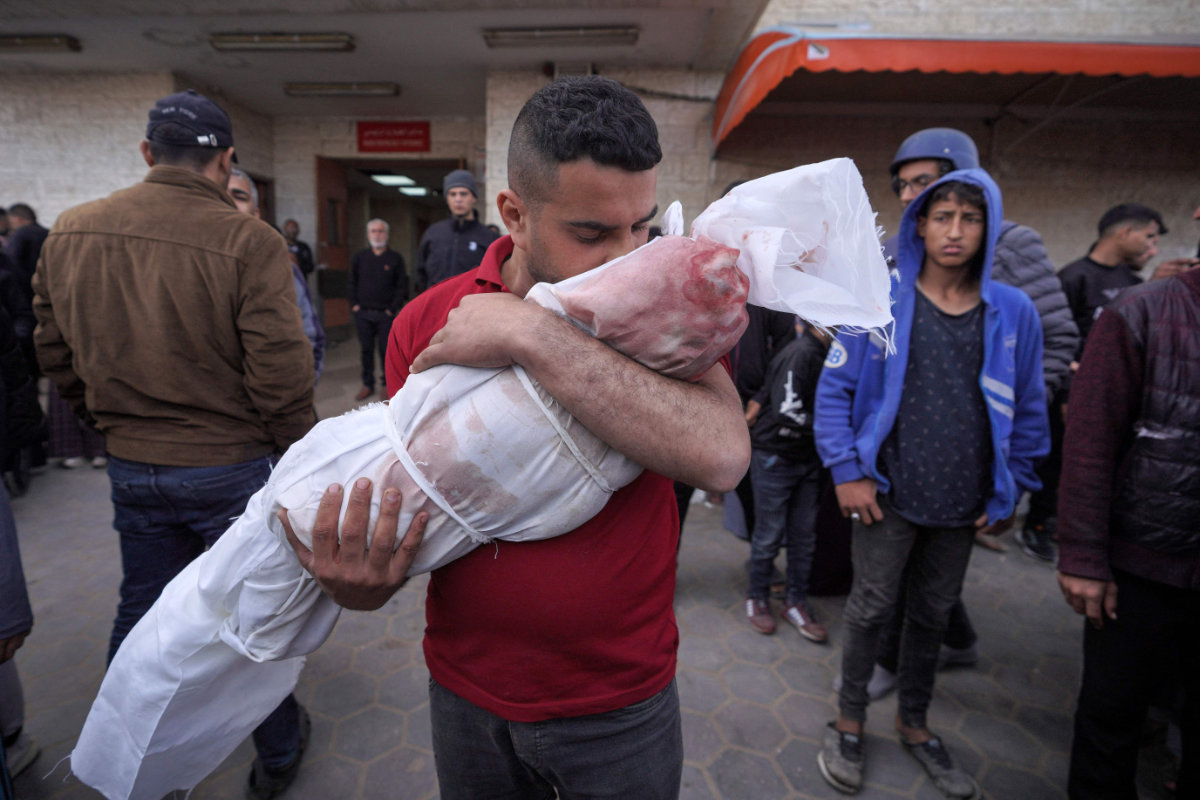
A Palestinian man kisses the shrouded body of a child killed in an Israeli bombing in Deir el-Balah in the central Gaza Strip before the burial on March 14, 2024. (AFP)
So, it is the duty of the international community to abide by the principles and the reasons why we established the UN, elected in the charter of the UN, to stop the killing, to stop the fighting, and to try to find solutions to these conflicts.”
Since the onset of the war, Israel has accused Hamas of using the civilian population of Gaza as human shields — building tunnel networks, command centers, weapons caches, and places to hold hostages under hospitals and schools where they are less likely to be targeted in bombing raids.
Does Hamas, therefore, hold a share of responsibility for the civilian death toll in Gaza?
“The Israeli government can’t blame anyone they wish. There is international humanitarian law and obedience to that law regardless of any reasoning or narrative or spinning of whatever one wants to say.
“International humanitarian law puts the responsibility on the attacking army or government to protect civilians, not to harm them under any condition or situation. They have to protect them, they have to protect hospitals, they have to protect personnel who are working in the humanitarian field.
“These are the provisions of international humanitarian law that Israel and any invading or attacking country should abide by and not to blame anyone else but to blame themselves for violating the provisions of these humanitarian international laws,” Mansour added.
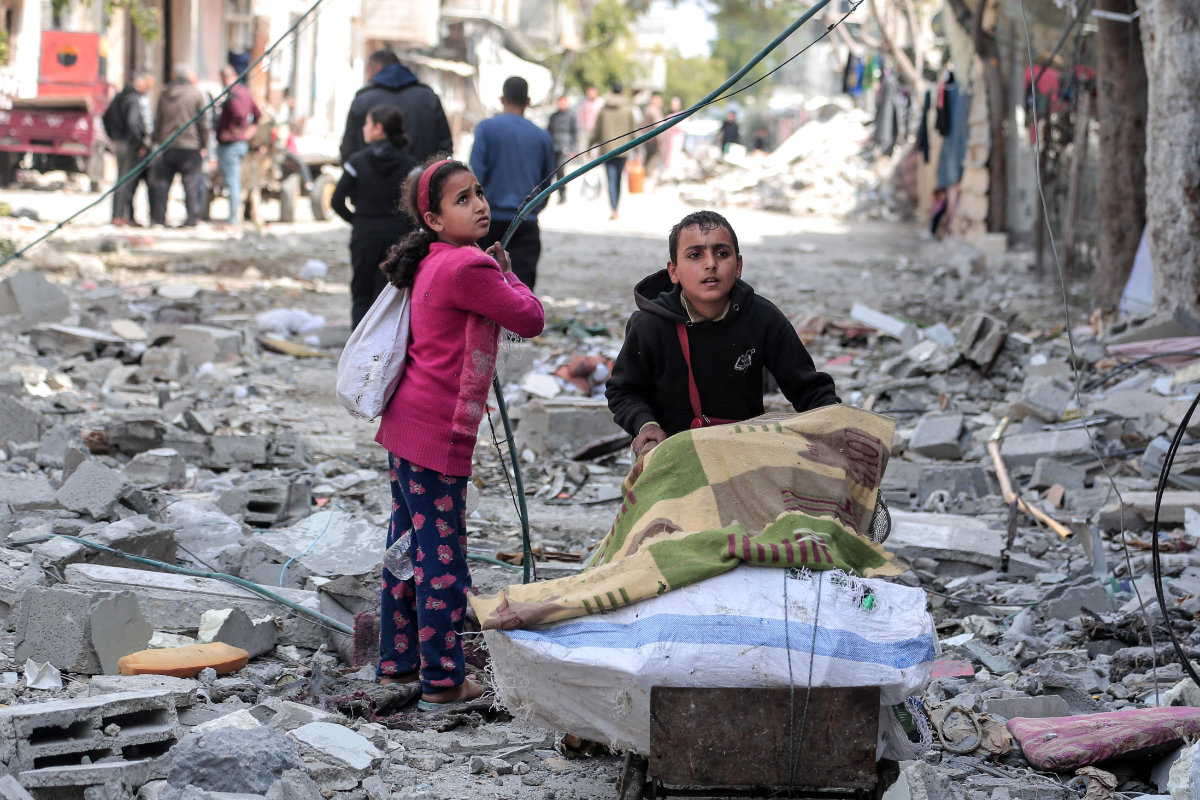
Palestinian children salvage some items found amid the destruction caused by Israeli bombing in Bureij in the central Gaza Strip on March 14, 2024. (AFP)
Repeated attempts to secure a ceasefire have failed since the conflict began. Even efforts at the UN Security Council to symbolically demand an immediate halt to the fighting have foundered after the US used its veto power, shielding its Israeli allies from censure.
On whether he and his colleagues at the UN felt let down by the international community for allowing the bloodshed in Gaza to continue, Mansour accused the UN Security Council of dragging its feet.
“The international community should have called for an immediate ceasefire a long time ago, because every day we do not have a ceasefire in place, we have large numbers — hundreds, sometimes thousands — of Palestinians being killed and injured, the great majority of them are women and children,” he said.
READ MORE:
UNICEF says over 13,000 children killed in Gaza in Israeli offensive
US should end weapon supplies to Israel over Gaza war, says top Democrat senator
UN Secretary-General Antonio Guterres issued a plea last week urging Israel and Hamas to agree to an immediate humanitarian ceasefire during the month of Ramadan.
“We are working relentlessly in the Security Council for that objective.
“We are grateful for the General Assembly that supported us in that regard, when we went there twice, but the Security Council is still dragging its feet, mainly because one country that has a veto power and it’s not listening to the billions of people who are calling for a ceasefire now and to almost 14 countries in the Security Council who are supporting this position,” Mansour added.
Even as consensus evades the UN Security Council, discussions between the Israelis and Hamas brokered by Qatar have also stalled.
Qatari officials accuse the Israeli government of adopting inflexible positions, while Israeli and US officials put the blame on Hamas for failing to release hostages or even agreeing to identify their names or disclose how many remain alive.

Relatives of Israelis being held in Gaza by Hamas militants in Gaza gather in front of the Defense Ministry in Tel Aviv on March 9, 2024, to press their demand for the release of their loved ones. (AFP)
“You don’t have to listen to all the countries that speak today. It is not an issue trying to blame one party or the other,” Mansour said.
“Pay attention to the reports of international organizations, bodies of the UN, in which they are saying there is a famine situation in northern Gaza, and they are crying day and night; allow humanitarian assistance to scale to enter the Gaza Strip.
“And they are also saying that we cannot distribute all this humanitarian assistance to all parts of the Gaza Strip unless we have a safe way of doing it, which means that we need a ceasefire.
“Those are the objective ones who are the specialists in dealing with saving lives, civilians in situations of war. Those are the ones who are saying objectively what needs to be done — that this war has to stop, a ceasefire, humanitarian assistance in massive amounts should reach all Palestinians in the Gaza Strip.
“And they’re not being allowed to do so because of the Israeli occupying authorities who declared from the beginning there will not be water, there will not be food, there will not be fuel extended to the Palestinian people in the Gaza Strip unless Hamas releases the hostages.
“Therefore, they are using these illegal things to starve the population as tools of war, and that is illegal and it is forbidden and it is a form of genocide — atrocities and wholesale killing of the civilian population to attain political objectives,” he added.
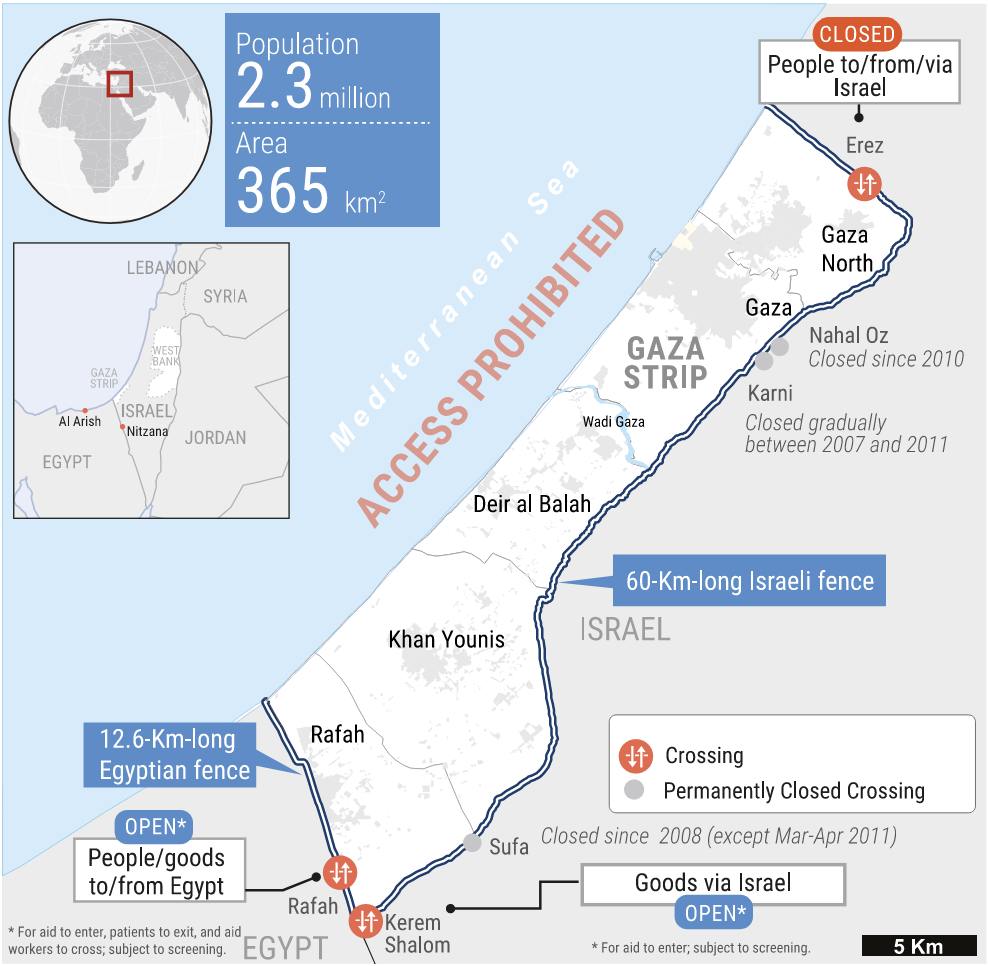
Infographic courtesy of the UN Office for the Coordination of Humanitarian Affairs
UK Foreign Minister Cameron recently said that the leaders of Hamas would need to leave Gaza and must not be permitted to play a role in the enclave’s post-war governance or in a future independent Palestinian state.
But Mansour pointed out that this was a matter for the Palestinians themselves to decide.
He said: “First of all, it is not up to anyone to put conditions on our natural and individual right to exercise self-determination, including our right to have our own independent state.
“These are innate rights for the Palestinian people unconditionally. The UK or anybody else, they cannot impose on the Palestinian people different conditions. For example, when Israel declared its independence in 1948, they did not negotiate that with anyone, nor did they ask for permission from anyone.
“The Palestinian people will not be the exception to the rule. They will behave in such a way that it is an innate right for them to exercise self-determination, including statehood and the independence of our state without conditions, without negotiations, without permit from anyone.”