

Thai tourist hotspot Chiang Mai tops world’s most polluted cities

1 / 3
An airplane flies over a busy road as it lands at Chiang Mai International Airport amid high levels of air pollution in Chiang Mai on March 15, 2024. (AFP)
2 / 3
An airplane flies over a busy road as it lands at Chiang Mai International Airport amid high levels of air pollution in Chiang Mai on March 15, 2024. (AFP)
3 / 3
A man steers a boat on a lake amid high air pollution at the Srilanna National Park in the northern Thai province of Chiang Mai on March 16, 2024. (AFP)
Short Url
Updated 17 March 2024
Follow

Thai tourist hotspot Chiang Mai tops world’s most polluted cities

  • High levels of pollution frequently hit Chiang Mai during the early months of the year when farmers often burn crops to clear land
  • Located in the north, Thailand's second largest city has a population of 1.2 million people as of 2022

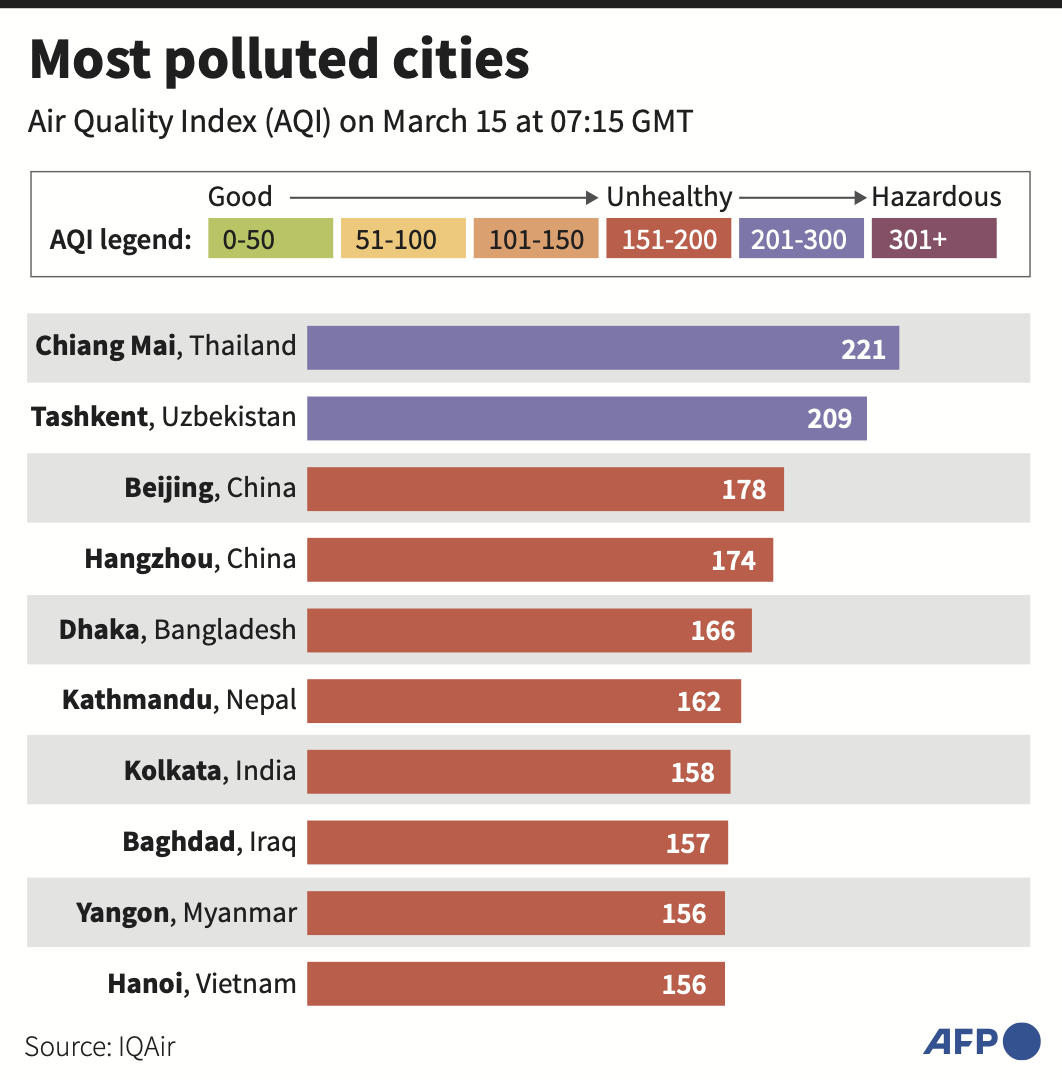
CHIANG MAI, Thailand: Thai tourist hotspot Chiang Mai was blanketed by hazy smog Friday, as residents and visitors to the usually picturesque northern city were left wheezing in the toxic air.

The country's second largest city topped air monitoring website IQAir’s table of the world’s most polluted cities early Friday.
Levels of PM2.5 pollutants — cancer-causing microparticles small enough to enter the bloodstream through the lungs — were classified as “very unhealthy” and hit more than 35 times the World Health Organization’s annual guideline.
“It’s very high. All I have is this mask which is the same one I used for Covid,” orange seller Kamol, 62, told AFP at the city’s Warorot Market.
Thailand’s former prime minister Thaksin Shinawatra, who was recently freed early from a jail sentence for graft and abuse of power following 15 years in self-exile, visited the market on Friday, donning a face mask while he posed for photos with well-wishers.
High levels of pollution frequently hit Thaksin’s hometown of Chiang Mai during the early months of the year when farmers often burn crops to clear land, and forest fires and exhaust fumes also add to the problem.
Rising awareness of the health implications has prompted some action from the government, with Prime Minister Srettha Thavisin’s cabinet approving a Clean Air Act to tackle the issue in January.
The premier is also due to visit later Friday and is expected to meet with organizations tackling forest fires on Saturday.
But Chiang Mai residents — like orange seller Kamol, who sighed and shook his head when asked — said they had received no help.
“I need to get my health checked every year, especially for respiratory diseases,” he said.
A government agency warned this month that more official action was needed, saying at least 10 million people required treatment for pollution-related health problems last year.
“The pollution is always high, especially this time of year,” said 50-year-old Sariya while shopping for groceries in Chiang Mai.
“There is nothing we can do about it since it’s always high.”
Sariya, who gave only one name, also said the city’s location — nestled between hills, trapping the toxic smog — made the situation worse.
But he was “more worried” about people living there with underlying health issues, adding: “We need to help ourselves.”

Last year, sky-rocketing levels of pollution saw international tourists discouraged from visiting, with vendors despairing for business, as the Thai Hotel Association Northern Chapter also warned domestic visitors were canceling bookings.
But in Chiang Mai on Friday, the streets were filled with ambling tourists who seemed unperturbed by the smog.
“I’m not afraid of the pollution,” said 32-year-old Chinese tourist Andy, visiting from Chengdu, who said his country also suffered from poor air pollution.
“I just enjoy the city because it’s very nice.”
French programmer Guillaume Tieufri, 44, said the pollution had not spoilt his four-day trip.
“You just have to go on and live your day.”


Philippines struggles to evacuate nationals from Middle East as attacks escalate across region

Philippine President Ferdinand Marcos Jr. leads a Special Cabinet Meeting to discuss the situation in the Middle East.
Updated 6 sec ago
Follow

Philippines struggles to evacuate nationals from Middle East as attacks escalate across region

  • Over 1,400 Philippine nationals in Middle East have requested for repatriation
  • Filipinos are told to shelter in place, follow host government’s advice on situation

MANILA: The Philippines is in talks to evacuate its nationals from across the Middle East, President Ferdinand Marcos Jr. said on Tuesday, as an increasing number of Filipinos are seeking to leave amid growing destruction from US-Israeli strikes on Iran and Tehran’s counterstrikes against US bases in Gulf countries.

More than 2.4 million Filipinos live and work in the Middle East, where tensions have been high since Saturday, after coordinated US-Israel strikes killed Iran’s Supreme Leader Ali Khamenei and senior Iranian officials.

Tehran responded by targeting US military bases in Gulf countries, and violence has been widening across the region. 

Evacuating Philippine nationals across the region is not yet possible, Marcos said, as countries closed their airspace, leading to airport shutdowns and the cancellation of thousands of flights throughout the Middle East.

“For now, we are depending on the advice that will be given to us by the local authorities in the place where our nationals — where our people — are,” Marcos told reporters in Manila on Tuesday.

The Philippine government has received requests for repatriation from more than 1,400 Filipino nationals in various Middle Eastern countries, including 872 from the UAE and almost 300 from Israel. Similar requests have also been made by Filipinos in Iran, Bahrain and Jordan.

“Right now, the most dangerous area for our people right now would be Israel as attacks there are continuous,” Marcos said.

“The problem now is that no planes are flying and airports are being hit. That’s why the situation is very fluid, our assessment is that it may be too dangerous to mount flights.

“Even if we could charter an aircraft, we cannot do anything because number one, the airports are closed. They are all no-fly zones.”

As the Philippine government prepares for multiple scenarios, officials have secured buses and other vehicles for possible evacuation by land.

Filipinos in “danger areas” have been moved to a safer place, Marcos said, citing the targeting of Saudi Arabia’s Ras Tanura oil refinery by Iranian drones on Monday morning.

“But essentially our advice to them is shelter in place and follow the host government’s advice … For now it’s extremely difficult to enter or exit the region because the only aircraft flying are fighter jets and drones, and missiles.

“That’s why it is not a place that you would want to put in a civilian aircraft to take out our nationals,” he said.

“But again, as I said, the situation is changing by the minute, by the hour. We just have to be in very good and close contact with the local authorities.”