

Hamas, Houthis hold rare meeting: Palestinian sources

1 / 3
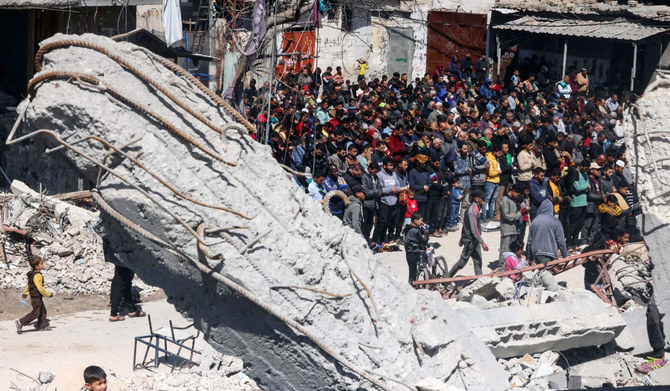
Palestinians perform the first Friday noon prayer of the Muslim holy fasting month of Ramadan in front of the ruins of Al-Farouq Mosque on March 15, 2024, destroyed in Israeli bombardment in Rafah in the southern Gaza Strip, amid ongoing battles between Israel and the militant group Hamas. (AFP)
2 / 3
This picture taken from Israel near the border with the Gaza Strip shows Israeli armoured personnel carriers moving out of Gaza on February 26, 2024, amid the ongoing battles between Israel and the Palestinian militant group Hamas. (AFP)
3 / 3
This picture taken from a position in northern Israel shows an Israeli Air Force fighter jet flying over the border area with south Lebanon on March 10, 2024, amid increasing cross-border tensions between Lebanon's Hezbollah and Israel as fighting continues with Hamas militants in the Gaza Strip. (AFP)
Short Url
Updated 16 March 2024
Follow

Hamas, Houthis hold rare meeting: Palestinian sources

  • The Palestinian groups and the Houthis also talked about a possible Israeli ground assault into southern Gaza’s Rafah, said the sources, who requested anonymity

BANDE DE GAZA, Palestinian Territories: Senior figures from Hamas and Yemen’s Houthi rebels held a rare meeting to discuss coordinating their actions against Israel, Palestinian factional sources told AFP on Friday.
Hamas and the Houthis belong to the “axis of resistance,” a collection of Iran-backed movements hostile to Israel and the United States that also includes Lebanon’s Hezbollah and Iraqi militias.
The Houthis have attacked Red Sea shipping for months since the Israel-Hamas war broke out on October 7, saying they are targeting Israeli-linked vessels in solidarity with Palestinians in Gaza.
According to sources from Hamas and Islamic Jihad, leaders from the two Palestinian Islamist groups, as well as the Marxist Popular Front for the Liberation of Palestine, held an “important meeting” with Houthi representatives last week.
The groups discussed “mechanisms to coordinate their actions of resistance” for the “next stage” of the war in Gaza, the sources said without identifying where the meeting took place.
The Palestinian groups and the Houthis also talked about a possible Israeli ground assault into southern Gaza’s Rafah, said the sources, who requested anonymity.
According to the United Nations, around 1.5 million people are crowded into and around Rafah, Hamas’s last stronghold in Gaza, most of whom are displaced and crammed against the Egyptian border in dire living conditions.
Israeli Prime Minister Benjamin Netanyahu’s office said on Friday he had approved the military’s plan for an operation in Rafah.
The Houthis confirmed they would continue their attacks on Red Sea shipping to “support the Palestinian resistance,” according to the Hamas and Islamic Jihad sources.
The rebels’ leader Abdul Malik Al-Houthi said on Thursday their attacks would expand to target ships avoiding the Red Sea by navigating past South Africa’s Cape of Good Hope.
Hamas’s unprecedented October 7 attack resulted in about 1,160 deaths in Israel, mostly civilians, according to an AFP tally of official Israeli figures.
Palestinian militants also seized about 250 Israeli and foreign hostages, dozens of whom were released during a week-long truce in November. Israel believes about 130 captives remain in Gaza, including 32 presumed dead.
Israel’s retaliatory campaign against Hamas has killed at least 31,490 people in Gaza, most of them women and children, according to the territory’s health ministry.


Lebanon’s south could become US-backed economic zone, according to local paper Nidaa Al-Watan

Updated 7 sec ago
Follow

Lebanon’s south could become US-backed economic zone, according to local paper Nidaa Al-Watan

  • Lebanese daily quotes sources as saying the US plan casts southern Lebanon as a key gateway for broader economic transformation
  • White House fails to respond to Arab News’ request for comment

LONDON: Lebanese daily Nidaa Al-Watan has reported that the office of Jared Kushner, son-in-law and senior adviser to US President Donald Trump, has prepared detailed maps for a so‑called “Trump Economic Zone” in southern Lebanon. 

According to columnist Tarek Abou Zeinab, the Kushner plan has been formally submitted to the White House for consideration. 

Citing unnamed sources, the column said that the idea is no longer just a “whispered” concept among political circles but has entered what it described as “concrete border‑related discussions aimed at fast‑tracking the plan onto the US administration’s Middle East implementation agenda.” 

Arab News asked the US Embassy in Beirut and the US State Department for comment, but was directed to the White House for any official response. The White House was subsequently contacted but has not responded. 

Lebanon has been mired in prolonged political paralysis. Large parts of the south remain under Hezbollah’s influence, while Israel illegally occupies at least five outposts along the border that are within Lebanese sovereign land. 

According to Nidaa Al‑Watan’s sources, the US concept frames southern Lebanon as a key gateway for a wider economic transformation, tying large‑scale investment and infrastructure projects to security arrangements on the ground. 

The reported plan would seek to attract international capital, establish factories and logistics hubs, upgrade infrastructure, and build a port connected to global shipping routes. 

Its aim, according to the column, would be to open new export channels through a free‑zone model and lure major energy companies by linking southern Lebanon to wider schemes such as the India–Middle East–Europe Economic Corridor. 

Supporters of the plan argue it could trigger large Arab and international investments, raise living standards and create long‑term jobs, thereby lowering the risk of renewed conflict. 

However, Lebanese political and media sources quoted by the daily have warned that the proposal follows a new “hegemonic” approach and carries major political implications that cannot be ignored. 

The critics say the reported US vision goes beyond development to include the establishment of Jewish settlements in parts of southern Lebanon, justified on religious and security grounds to protect northern Israel. 

One source expressed concern that such moves would create a geographic and symbolic link between Israel and southern Lebanon, deepening fears over sovereignty and the region’s future political trajectory. 

The paper said Kushner is focussed on areas stretching from Mount Hermon to Shebaa and Naqoura in the far south at a time when Israel has been pressing for a buffer zone along the border, citing security concerns since the end of major clashes with Hezbollah in November 2024. 

The proposed zone would cover more than 27 southern towns, raising questions over Lebanese sovereignty. 

In parallel, the Lebanese army has been tasked with bringing all weapons under state control and asserting government authority in areas long dominated by Hezbollah, as part of a broader disarmament and security plan. 

Despite a ceasefire, Israel has continued to carry out attacks inside Lebanese territory and maintains control over parts of the south, saying the measures are necessary for security. 

Lebanese and Israeli delegations held talks in Naqoura earlier in December to shore up the ceasefire and discuss reconstruction in the south.