Nicaragua-Germany Gaza case before ICJ next month

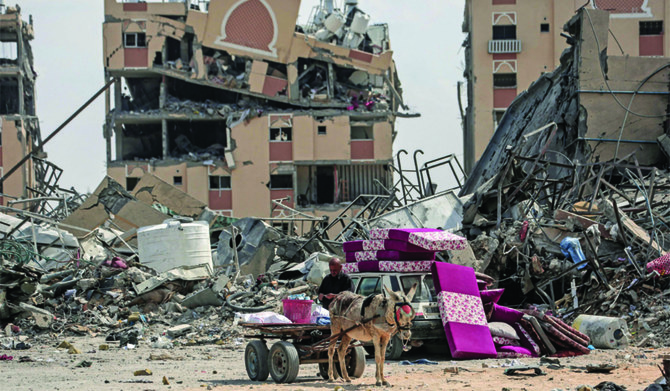
A displaced Palestinian man sits on a donkey cart amid the rubble of houses destroyed by Israeli bombardment in Hamad area, west of Khan Younis in the southern Gaza Strip, amid the ongoing conflict between Israel and Hamas. (AFP)
Short Url
Updated 16 March 2024
Follow

Nicaragua-Germany Gaza case before ICJ next month

  • The lodging of the case follows the ICJ saying on January 26 that Israel must do everything to prevent genocidal acts in Gaza and take “immediate” measures for aid provisions

THE HAGUE: Top UN judges will start listening to submissions next month in the case filed by Nicaragua accusing Berlin of facilitating “genocide” in Gaza because it supported Israel, officials said on Friday.
Two weeks ago, Nicaragua filed a case against Germany before the International Court of Justice, saying Berlin was “facilitating the commission of genocide and ... failed in its obligation to do everything possible to prevent the commission of genocide” in Gaza.
This included Berlin’s suspension of funding of the UN Palestinian refugee agency.
The Hague-based ICJ said it will hold hearings on April 8 and 9 for both countries to make submissions.
“The hearings will be devoted to the request for the indication of provisional measures contained in Nicaragua’s application,” the ICJ said in a statement.
Managua had asked the court to take a swift interim stance against Germany before judges gave the case an in-depth study.
The lodging of the case follows the ICJ saying on January 26 that Israel must do everything to prevent genocidal acts in Gaza and take “immediate” measures for aid provisions.
That interim order was given as the court moves to weigh in full a case lodged in December by South Africa alleging that Israel was engaged in genocide in Gaza.
Israel has dismissed South Africa’s case as a “grossly distorted story.”
ICJ rulings are legally binding, but the court has no enforcement mechanism.
Accusations from Israel that staff from UNRWA, the UN agency for Palestinian refugees, took part in the Oct. 7 Hamas attack on Israel prompted several countries — including Germany, Britain, Japan and the US — to suspend their funding.
However, Canada and Sweden said they would resume UNRWA aid, and Spain has pledged an additional €20 million.
Efforts haveintensified to bring more aid into the war-devastated Gaza.


Tunisians revive protests in Gabes over pollution from state chemical plant

Updated 12 sec ago
Follow

Tunisians revive protests in Gabes over pollution from state chemical plant

  • People chanted mainly “Gabes wants to live“
  • The powerful UGTT union has called for a nationwide strike next month

TUNIS: Around 2,500 Tunisians marched through the coastal city of Gabes on Wednesday, reviving protests over pollution from a state-owned phosphate complex amid rising anger over perceived failures to protect public health.
People chanted mainly “Gabes wants to live,” on the 15th anniversary of the start of the 2011 pro-democracy uprising that sparked the Arab Spring movement against autocracy.
The protest added to the pressure on President Kais Saied’s government, which is grappling with a deep financial crisis and growing street unrest, protests by doctors, journalists, banks and public transport systems.
The powerful UGTT union has called for a nationwide strike next month, signalling great tension in the country. The recent protests are widely seen as one of the biggest challenges facing Saied since he began ruling by decree in 2021.
Protesters chanted slogans such as “We want to live” and “People want to dismantle polluting units,” as they marched toward Chatt Essalam, a coastal suburb north of the city where the Chemical Group’s industrial units are located.
“The chemical plant is a fully fledged crime... We refuse to pass on an environmental disaster to our children, and we are determined to stick to our demand,” said Safouan Kbibieh, a local environmental activist.
Residents say toxic emissions from the phosphate complex have led to higher rates of respiratory illnesses, osteoporosis and cancer, while industrial waste continues to be discharged into the sea, damaging marine life and livelihoods.
The protests in Gabes were reignited after hundreds of schoolchildren suffered breathing difficulties in recent months, allegedly caused by toxic fumes from a plant converting phosphates into phosphoric acid and fertilizers.
In October, Saied described the situation in Gabes as an “environmental assassination”, blaming policy choices made by previous governments, and has called for urgent maintenance to prevent toxic leaks.
The protesters reject the temporary measures and are demanding the permanent closure and relocation of the plant.