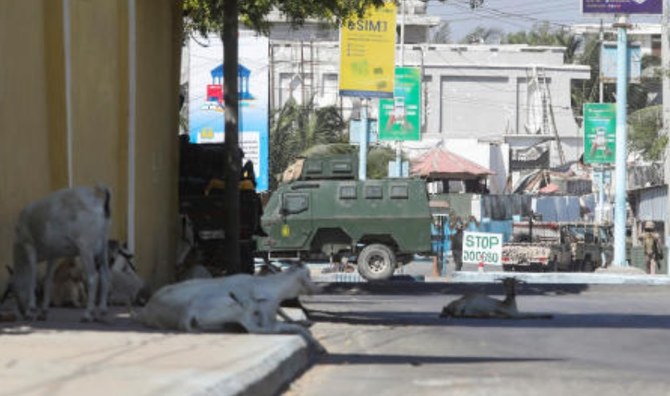
MOGADISHU: Three people were killed in an hours-long siege by Al-Shabab militants at a popular hotel near the presidential palace in the Somali capital Mogadishu, police said Friday.
Armed fighters had stormed the SYL hotel in a hail of bullets late on Thursday before security forces announced Friday they had brought the situation under control after more than 13 hours.
“Three people died in the attack and 27 others including 18 civilians and nine soldiers were wounded,” Somali police spokesman Col. Qasim Ahmed Roble told a press conference, adding that the injury toll included three lawmakers.
Security forces also killed five assailants in a gunbattle, he added.
“The situation at the hotel is back to normal now,” Roble said.
The attack on the SYL hotel — which has been targeted several times in the past — occurred at the start of the holy Muslim month of Ramadan.
It broke a relative lull in violence by the Al-Qaeda-linked jihadist group, demonstrating its continued ability to strike despite a major military offensive against the militants.
“Several gunmen forced their way into the building after destroying the perimeter wall with a heavy explosion,” security officer Ahmed Dahir told AFP.
Witnesses described hearing the assailants shoot indiscriminately.
“I don’t know about the casualties but there were many people inside when the attack started,” said Hassan Nur, who escaped by scaling a wall.
Other witnesses said police arrived at the hotel within minutes of the attack, triggering a fierce gunbattle.
Abdullahi Hassan, who was at a nearby house, said the officers arrived in multiple vehicles and that ambulances carried away wounded people.
The same hotel has been hit by Al-Shabab several times, most recently in 2019 when five people were killed.
The SYL is close to the Villa Somalia government complex, a high-security area that includes the presidential palace, the prime minister’s office and ministry buildings.
“It is a highly significant attack that shatters a sense of calm in Mogadishu that has developed in recent months following some security reforms,” said Omar Mahmood, senior analyst at the International Crisis Group (ICG), noting that in the past Al-Shabab assaults had increased during Ramadan.
“It also serves as a signal from Al-Shabab that despite much heralded efforts by this government to weaken them, the group remains active and resilient, and even able to hit the government close to home.”
The jihadists have been waging war against the federal government for more than 16 years and have often targeted hotels, which tend to host high-ranking Somali and foreign officials.
Although Al-Shabab was driven out of the capital by an African Union force, it retains a strong presence in rural Somalia and has carried out numerous attacks against political, security and civilian targets.
The beleaguered central government launched a major offensive against the Islamists in August 2022, joining forces with local clan militias.
The army and militias known as “macawisley” have retaken swathes of territory in central Somalia in an operation backed by the AU mission known as ATMIS and US air strikes.
But the offensive has suffered setbacks, with Al-Shabab earlier this week claiming that it had taken control of multiple locations in the center of the country.
President Hassan Sheikh Mohamud met defense officials on Thursday at a “strategic meeting” to establish a plan to reclaim the lost territory, Somali national news agency SONNA reported.
“The president commended the valiant efforts of Somali forces and emphasized the government’s unwavering resolve to eradicate terrorism,” it said.
In January, Al-Shabab took a number of people hostage after a UN helicopter carrying nine passengers made an emergency landing in its territory.
In June last year, six civilians were killed in a six-hour siege at a beachside hotel in Mogadishu.
And in August 2022, 21 people were killed and more than 100 injured in a 30-hour siege on Mogadishu’s Hayat Hotel.
In October 2022, 100 people lost their lives in twin car bombings in Mogadishu, the deadliest strike since Mohamud took office in May of that year.
Thursday’s attack comes days after the US slapped sanctions on 16 individuals and entities across the Horn of Africa and the Middle East that it accused of laundering money for Al-Shabab.

Three killed in Al-Shabab siege at Mogadishu hotel: police
https://arab.news/cpnsx
Three killed in Al-Shabab siege at Mogadishu hotel: police
- Security forces announced Friday they had brought the situation under control after more than 13 hours
- Three people died in the attack and 27 others including 18 civilians and nine soldiers were wounded
The shootings in Minneapolis are upending the politics of immigration in Congress
- Many GOP lawmakers continue to embrace the Trump administration’s deportation strategy
WASHINGTON: The shooting deaths of two American citizens during the Trump administration’s deportation operations in Minneapolis have upended the politics of immigration in Congress, plunging the country toward another government shutdown.
Democrats have awakened to what they see as a moral moment for the country, refusing funds for the Department of Homeland Security’s military-style immigration enforcement operations unless there are new restraints. Two former presidents, Barack Obama and Bill Clinton, have broken from retirement to speak out.
At the same time, Republicans who have championed President Donald Trump’s tough approach to immigration are signaling second thoughts. A growing number of Republicans want a full investigation into the shooting death of Alex Pretti and congressional hearings about US Immigration and Customs Enforcement operations.
“Americans are horrified & don’t want their tax dollars funding this brutality,” Sen. Chris Van Hollen, D-Md., wrote on social media. “Not another dime to this lawless operation.”
The result is a rapidly changing political environment as the nation considers the reach of the Trump administration’s well-funded immigration enforcement machinery and Congress spirals toward a partial federal shutdown if no resolution is reached by midnight Friday.
“The tragic death of Alex Pretti has refocused attention on the Homeland Security bill, and I recognize and share the concerns,” said Sen. Susan Collins of Maine, the GOP chair of the Appropriations Committee, in brief remarks Monday.
Still, she urged colleagues to stick to the funding deal and avoid a “detrimental shutdown.”
Searching for a way out of a crisis
As Congress seeks to defuse a crisis, the next steps are uncertain.
The White House has indicated its own shifting strategy, sending Trump’s border czar Tom Homan to Minneapolis to take over for hard-charging Border Patrol Commander Gregory Bovino, which many Republicans see as a potential turning point to calm operations.
“This is a positive development — one that I hope leads to turning down the temperature and restoring order in Minnesota,” Senate Majority Leader John Thune posted about Homan.
Behind the scenes, the White House is reaching out to congressional leaders, and even individual Democratic senators, in search of a way out of another government shutdown.
At stake is a six-bill government funding package, not just for Homeland Security but for Defense, Health and other departments, making up more than 70 percent of federal operations.
Even though Homeland Security has billions from Trump’s big tax break bill, Democrats are coalescing around changes to ICE operations. “We can still have some legitimate restriction on how these people are conducting themselves,” said Sen. Ruben Gallego, D-Arizona
But it appears doubtful the Trump administration would readily agree to Democrats’ demands to rein in immigration operations. Proposals for unmasking federal agents or limiting their reach into schools, hospitals or churches would be difficult to quickly approve in Congress.
White House press secretary Karoline Leavitt said that while conversations are underway, Trump wants to see the bipartisan spending package approved to avoid the possibility of a government shutdown.
“We absolutely do not want to see that funding lapse,” Leavitt said.
Politics reflect changing attitudes on Trump’s immigration agenda
The political climate is a turnaround from just a year ago, when Congress easily passed the Laken Riley Act, the first bill Trump signed into law in his second term.
At the time, dozens of Democrats joined the GOP majority in passing the bill named after a Georgia nursing student who was killed by a Venezuelan man who had entered the country illegally.
Many Democrats had worried about the Biden administration’s record of having allowed untold immigrants into the country. The party was increasingly seen as soft on crime following the “defund the police” protests and the aftermath of the death of George Floyd at the the hands of law enforcement.
But the Trump administrations tactics changed all that.
Just 38 percent of US adults approve of how Trump is handling immigration, down from 49 percent in March, according to an AP-NORC poll conducted in January, shortly after the death of Renee Good, who was shot and killed by a ICE officer in Minnesota.
Last week, almost all House Democrats voted against the Homeland Security bill, as the package was sent the Senate.
Then there was the shooting death of Pretti over the weekend in Minneapolis.
Rep. Tom Suozzi of New York, who was among the seven Democrats who had voted to approve the Homeland Security funds, reversed course Monday in a Facebook post.
“I hear the anger from my constituents, and I take responsibility for that,” Suozzi wrote.
He said he “failed to view the DHS funding vote as a referendum on the illegal and immoral conduct of ICE in Minneapolis.”
Voting ahead as shutdown risk grows
Senate Democratic Leader Chuck Schumer said Monday the responsibility for averting another shutdown falls to Republicans, who have majority control, to break apart the six-bill package, removing the homeland funds while allowing the others to go forward.
“We can pass them right away,” Schumer said.
But the White House panned that approach and House Speaker Mike Johnson, who has blamed Democrats for last year’s shutdown, the longest in history, has been mum. The GOP speaker would need to recall lawmakers to Washington to vote.
Republicans believe they will be able to portray Democrats as radical if the government shuts down over Homeland Security funds, and certain centrist Democrats have warned the party against strong anti-ICE language.
A memo from centrist Democratic group Third Way had earlier warned lawmakers against proposals to “abolish” ICE as “emotionally satisfying, politically lethal.” In a new memo Monday it proposed “Overhauling ICE” with top-to-bottom changes, including removing Homeland Security Secretary Kristi Noem from her job.
GOP faces a divide on deportations
But Republicans also risk being sideways with public opinion over Trump’s immigration and deportation agenda.
Republicans prefer to keep the focus on Trump’s ability to secure the US-Mexico border, with illegal crossings at all-time lows, instead of the military-style deportation agenda. They are particularly sensitive to concerns from gun owners’ groups that Pretti, who was apparently licensed to carry a firearm, is being criticized for having a gun with him before he was killed.
GOP Sen. Rand Paul, the chairman of the Homeland Security and Government Oversight Committee, demanded that acting ICE director Todd Lyons appear for a hearing — joining a similar demand from House Republicans over the weekend.
At the same time, many GOP lawmakers continue to embrace the Trump administration’s deportation strategy.
“I want to be very clear,” said Sen. Rick Scott, R-Fla., in a post. “I will not support any efforts to strip DHS of its funding.”
And pressure from their own right flank was bearing down on Republicans.
The Heritage Foundation chastised those Republicans who were “jubilant” at the prospect of slowing down ICE operations. “Deport every illegal alien,” it said in a post. “Nothing less.”