

Qatar, UAE ministers attend virtual meeting on maritime corridor in Gaza

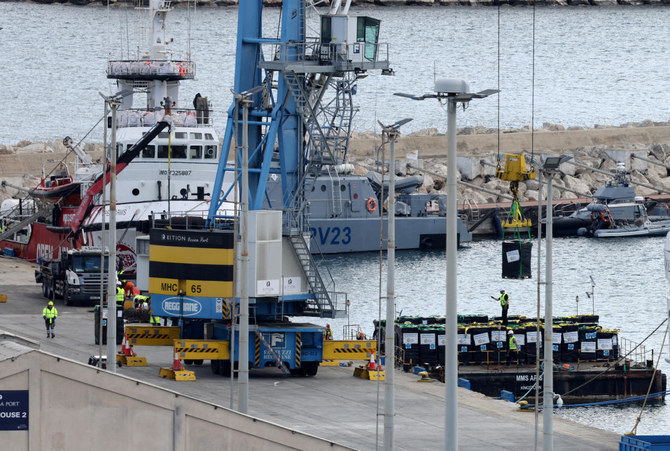
Humanitarian aid for Gaza is loaded onto a platform next to a Spanish NGO Open Arms rescue vessel at the port of Larnaca on Mar. 9, 2024. (Reuters)
Short Url
Updated 14 March 2024
Follow

Qatar, UAE ministers attend virtual meeting on maritime corridor in Gaza

  • Discussions focus on addressing logistical hurdles in transporting humanitarian aid

LONDON: Qatar and the UAE participated in a virtual ministerial meeting on Thursday on advancing a maritime corridor to deliver humanitarian assistance to Gaza.

The meeting, which was hosted by Cyprus’ Foreign Minister Constantinos Kombos, included Qatar’s Minister of State at the Ministry of Foreign Affairs Mohammed bin Abdulaziz bin Saleh Al-Khulaifi, and the UAE’s Foreign Minister Sheikh Abdullah bin Zayed Al-Nahyan.

The US Secretary of State Antony Blinken, UK Foreign Secretary David Cameron, EU Commissioner for Crisis Management Janez Lenarcic, and UN Senior Humanitarian and Reconstruction Coordinator for Gaza Sigrid Kaag also took part.

Discussions focused on addressing logistical hurdles in transporting humanitarian aid into the Gaza Strip, which is currently facing severe restrictions due to Israel’s blockade.

Israel’s action has isolated an estimated 300,000 Palestinians in northern Gaza, where the World Food Programme has reported catastrophic levels of hunger.

A joint statement issued by the governments involved underscored a consensus that there was no substitute for land routes through Egypt, Jordan, and other crossings into Gaza for broad aid delivery. It also welcomed the opening of Ashdod Port to humanitarian aid as an important addition to the maritime corridor.

Plans were set for senior officials to convene in Cyprus in the following week for comprehensive briefings on the maritime corridor’s operations. These will include discussions on the potential establishment of a joint fund to boost operations, and the coordination of both material and financial contributions for its maintenance.

The ministers said that the maritime corridor should be part of ongoing efforts to increase the flow of aid and commercial goods to Gaza via all available means, including expanded land routes and continuous airlift operations, in collaboration with Kaag, who is tasked with facilitating, monitoring, and verifying the flow of aid to the Gaza Strip under UN Security Council Resolution 2,720.

Agnes Callamard, secretary-general at Amnesty International, said on Wednesday that efforts to deliver aid to the Gaza Strip by constructing a seaport or through airdrops were a sign of international weakness.

She said: “A huge concern is that the proposed investment into building a port and transporting humanitarian assistance via sea appears to indicate that the international community ... are expecting the situation to last. Why are you making an investment that is going to take two months?”


Fledgling radio station aims to be ‘voice of the people’ in Gaza

Updated 15 February 2026
Follow

Fledgling radio station aims to be ‘voice of the people’ in Gaza

  • The electricity crisis is one of the most serious and difficult problems in the Gaza Strip, says Shereen Khalifa Broadcaster

DEIR EL-BALAH: From a small studio in the central city of Deir El-Balah, Sylvia Hassan’s voice echoes across the Gaza Strip, broadcast on one of the Palestinian territory’s first radio stations to hit the airwaves after two years of war.

Hassan, a radio host on fledgling station “Here Gaza,” delivers her broadcast from a well-lit room, as members of the technical team check levels and mix backing tracks on a sound deck. “This radio station was a dream we worked to achieve for many long months and sometimes without sleep,” Hassan said.

“It was a challenge for us, and a story of resilience.”

Hassan said the station would focus on social issues and the humanitarian situation in Gaza, which remains grave in the territory despite a US-brokered ceasefire between Israel and Hamas since October.

“The radio station’s goal is to be the voice of the people in the Gaza Strip and to express their problems and suffering, especially after the war,” said Shereen Khalifa, part of the broadcasting team.

“There are many issues that people need to voice.” Most of Gaza’s population of more than 2 million people were displaced at least once during the gruelling war.

Many still live in tents with little or no sanitation.

The war also decimated Gaza’s telecommunications and electricity infrastructure, compounding the challenges in reviving the territory’s local media landscape. “The electricity problem is one of the most serious and difficult problems in the Gaza Strip,” said Khalifa.

“We have solar power, but sometimes it doesn’t work well, so we have to rely on an external generator,” she added.

The station’s launch is funded by the EU and overseen by Filastiniyat, an organization that supports Palestinian women journalists, and the media center at the An-Najah National University in Nablus, in the occupied West Bank.

The station plans to broadcast for two hours per day from Gaza and for longer from Nablus. It is available on FM and online.

Khalifa said that stable internet access had been one of the biggest obstacles in setting up the station, but that it was now broadcasting uninterrupted audio.

The Gaza Strip, a tiny territory surrounded by Israel, Egypt, and the Mediterranean Sea, has been under Israeli blockade even before the attack on Oct. 7, 2023, which sparked the war. Despite the ceasefire, Israel continues to strictly control the entry of all goods and people to the territory.

“Under the siege, it is natural that modern equipment necessary for radio broadcasting cannot enter, so we have made the most of what is available,” she said.