EU denies ‘official communication’ from Imran Khan’s party on Pakistan’s GSP+ status

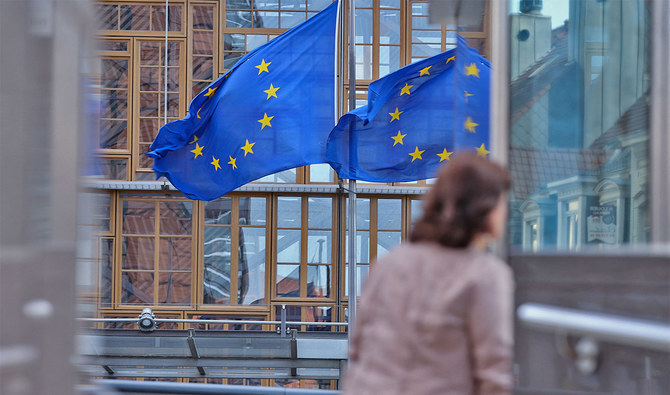
European Union flags fly outside the European Commission building in Brussel on June 1, 2022. (AFP/File)
Short Url
Updated 14 March 2024
Follow

EU denies ‘official communication’ from Imran Khan’s party on Pakistan’s GSP+ status

  • Information Minister Tarar has accused PTI of conspiring to get special trade status withdrawn
  • Current GSP regulation was set to expire in December 2023 but extended until Dec. 31, 2027

ISLAMABAD: The European Union’s mission in Islamabad said on Thursday it had not received any “official communication” from the Pakistan Tehreek-e-Insaf party of jailed ex-premier Imran Khan on the Generalized Scheme of Preferences Plus (GSP+) special trade scheme. 
In a press conference on Wednesday, Information Minister Attaullah Tarar accused the PTI of approaching the EU and starting a series of online petitions urging European authorities to withdraw Pakistan’s GSP+ status, a special trade arrangement offered to developing economies in return for their commitment to implement 27 international conventions on human rights, environmental protection and governance.
The current GSP framework came to an end in December 2023 but Members of EU Parliament (MEPs) voted in October to extend the current rules on the scheme for another four years for developing countries, including Pakistan.
“We have not received any official communication from PTI regarding GSP+,” Samar Saeed Akhtar, EU Press and Information Officer in Islamabad, told Arab News.
The PTI has also said it had not written any letter to the EU, as alleged by the information minister, on Pakistan’s GSP+ status.
“During a recent visit, both EU and Commonwealth delegations met with various political parties, including PTI and no other engagement with the EU took place than this,” PTI spokesperson Raoof Hassan said.
Last month, the PTI sent a letter to the International Monetary Fund, urging it to ensure an audit of the disputed Feb. 8 elections before any more bailout talks with Islamabad. The letter was widely decried by Khan’s rivals as an attack on Pakistan’s efforts to achieve economic stability.
The International Monetary Fund will hold a second and last review of Pakistan’s $3 billion stand-by arrangement (SBA) this week, the finance ministry and the IMF said on Wednesday, during which the South Asian nation will ask for a new longer-term bailout. 
The four-day review begins today, Thursday, and if successful, will release a final tranche of around $1.1 billion secured by Islamabad under a last-gasp rescue package last summer, averting a sovereign debt default.


Pakistan’s 120-year-old wooden mosque draws worshippers, visitors in Ramadan

Updated 10 sec ago
Follow

Pakistan’s 120-year-old wooden mosque draws worshippers, visitors in Ramadan

  • Baba Jee Mosque in northwest Pakistan fills nightly for Taraweeh prayers
  • Hand-carved timber structure reflects century-old Pashtun craftsmanship

LOWER DIR, Pakistan: As dusk settles over Timergara in northwest Pakistan, worshippers stream toward the 120-year-old Baba Jee Mosque, where the holy month of Ramadan brings nightly Taraweeh prayers beneath intricately carved wooden ceilings that have stood for generations.

During Ramadan, Muslims fast from dawn to sunset and gather in the evenings for extended congregational prayers. At Baba Jee Mosque, those gatherings swell, turning the historic structure into one of the region’s spiritual focal points.

The mosque, built in the 1890s by Mian Gul Muhayuddin, a religious figure from the prominent Pashtun Yousafzai tribe known locally as Baba Jee? has long served as a central place of worship for Dir Lower and surrounding districts.

Its significance intensifies during the fasting month when the mosque traditionally holds two Khatm-ul-Qur’an, or the full recitation of the Qur’an during Taraweeh prayers.

“Ten paras would be recited every day by two reciters. The two Khatams were completed in six days, three days each, and the mosque used to be full of worshippers,” said Naqeeb Ul Abrar, 62, the mosque’s custodian.

For decades, Baba Jee Mosque was the primary congregational mosque for the wider area, drawing worshippers from distant towns in a mountainous region near the Afghan border.

“In the past, mosques weren’t in such numbers as they are now. It was the only mosque where the Friday and Eid congregations were offered,” Abrar said. “People from far-flung areas like Medan, Rabat, Talash (Dir Lower), Arang (Bajaur), and Dir (Upper) would come for Friday and Eid prayers.”

For many locals, attending Baba Jee Mosque during Ramadan is a generational tradition.

“I have been coming to this mosque for the last 35-40 years,” said Burhan Uddin, 59. “Earlier, my grandfather would come here, and then my father would come, and this whole journey continues for 115-120 years. I am coming regularly now.”

“THE SOUL FEELS HAPPY HERE”

Beyond its Ramadan crowds, the mosque stands out for its remarkable preservation. 

Made of mud-plastered walls painted white, the structure is supported by large timber beams resting on ornately carved wooden columns. The heavy doors open inward with a distinct cracking sound, a reminder of its age.

Abrar said building the mosque in the late 19th century was an arduous task in the mountainous terrain, long before modern transport.

“This mosque was made with a lot of struggle. At that time, there was no transportation, so the wood was transported through the river Panjkoora,” he said. “They would drop all the large and big wood into the river water at Dir (Upper) and would collect it in Timergara.”

Craftsmen renowned for their skills were brought from Peshawar’s Tehkal area and Mardan’s Londkhwar to execute the detailed woodwork that still defines the interior.

“After completion, Baba Jee Sab [Mian Gul Muhayuddin] offered prayer for 12 years followed,” Abrar said. “The height of the mosque is 17 feet, and the width of the stone wall is 3.5 feet.”

The main hall accommodates around 500 worshippers inside and up to 800 more in the courtyard. While modern extensions using cement, tiles and marble have expanded capacity, the original wooden hall remains the mosque’s architectural and spiritual heart.

Many visitors are drawn by the craftsmanship that predates machinery.

“The wooden work here is done with detailed, hard work. At that time, it was done by hand with files, chisels, and screwdrivers,” Uddin said. 

“Now it is the time of machines, everything is done fast. This work has been done by hand, god knows how much time it would have taken. It is a kind of antique work, so many people come to see it too.”

Seventy-five-year-old Saeed ur Rahman said the mosque’s atmosphere remains unchanged despite modern development around it.

“People from Timergara and the surrounding areas come and offer their prayers here,” he said.

Recalling childhood memories, Rahman described how religious lessons and extended Qur’an recitations have long been part of the mosque’s Ramadan traditions.

“In the past, there used to be Darsi Qur’ani, and so it is now. The Khatm-ul-Qur’an (in Taraweeh) is done in Ramadan, and there are madrassa students, and I have been coming here to offer prayers for a very long time now.”

He said praying inside the wooden structure brings a particular sense of peace.

“Look, where stands the beauty of marble and where does the beauty of wood. In the wooden construction, the soul feels happy here. Look how beautiful its ornamentation is.”