

CM of province run by Khan loyalists breaks ice in meeting with Pakistan PM 

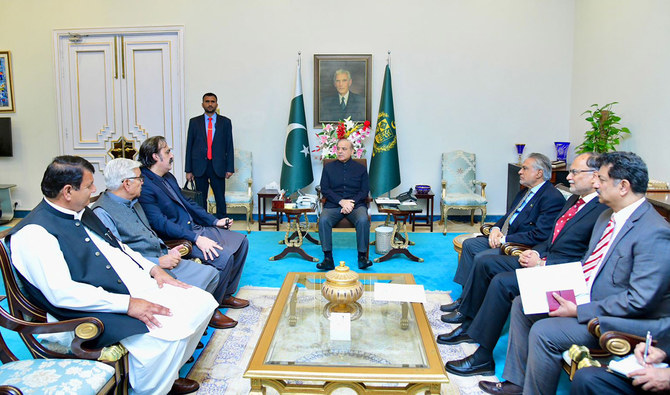
Khyber Pakhtunkhwa (KP) Chief Minister Ali Amin Gandapur (3rd left) meeting with Prime Minister Shehbaz Sharif (center) on March 13, 2024, in Islamabad, Pakistan. (Photo courtesy: PMO)
Short Url
Updated 13 March 2024
Follow

CM of province run by Khan loyalists breaks ice in meeting with Pakistan PM 

  • KP Chief Minister Ali Amin Gandapur says PM Sharif assured the center would pay province’s outstanding dues
  • Federal minister, Sharif aide Ahsan Iqbal urges all parties to join hands to tackle Pakistan’s pressing issues

ISLAMABAD: Khyber Pakhtunkhwa (KP) Chief Minister Ali Amin Gandapur met Prime Minister Shehbaz Sharif on Wednesday to break the ice between the two political adversaries, saying that the meeting was held on a “positive” note where administrative issues of the province were discussed. 

The meeting between the two was held at the Prime Minister’s Office (PMO) in Islamabad, where Gandapur had arrived to meet Sharif. Relations between the KP chief minister and Sharif had been tense, with Gandapur refusing to meet the Pakistani prime minister when he arrived in the province last week to meet rain-affected victims due to political differences.

Local media had widely reported Gandapur wanted the center to replace the incumbent KP chief secretary with bureaucrat Shahab Ali Shah. The KP chief minister is also actively seeking payment of the province’s outstanding dues from the center, which amount to billions of rupees.

“It was a very positive [meeting] and he assured his full support,” Gandapur, flanked by federal ministers, Sharif aides Ahsan Iqbal and Amir Muqam, told reporters after the meeting.

“About the outstanding dues, he said it is our province’s right which we will pay.”

Iqbal said he welcomed Gandapur’s meeting with Sharif, saying the prime minister had assured Gandapur the center would pay KP’s dues.

He said Sharif has directed Pakistan’s finance ministry personnel to resolve the issue of KP’s outstanding dues with the province’s relevant officials on Mar. 19, a day after Pakistan’s talks with the International Monetary Fund (IMF) conclude.

“The resources that are due to Khyber Pakhtunkhwa will be paid to them,” Iqbal said. He said Sharif had assured Gandapur there would be no power cuts in the northwestern province during Sehri and Iftar times in Ramadan.

“The prime minister has also said that a team comprising members from KP province and the center be formed in the future, which would work with the center to solve the province’s problems,” he said.

When a reporter asked whether the prime minister had agreed to Gandapur’s demand to appoint Shah as the chief secretary, he replied:

“That is resolved, he has said the due process of that would be followed and the people of the province have given you the mandate so whatever team you want to bring, we would not have any reservations over that.”

The Punjab government’s decision this week to impose a two-week blanket ban on visits and meetings at Adiala Jail, Rawalpindi due to security reasons also raised tensions between Khan’s Pakistan Tehreek-e-Insaf (PTI) party and Sharif’s Pakistan Muslim League-Nawaz (PML-N). 

Khan’s party said on Tuesday the move was an attempt to isolate the former prime minister, who is incarcerated at Adiala Jail, by keeping the media and his party colleagues away from him. 

The ban had been imposed days after the government announced it had foiled a militant attack on the prison by arresting three individuals with heavy weaponry who were taken to an undisclosed location.

Gandapur said he had asked Sharif to facilitate a meeting between him and Khan. 

“I told him political engagement with Khan is very necessary to solve political issues,” Gandapur said. 

“He was very positive and told me plainly he would make my meeting possible so I can complete consultations regarding the [upcoming] Senate election.”


Pakistan announces four-day work week among austerity measures to offset impact of Middle East crisis

Updated 5 sec ago
Follow

Pakistan announces four-day work week among austerity measures to offset impact of Middle East crisis

  • The development comes as ongoing US-Israeli strikes on Iran disrupt oil supplies in Strait of Hormuz, push prices past $119 a barrel
  • Islamabad bans government purchases, cuts fuel allocation for vehicles as well as workforce in public and private offices by 50 percent

ISLAMABAD: Prime Minister Shehbaz Sharif on Monday announced austerity measures, including a four-day work week and cuts in government expenditures, to offset the impact of rising global oil prices due to an ongoing conflict in the Middle East.

Global fuel supply lines have been disrupted in the Strait of Hormuz, which supplies nearly a fourth of world oil consumption, after Tehran blocked it following United States-Israeli strikes on Iran and counterattacks against US interests in the Gulf region.

Oil prices surged more than 25 percent globally on Monday to $119.50 a barrel, the highest levels since mid-2022, as some major producers cut supplies and fears of prolonged shipping disruptions gripped the market due to the expanding US-Israeli war with Iran.

In his televised address on Sunday night, Sharif said global oil prices were expected to rise again in the coming days but vowed not to let the people bear their brunt, announcing austerity measures to lessen the impact of fuel price hikes.

“Fifty percent staff in public and private entities will work from home,” he announced, adding this would not be applicable to essential services. “Offices will remain open for four days a week. One-day additional off is being given to conserve oil, but it would not be applicable to banks.”

Sharif didn’t specify working days of the week and the government was likely to issue a notification in this regard.

He said a decrease of 50 percent was being made in fuel allocation for government vehicles immediately for the next two months, but they would not include ambulances and public buses.

“Cabinet members, advisers and special assistants will not draw salaries for the next two months, 25 percent salaries of parliamentarians are being deducted, two-day salaries of Grade 20 and above officers, or those who are paid Rs300,000 ($1,067) a month, are being deducted for public relief,” he said.

Similarly, there will be 20 percent reduction in public department expenses and a complete ban on the purchase of cars, furniture, air conditioners and other goods, according to the prime minister.

Foreign trips of ministers and other government officials will also be banned along with government dinners and iftar buffets, while teleconferences and online meetings will be given priority.

Sharif’s comments were aired hours after Pakistani authorities said the country had “comfortable levels” of petroleum stocks and the supply chains were functioning smoothly, despite intensifying Middle East conflict.

Petroleum Minister Ali Pervaiz Malik said three oil shipments were due to reach Pakistan this week, state media reported.

Meanwhile, Pakistan Navy (PN) launched ‘Operation Muhafiz-ul-Bahr’ to safeguard national energy shipments, the Pakistani military said on Monday, amid disruptions to critical sea lanes due to the conflict.

The navy is conducting escort operations in close coordination with the Pakistan National Shipping Corporation (PNSC), according to the Inter-Services Public Relations (ISPR), the military’s media wing. It is fully cognizant of the prevailing maritime situation and is actively monitoring and controlling the movement of merchant vessels to ensure their safe and secure transit.

“With approximately 90 percent of Pakistan’s trade conducted via sea, the operation aims to ensure that vital sea routes remain safe, secure, and uninterrupted,” the ISPR said on Monday. “Currently, PN ships are escorting 2 x Merchant Vessels, one of which is scheduled to arrive Karachi today.”