

India’s new citizenship law that excludes Muslims has them worried. Here’s what it says

1 / 6
Members of the Asom Jatiyatabadi Yuba Chatra Parishad (AJYCP), a student's organisation, burn the effigy of India's Prime Minister Narendra Modi during a protest against the implementation of the Citizenship Amendment Act (CAA) in Guwahati on March 12, 2024. India's interior ministry said March 11 it was enacting a citizenship law that critics say discriminates against Muslims, just weeks before the world's most populous country heads into a general election. (AFP)
2 / 6
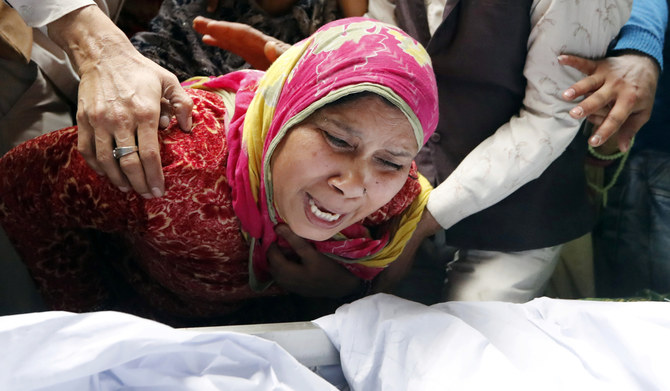
A woman mourns over the body of her son, Hashim Ali, who was wounded on Tuesday in a clash between people demonstrating for and against a new citizenship law, after he succumbed to his injuries, in a riot affected area in New Delhi, India, February 29, 2020. (REUTERS)
3 / 6
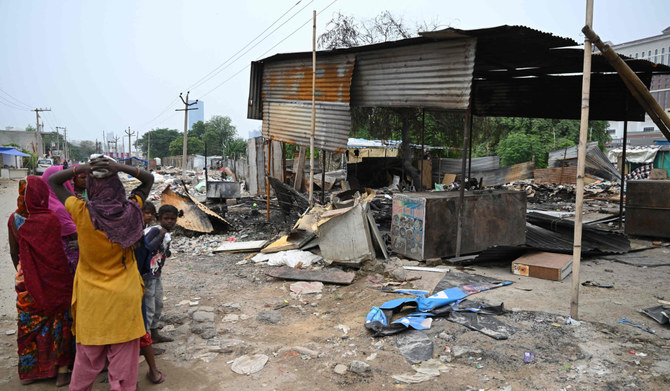
People stand next to a burnt strucutre in Gurugram, Haryana State, on August 4, 2023, following sectarian riots. (AFP)
4 / 6
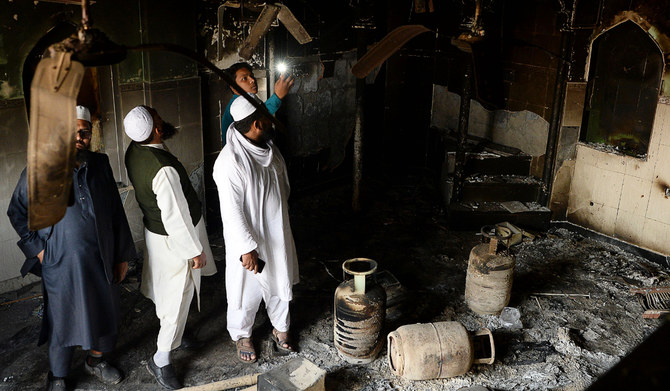
Muslim men check the interiors of a partially burnt mosque in a riot-affected area, in New Delhi on March 1, 2020, after violence broke out in India's capital. (AFP)
5 / 6
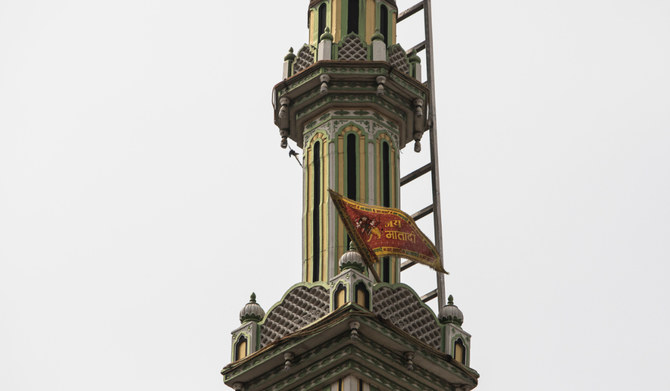
A Hindu religious flag flutters on the minaret of a burnt-out mosque following sectarian riots over India's new citizenship law, at Mustafabad area in New Delhi on February 28, 2020. (AFP)
6 / 6
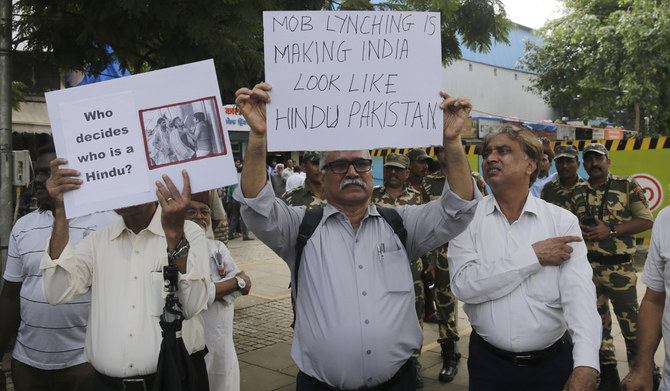
Indian activists hold placards during a protest against the recent attack on scholar and social activist Swami Agnivesh in Mumbai, India, Thursday, July 19, 2018. (AP)
Short Url
Updated 13 March 2024
Follow

India’s new citizenship law that excludes Muslims has them worried. Here’s what it says

  • Modi’s conspicuous silence over anti-Muslim violence has emboldened some of his most extreme supporters and enabled more hate speech against Muslims
  • India is home to 200 million Muslims who make up a large minority group in the country of more than 1.4 billion people

NEW DELHI: India has implemented a controversial citizenship law that has been widely criticized for excluding Muslims, a minority community whose concerns have heightened under Prime Minister Narendra Modi’s Hindu nationalist government.
The rules for the law were announced Monday. It establishes a religious test for migrants from every major South Asian faith other than Islam. Critics argue that the law is further evidence that Modi’s government is trying to reshape the country into a Hindu state and marginalize its 200 million Muslims.
WHAT IS THE NEW CITIZENSHIP LAW?
The Citizenship Amendment Act provides a fast track to naturalization for Hindus, Parsis, Sikhs, Buddhists, Jains and Christians who fled to Hindu-majority India from Afghanistan, Bangladesh and Pakistan before Dec. 31, 2014. The law excludes Muslims, who are a majority in all three nations.
It also amends the old law, which prevents illegal migrants from becoming Indian citizens, and marks the first time that India — an officially secular state with a religiously diverse population — has set religious criteria for citizenship.

HIGHLIGHTS

• Scores of Muslims have been lynched by Hindu mobs over allegations of eating beef or smuggling cows, an animal considered holy to Hindus

• Muslim businesses have been boycotted, their localities have been bulldozed and Mosques set on fire

• Some Hindutva leaders have made open calls for genocide against Muslims

The Indian government has said those eligible can apply for Indian citizenship through an online portal.
The implementation of the law has been one of the key poll promises of Modi’s ruling Bharatiya Janata Party in the run-up to the general election, which is scheduled to be held by May.
Modi’s government has dismissed the notion that the law is discriminatory and defended it as a humanitarian gesture. It argues the law is meant only to extend citizenship to religious minorities fleeing persecution and would not be used against Indian citizens.
WHAT MAKES THE LAW SO CONTROVERSIAL?
The law was approved by India’s Parliament in 2019, but Modi’s government held off its implementation after deadly protests broke out in New Delhi and elsewhere. Scores were killed during days of clashes.
The nationwide protests in 2019 drew people of all faiths who said the law undermines India’s foundation as a secular nation. Muslims were particularly worried that the government could use the law, combined with a proposed national register of citizens, to marginalize them.
The National Register of Citizens is part of the Modi government’s effort to identify and weed out people it claims came to India illegally. The register has only been implemented in the northeastern state of Assam, but Modi’s party has promised to roll out a similar citizenship verification program nationwide.
Critics and Muslim groups say the new citizenship law will help protect non-Muslims who are excluded from the register, while Muslims could face the threat of deportation or internment.
WHY ARE INDIA’S MUSLIMS WORRIED?
Opponents of the law — including Muslims, opposition parties and rights groups — say it is exclusionary and violates the secular principles enshrined in the constitution. They say faith cannot be made a condition of citizenship.
On Monday, Human rights watchdog Amnesty India said the law “legitimizes discrimination based on religion.”
Some also argue that if the law is aimed at protecting persecuted minorities, then it should have included Muslim religious minorities who have faced persecution in their own countries, including Ahmadis in Pakistan and Rohingyas in Myanmar.
To critics, Modi is pushing a Hindu nationalist agenda that threatens to erode the country’s secular foundation, shrink space for religious minorities, particularly Muslims, and move the country closer to a Hindu nation.
India is home to 200 million Muslims who make up a large minority group in the country of more than 1.4 billion people. They are scattered across almost every part of India and have been targeted in a series of attacks that have taken place since Modi first assumed power in 2014.
Scores of Muslims have been lynched by Hindu mobs over allegations of eating beef or smuggling cows, an animal considered holy to Hindus. Muslim businesses have been boycotted, their localities have been bulldozed and places of worship set on fire. Some open calls have been made for their genocide.
Critics say Modi’s conspicuous silence over anti-Muslim violence has emboldened some of his most extreme supporters and enabled more hate speech against Muslims.
Modi has also increasingly mixed religion with politics in a formula that has resonated deeply with India’s majority Hindu population. In January, he opened a Hindu temple at the site of a demolished mosque in northern Ayodhya city, fulfilling his party’s long-held Hindu nationalist pledge.


Putin warns that Russia will seek to extend its gains in Ukraine if peace talks fail

Updated 4 sec ago
Follow

Putin warns that Russia will seek to extend its gains in Ukraine if peace talks fail

Russian President Vladimir Putin warned Wednesday that Moscow will seek to extend its gains in Ukraine if Kyiv and its Western allies reject the Kremlin’s demands in peace talks.

US President Donald Trump has unleashed an extensive diplomatic push to end nearly four years of fighting following Russia’s full-scale invasion of Ukraine in February 2022, but Washington’s efforts have run into sharply conflicting demands by Moscow and Kyiv.

Speaking at an annual meeting with top military officers, Putin said Moscow would prefer to achieve its goals and “eliminate the root causes of the conflict” by diplomatic means, but he added that “if the opposing side and its foreign patrons refuse to engage in substantive dialogue, Russia will achieve the liberation of its historical lands by military means.”

Putin was referring to Ukrainian territory seized by Russia — action widely condemned in the West as a violation of Ukraine’s sovereignty and an unprovoked act of aggression.

Putin claimed that “the Russian army has seized and is firmly holding strategic initiative all along the front line” and warned that Moscow will move to expand a “buffer security zone” alongside the Russian border.

“Our troops are different now, they are battle-hardened and there is no other such army in the world now,” he said.

In this image, made from video provided by Russian Defense Ministry Press Service on Dec. 16, 2025, a Russian “Grad” self-propelled multiple rocket launcher fires towards Ukrainian positions on an undisclosed location in Ukraine. (Russian Defense Ministry Press Service via AP)

Putin praised Russia’s growing military might and particularly noted the modernization of its atomic arsenal, including the new nuclear-capable intermediate range Oreshnik ballistic missile that he said will officially enter combat duty this month. Russia first tested a conventionally armed version of the Oreshnik to strike a Ukrainian factory in November 2024, and Putin has boasted that it’s impossible to intercept.

At the same time, he rejected European officials’ statements about Moscow’s purported plans to attack European nations as “lies and sheer nonsense ... driven by short-sighted personal or group political interests, not by the interests of their people.”

Sharply different demands by Moscow and Kyiv

Putin’s tough statements follow several rounds of talks this week between Ukrainian. American and European officials on a U.S.-drafted peace plan. Ukrainian President Volodymyr Zelenskyy said after meeting with US envoys in Berlin that the document could be finalized within days, after which U.S. envoys will present it to the Kremlin.

Putin wants all the areas in four key regions captured by his forces, as well as Crimea, which was illegally annexed in 2014, to be recognized as Russian territory. He also has demanded that Ukraine withdraw from some areas in eastern Ukraine that Moscow’s forces have not captured yet.

The Kremlin also insists that Ukraine abandon its bid to join NATO and warns it won’t accept the deployment of any troops from NATO members and will view them as “legitimate target.”

Zelenskyy has expressed readiness to drop Ukraine’s bid to join NATO if the US and other Western nations give Kyiv security guarantees similar to those offered to NATO members. But Ukraine’s preference remains NATO membership as the best security guarantee to prevent further Russian aggression.

At the same time, Zelenskyy has rejected Moscow’s demands that it pull back its troops from other areas that Russia has not been able to take by force.

The Ukrainian leader described the draft peace plan discussed with the US during talks in Berlin on Monday as “not perfect” but “very workable,” noting that Kyiv and its allies were very close to a deal on “strong security guarantees.” But he also emphasized that the key issue of control over territory remain unresolved and rejected the U.S. push for Ukraine to cede control over the eastern Donetsk region.

Putin on Wednesday again praised Trump’s settlement efforts and seconded Trumps’ repeated claims that the war in Ukraine wouldn’t have erupted under his watch. He charged that the previous U.S. administration and some of the European allies he contemptuously called “piglings” had vainly expected Russia’s collapse.

The Russian leader said a dialogue with Europe “is unlikely to become possible with the current political elites, but in any case, it will be inevitable as we grow stronger if not with the current politicians, then with a change in political elites in Europe.”

Russian military maps out for more gains

Reporting to Putin at Wednesday’s military meeting, Defense Minister Andrei Belousov spelled out plans for further advances, saying the latest Russian advances in Donetsk have set the stage for a quick push into the Ukrainian-controlled part of the region.

Belousov also declared that Russian troops were preparing to drive Ukrainian forces from parts of the Zaporizhzhia region that Moscow also annexed in 2022 but never fully captured, as well as extend gains in neighboring Dnipropetrovsk.

“The key task for the next year is to preserve and accelerate the tempo of the offensive,” he said.

Belousov spelled out plans for expanding Russian military capabilities, focusing on drones, jamming equipment and air defense assets.

Aerial attacks continue

As Russia continues its grinding advances in many sectors of the front, it also pummeled Ukraine with daily missile and drone strikes.

At least 26 people were injured by Russian glide bombs in Zaporizhzhia and its vicinity, according to regional administration head Ivan Fedorov. The attack damaged several residential buildings, as well as infrastructure and an educational facility.

At least 69 long-range drones were launched by Russia overnight, the Ukrainian air force said. Air defenses intercepted or jammed 29 drones in the morning, with the assault continuing during the day.

Russia’s Defense Ministry said that air defenses downed 94 Ukrainian drones overnight.

In Russia’s southern Krasnodar region, drones injured two people and damaged several private houses, according to regional emergency officials. In the southwestern Voronezh region, Gov. Alexander Gusev said drone fragments damaged a power line serving an infrastructure facility, causing a blaze that was quickly extinguished.