

Putin warns that Russia will seek to extend its gains in Ukraine if peace talks fail

In this image, made from video provided by Russian Defense Ministry Press Service on Dec. 16, 2025, a Russian “Grad” self-propelled multiple rocket launcher fires towards Ukrainian positions on an undisclosed location in Ukraine. (Russian Defense Ministry Press Service via AP)
Short Url
Updated 18 December 2025
Follow

Putin warns that Russia will seek to extend its gains in Ukraine if peace talks fail

  • Putin wants all the areas in four key regions captured by his forces, as well as Crimea, which was illegally annexed in 2014, to be recognized as Russian territory
  • “Our troops are different now, they are battle-hardened and there is no other such army in the world now,” Putin said at an annual meeting with top military officers

Russian President Vladimir Putin warned Wednesday that Moscow will seek to extend its gains in Ukraine if Kyiv and its Western allies reject the Kremlin’s demands in peace talks.

US President Donald Trump has unleashed an extensive diplomatic push to end nearly four years of fighting following Russia’s full-scale invasion of Ukraine in February 2022, but Washington’s efforts have run into sharply conflicting demands by Moscow and Kyiv.

Speaking at an annual meeting with top military officers, Putin said Moscow would prefer to achieve its goals and “eliminate the root causes of the conflict” by diplomatic means, but he added that “if the opposing side and its foreign patrons refuse to engage in substantive dialogue, Russia will achieve the liberation of its historical lands by military means.”

Putin was referring to Ukrainian territory seized by Russia — action widely condemned in the West as a violation of Ukraine’s sovereignty and an unprovoked act of aggression.

Putin claimed that “the Russian army has seized and is firmly holding strategic initiative all along the front line” and warned that Moscow will move to expand a “buffer security zone” alongside the Russian border.

“Our troops are different now, they are battle-hardened and there is no other such army in the world now,” he said.
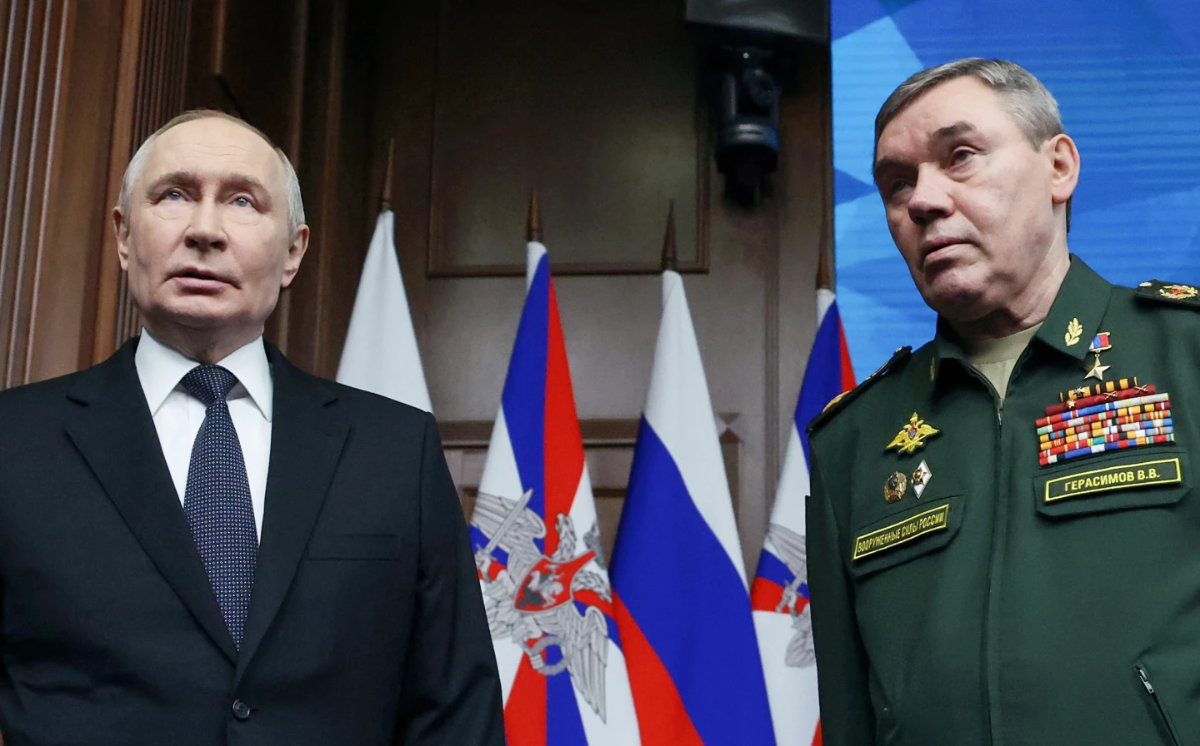


Russian President Vladimir Putin, left, and Russian Chief of General Staff Gen. Valery Gerasimov attend the annual board meeting of the country’s Defense Ministry on Dec. 17, 2025. (Sputnik, Kremlin Pool Photo via AP)

Putin praised Russia’s growing military might and particularly noted the modernization of its atomic arsenal, including the new nuclear-capable intermediate range Oreshnik ballistic missile that he said will officially enter combat duty this month. Russia first tested a conventionally armed version of the Oreshnik to strike a Ukrainian factory in November 2024, and Putin has boasted that it’s impossible to intercept.

At the same time, he rejected European officials’ statements about Moscow’s purported plans to attack European nations as “lies and sheer nonsense ... driven by short-sighted personal or group political interests, not by the interests of their people.”

Sharply different demands by Moscow and Kyiv

Putin’s tough statements follow several rounds of talks this week between Ukrainian. American and European officials on a US-drafted peace plan. Ukrainian President Volodymyr Zelenskyy said after meeting with US envoys in Berlin that the document could be finalized within days, after which U.S. envoys will present it to the Kremlin.

Putin wants all the areas in four key regions captured by his forces, as well as Crimea, which was illegally annexed in 2014, to be recognized as Russian territory. He also has demanded that Ukraine withdraw from some areas in eastern Ukraine that Moscow’s forces have not captured yet.

The Kremlin also insists that Ukraine abandon its bid to join NATO and warns it won’t accept the deployment of any troops from NATO members and will view them as “legitimate target.”

Zelenskyy has expressed readiness to drop Ukraine’s bid to join NATO if the US and other Western nations give Kyiv security guarantees similar to those offered to NATO members. But Ukraine’s preference remains NATO membership as the best security guarantee to prevent further Russian aggression.

At the same time, Zelenskyy has rejected Moscow’s demands that it pull back its troops from other areas that Russia has not been able to take by force.

The Ukrainian leader described the draft peace plan discussed with the US during talks in Berlin on Monday as “not perfect” but “very workable,” noting that Kyiv and its allies were very close to a deal on “strong security guarantees.” But he also emphasized that the key issue of control over territory remain unresolved and rejected the U.S. push for Ukraine to cede control over the eastern Donetsk region.

Putin on Wednesday again praised Trump’s settlement efforts and seconded Trumps’ repeated claims that the war in Ukraine wouldn’t have erupted under his watch. He charged that the previous U.S. administration and some of the European allies he contemptuously called “piglings” had vainly expected Russia’s collapse.

The Russian leader said a dialogue with Europe “is unlikely to become possible with the current political elites, but in any case, it will be inevitable as we grow stronger if not with the current politicians, then with a change in political elites in Europe.”

Russian military maps out for more gains

Reporting to Putin at Wednesday’s military meeting, Defense Minister Andrei Belousov spelled out plans for further advances, saying the latest Russian advances in Donetsk have set the stage for a quick push into the Ukrainian-controlled part of the region.

Belousov also declared that Russian troops were preparing to drive Ukrainian forces from parts of the Zaporizhzhia region that Moscow also annexed in 2022 but never fully captured, as well as extend gains in neighboring Dnipropetrovsk.

“The key task for the next year is to preserve and accelerate the tempo of the offensive,” he said.

Belousov spelled out plans for expanding Russian military capabilities, focusing on drones, jamming equipment and air defense assets.

Aerial attacks continue

As Russia continues its grinding advances in many sectors of the front, it also pummeled Ukraine with daily missile and drone strikes.

At least 26 people were injured by Russian glide bombs in Zaporizhzhia and its vicinity, according to regional administration head Ivan Fedorov. The attack damaged several residential buildings, as well as infrastructure and an educational facility.

At least 69 long-range drones were launched by Russia overnight, the Ukrainian air force said. Air defenses intercepted or jammed 29 drones in the morning, with the assault continuing during the day.

Russia’s Defense Ministry said that air defenses downed 94 Ukrainian drones overnight.

In Russia’s southern Krasnodar region, drones injured two people and damaged several private houses, according to regional emergency officials. In the southwestern Voronezh region, Gov. Alexander Gusev said drone fragments damaged a power line serving an infrastructure facility, causing a blaze that was quickly extinguished.


Police are investigating link between Brown shooting and killing of MIT professor, AP sources say

Updated 9 sec ago
Follow

Police are investigating link between Brown shooting and killing of MIT professor, AP sources say

PROVIDENCE, R.I.: Six days into the investigation into last weekend’s mass shooting at Brown University, authorities said Thursday that they’re looking into a connection between that attack and one two days later near Boston that killed a professor at another elite school.
That is according to three people familiar with the matter who were not authorized to discuss an ongoing investigation and spoke on condition of anonymity. Two of the people said investigators had identified a person of interest in the shootings and were actively seeking that individual.
The attacker at Brown on Saturday killed two students and wounded nine others in a classroom in the school’s engineering building before getting away.
About 50 miles  north, Massachusetts Institute of Technology professor Nuno F.G. Loureiro was gunned down in his home Monday night in the Boston suburb of Brookline. The 47-year-old physicist and fusion scientist died at a hospital the next day.
The FBI previously said it knew of no links between the cases.
How is the Brown investigation going?
It’s been nearly a week since the shooting at Brown. There have been other high-profile attacks in which it took days or longer to make an arrest or find those responsible, including in the brazen New York City sidewalk killing of UnitedHealthcare’s CEO last year, which took five days.
But frustration is mounting in Providence that the person behind the attack managed to get away and that a clear image of their face has yet to emerge.
“There’s no discouragement among people who understand that not every case can be solved quickly,” the state attorney general, Peter Neronha, said at a news conference Wednesday.
Authorities have scoured the area for evidence and pleaded with the public to check any phone or security footage they might have from the week before the attack, believing the shooter might have cased the scene ahead of time. But they have given no sense that they’re close to catching the shooter.
Investigators have released several videos from the hours and minutes before and after the shooting that show a person who, according to police, matches witnesses’ description of the shooter. In the clips, the person is standing, walking and even running along streets just off campus, but always with a mask on or their head turned.
Although Brown officials say there are 1,200 cameras on campus, the attack happened in an older part of the engineering building that has few, if any, cameras. And investigators believe the shooter entered and left through a door that faces a residential street bordering campus, which might explain why the cameras Brown does have didn’t capture footage of the person.
Providence Mayor Brett Smiley said Wednesday that the city is doing “everything possible” to keep residents safe. However, he acknowledged that it is “a scary time in the city” and that families likely were having tough conversations about whether to stay in town over the holidays.
“We are doing everything we can to reassure folks, to provide comfort, and that is the best answer I can give to that difficult question,” Smiley said when asked if the city was safe.
Although it’s not unheard of for someone to disappear after carrying out such a high-profile shooting, it is rare.
What can be learned from past investigations?
In such targeted and highly public attacks, the shooters typically kill themselves or are killed or arrested by police, said Katherine Schweit, a retired FBI agent and expert on mass shootings. When they do get away, searches can take time.
“The best they can do is what they do now, which is continue to press together all of the facts they have as fast as they can,” Schweit said. “And, really, the best hope for solutions is going to come from the public.”
In the 2013 Boston Marathon bombing, it took investigators four days to catch up to the two brothers who carried it out. In a 2023 case, Army reservist Robert Card was found dead of an apparent suicide two days after he killed 18 people and wounded 13 others in Lewiston, Maine.
The man accused of killing conservative political figure Charlie Kirk in September turned himself in about a day and a half after the attack on Utah Valley University’s campus. And Luigi Mangione, who has pleaded not guilty to murder charges in the killing of UnitedHealthcare CEO Brian Thompson in Manhattan last year, was arrested five days later at a McDonald’s in Pennsylvania.
Felipe Rodriguez, a retired New York police detective sergeant and adjunct professor at the John Jay College of Criminal Justice, said it’s clear that shooters are learning from others who were caught.
“Most of the time an active shooter is going to go in, and he’s going to try to commit what we call maximum carnage, maximum damage,” Rodriguez said. “And at this point, they’re actually trying to get away. And they’re actually evading police with an effective methodology, which I haven’t seen before.”
Investigators have described the person they are seeking as about 5 feet, 8 inches  tall and stocky. The attacker’s motives remain a mystery, but authorities said Wednesday that none of the evidence suggests a specific person was being targeted.
MIT mourns the loss of an esteemed professor
Loureiro, who was married, joined MIT in 2016 and was named last year to lead MIT’s Plasma Science and Fusion Center, where he worked to advance clean energy technology and other research. The center, one of the school’s largest labs, had more than 250 people working across seven buildings when he took the helm. He was a professor of physics and nuclear science and engineering.
He grew up in Viseu, in central Portugal, and studied in Lisbon before earning a doctorate in London, according to MIT. He was a researcher at an institute for nuclear fusion in Lisbon before joining MIT, the university said.
“He shone a bright light as a mentor, friend, teacher, colleague and leader, and was universally admired for his articulate, compassionate manner,” Dennis Whyte, an engineering professor who previously led MIT’s Plasma Science and Fusion Center, told a campus publication.
Loureiro had said he hoped his work would shape the future.
“It’s not hyperbole to say MIT is where you go to find solutions to humanity’s biggest problems,” Loureiro said when he was named to lead the plasma science lab last year. “Fusion energy will change the course of human history.”