

In a first, Aseefa, daughter of President Zardari, to be named first lady of Pakistan

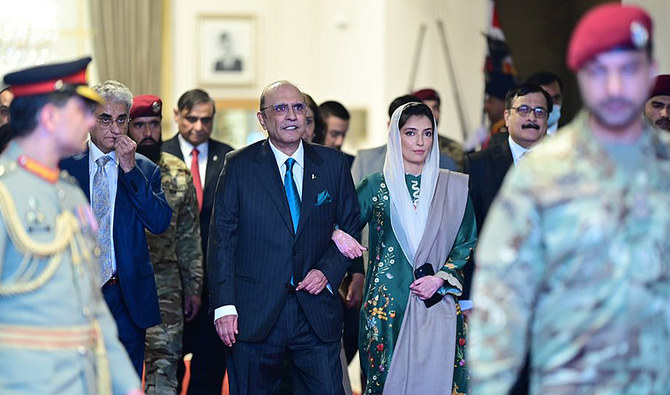
Aseefa Bhutto-Zardari (3rd right), daughter of President Asif Ali Zardari, pictures with her father, President Asif Ali Zardari at the presidential palace in Islamabad, Pakistan on March 9, 2024. (Pakistan Peoples Party/X))
Short Url
Updated 11 March 2024
Follow

In a first, Aseefa, daughter of President Zardari, to be named first lady of Pakistan

  • Naming a woman as first lady other than wife of the president or PM has never happened in Pakistan since its inception in 1947
  • The post remained vacant during Zardari’s first tenure from 2008 till 2013 after the assassination of his wife ex-PM Benazir Bhutto

ISLAMABAD: In a rare move, Aseefa Bhutto-Zardari, daughter of President Asif Ali Zardari, has been named as the first lady of Pakistan by her Pakistan Peoples Party, which is part of the ruling coalition in the South Asian country.

Zardari, who previously served as president from 2008 till 2013, took oath on Sunday for a second term as Pakistan president. His election to the presidency was part of a power sharing formula between his PPP, of which he is co-chairman, and the Pakistan Muslim League-Nawaz (PML-N) of three-time former prime minister Nawaz Sharif, whose younger brother Shehbaz Sharif is the new premier,

While the position of first lady remained vacant during Zardari’s first tenure following the assassination of his wife and ex-PM Benazir Bhutto, his daughter has been named as the first lady this time by his party.

“First lady with the President,” the PPP said in an X post on Sunday, with a picture of Zardari with Aseefa after the former’s oath-taking in Islamabad.

There has not yet been an official announcement of the appointment.

Aseefa, 31, has been an active figure in Zardari’s PPP party, often accompanying his father and brother to rallies, campaigns and other events. She was actively involved in the PPP’s electoral campaign in the run-up to the February 8 polls and was seen leading various rallies in a bid to seek support for her brother Bilawal Bhutto Zardari, the party’s then-candidate for the prime minister’s post. Additionally, her high-profile role as polio eradication ambassador in Pakistan has helped her become a more familiar face in Pakistan.

Naming a woman other than the wife of the president or prime minister as the first lady has never happened in Pakistan since its independence from Britain in 1947.

The position of the first lady remained vacant during the brief tenure of Muhammad Ali Jinnah, the founder of Pakistan, as the first governor general of the South Asian country. Jinnah’s second wife, Rattanbai, died in 1929 and he never remarried.

The post also remained vacant during the tenures of Yahya Khan, former president and chief martial law administrator, and ex-PM Huseyn Shaheed Suhrawardy. Khan never married, while Suhrawardy’s first wife had died and he had divorced his second wife before becoming prime minister in 1956.

While it may be a first in Pakistan, several women in the United States (US), who were not wives of the president, have served as the first lady, when the president was a bachelor, widower, or when his wife was unable to discharge duties of the first lady.

In such cases, the position was filled by a female relative of the president, such as Thomas Jefferson’s daughter Martha Jefferson Randolph, Andrew Jackson’s daughter-in-law Sarah Yorke Jackson and his wife’s niece Emily Donelson, Zachary Taylor’s daughter Mary Elizabeth Bliss, Benjamin Harrison’s daughter Mary Harrison McKee, James Buchanan’s niece Harriet Lane, and Grover Cleveland’s sister Rose Cleveland.


Pakistani student launches ‘Urdu ChatGPT’ AI model

Updated 5 sec ago
Follow

Pakistani student launches ‘Urdu ChatGPT’ AI model

  • Developer says “Qalb” is largest large language model built exclusively for Urdu
  • Project highlights push to localize artificial intelligence for non-English users

ISLAMABAD: A Pakistani student studying in the United States has launched an artificial intelligence model designed exclusively for the Urdu language, a development its creator says could help bridge longstanding gaps in access to advanced digital tools for millions of speakers worldwide.

The project, called Qalb, is positioned as an Urdu-first large language model at a time when most generative AI systems are primarily trained on English and other widely used global languages. Supporters of language-specific models argue they can improve accuracy, cultural relevance and accessibility for users in education, business and public services.

Urdu is spoken by more than 230 million people globally, including in Pakistan, India and diaspora communities, but remains under-represented in advanced AI systems. Efforts to localize artificial intelligence have increasingly been seen as critical for widening participation in digital economies, particularly in developing countries.

“Qalb is now recognized as the world’s largest Large Language Model created exclusively for the Urdu language,” Taimoor Hassan, the project’s developer, was quoted this month in a report in state-run news agency APP. 

“Trained on a massive dataset of 1.97 billion tokens and benchmarked across seven-plus international evaluation frameworks, Qalb outperforms existing Urdu-focused AI models on key real-world performance indicators, setting a new standard for natural language processing in Pakistan,” Hassan said.

“This is a development model and in the next phase we would soon launch App for mobile and web so that people could use and benefit from Qalb ChatGPT.”

Hassan completed his undergraduate degree in computer science at FAAST University’s Peshawar campus and is currently studying for a master’s degree in computer science and software engineering at Auburn University in the United States. According to APP, he is a serial entrepreneur who has previously launched and exited multiple startups and has represented Pakistan at international technology forums.

“I had the opportunity to contribute in a small way to a much bigger mission for the country,” Hassan said.

“Together with my undergraduate roommates and teammates, Jawad Ahmed and Muhammad Awais, we are committed to continuously fine-tuning localized models for niche industries, which we believe can become a major breakthrough for Pakistan.”

Both collaborators are also graduates of FAAST University Peshawar Campus and are currently studying in Germany, APP reported.

The team behind Qalb said the model is intended to support local businesses, startups, educational platforms and voice-based digital services, arguing that meaningful innovation is no longer limited to large technology firms.

“Technology is no longer locked behind big budgets or big teams. With the right mindset, even a small group can build products that educate, automate, and serve millions,” Hassan told APP.