

Arab League chief says halting war in Sudan is top priority

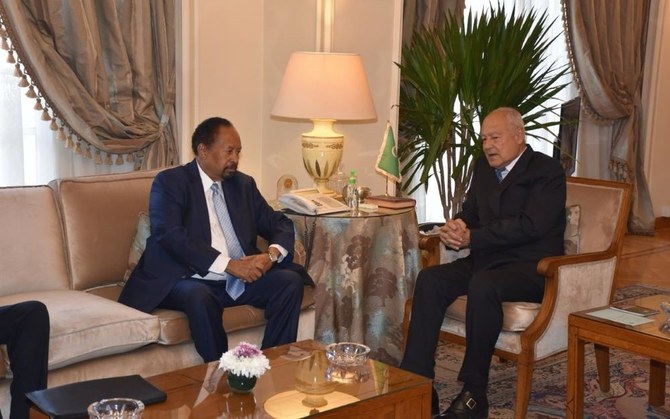
Abdalla Hamdok and Ahmed Aboul Gheit. (X/@arableague_gs)
Short Url
Updated 11 March 2024
Follow

Arab League chief says halting war in Sudan is top priority

  • Secretary-General Ahmed Aboul Gheit says members ready to arbitrate to bring an end to the violence
  • Former PM Hamdok presents ceasefire plan at meeting in Cairo

CAIRO: Preserving the territorial integrity of Sudan and ending the country’s civil war are priorities of the Arab League, according to its Secretary-General Ahmed Aboul Gheit.

He expressed the league’s readiness to assist the Sudanese parties in resolving the crisis by bringing factions together.

Aboul Gheit emphasized the importance of supporting any initiative to find a solution for the Sudanese state, while speaking during a meeting in Cairo with a delegation of the Sudanese Coordination of Civil Democratic Forces — known as Taqaddum — led by former Prime Minister Abdalla Hamdok.

Hamdok presented a plan for achieving a ceasefire and political process through an inclusive Sudanese dialogue to protect Sudan, save lives, and maintain progress.

He expressed gratitude to the secretary-general for the initiative taken on March 5 calling the various Sudanese parties in the conflict and urging a truce during Ramadan.

Hamdok said he hoped both parties could build upon this initiative to find a political solution to the crisis.

The head of the Arab League has already called on the warring parties to reach a ceasefire agreement before the holy month.

Aboul Gheit, in an appeal to the Sudanese people, warned: “Ahead of the holy month of Ramadan, beginning in a few days, Sudan continues to witness the shedding of precious blood and enduring wounds from a year-long war, jeopardizing the dreams and legitimate hopes of millions for a safe and stable life in their homeland.”


UN rights chief Shocked by ‘unbearable’ Darfur atrocities

Updated 18 January 2026
Follow

UN rights chief Shocked by ‘unbearable’ Darfur atrocities

  • Mediation efforts have failed to produce a ceasefire, even after international outrage intensified last year with reports of mass killings, rape, and abductions during the RSF’s takeover of El-Fasher in Darfur

PORT SUDAN: Nearly three years of war have put the Sudanese people through “hell,” the UN’s rights chief said on Sunday, blasting the vast sums spent on advanced weaponry at the expense of humanitarian aid and the recruitment of child soldiers.
Since April 2023, Sudan has been gripped by a conflict between the army and the paramilitary Rapid Support Forces that has left tens of thousands of people dead and around 11 million displaced.
Speaking in Port Sudan during his first wartime visit, UN Human Rights commissioner Volker Turk said the population had endured “horror and hell,” calling it “despicable” that funds that “should be used to alleviate the suffering of the population” are instead spent on advanced weapons, particularly drones.
More than 21 million people are facing acute food insecurity, and two-thirds of Sudan’s population is in urgent need of humanitarian aid, according to the UN.
In addition to the world’s largest hunger and displacement crisis, Sudan is also facing “the increasing militarization of society by all parties to the conflict, including through the arming of civilians and recruitment and use of children,” Turk added.
He said he had heard testimony of “unbearable” atrocities from survivors of attacks in Darfur, and warned of similar crimes unfolding in the Kordofan region — the current epicenter of the fighting.
Testimony of these atrocities must be heard by “the commanders of this conflict and those who are arming, funding and profiting from this war,” he said.
Mediation efforts have failed to produce a ceasefire, even after international outrage intensified last year with reports of mass killings, rape, and abductions during the RSF’s takeover of El-Fasher in Darfur.
“We must ensure that the perpetrators of these horrific violations face justice regardless of the affiliation,” Turk said on Sunday, adding that repeated attacks on civilian infrastructure could constitute “war crimes.”
He called on both sides to “cease intolerable attacks against civilian objects that are indispensable to the civilian population, including markets, health facilities, schools and shelters.”
Turk again warned on Sunday that crimes similar to those seen in El-Fasher could recur in volatile Kordofan, where the RSF has advanced, besieging and attacking several key cities.
Hundreds of thousands face starvation across the region, where more than 65,000 people have been displaced since October, according to the latest UN figures.