GAZA: The Muslim holy month of Ramadan begins Monday in Gaza with no truce in sight, as fighting rages between Israeli forces and Hamas militants and a dire humanitarian crisis grips the besieged Palestinian territory.
A Spanish charity ship with food aid prepared to sail from Cyprus to the coastal Gaza Strip, where the UN has repeatedly warned of famine.
Aid groups say only a fraction of the supplies required to meet basic humanitarian needs have been allowed into Gaza since October, when Israel placed it under near-total siege.
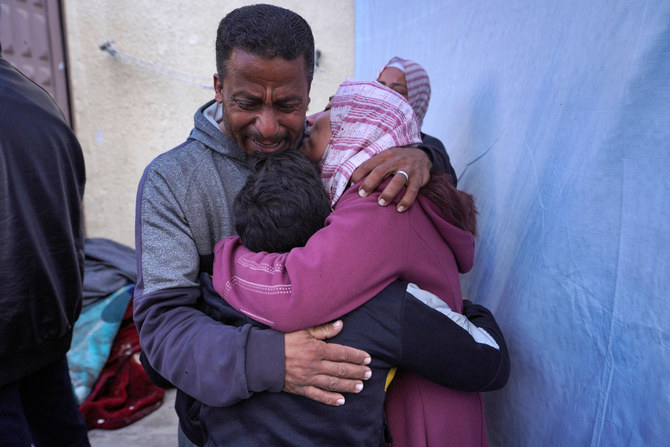
About 370 kilometers (230 miles) from Cyprus across the Mediterranean Sea, Mohammed Harara stood on the shores of Gaza, hoping for the aid to arrive.
“I’ve been waiting since this morning, because tomorrow is the start of the holy month of Ramadan and the situation is very tragic,” he said.
The non-governmental group Open Arms said its boat would tow a barge with 200 tons of food, which its partner the US charity World Central Kitchen would then unload on Gaza’s shores.
It was expected to depart “within the coming hours,” Cypriot government spokesman Konstantinos Letymbiotis told Cyprus News Agency.
Jordanian, US, French, Belgian and Egyptian planes parachuted aid into northern Gaza on Sunday, but the United Nations’ aid coordinator for the area has said boosting supply by land is the best way to get assistance to the territory’s 2.4 million people.
Aid airdrops
Some of the airdropped food packages smashed open on impact, leaving residents picking through the dirt to salvage what they could, AFPTV images showed.
The war started by the October 7 Hamas attack on Israel has killed 31,045 Palestinians, mostly women and children, according to the health ministry in Hamas-ruled Gaza, where vast swathes have been reduced to a bombed-out wasteland.
Weeks of talks involving US, Qatari and Egyptian mediators have aimed for a six-week truce and the release of many of the hostages taken on October 7 that militants are still holding. In return, Israel would free Palestinian prisoners being held in Israeli jails.
The aim had been to halt the fighting by the start of Ramadan.
Both sides have blamed each other for failing to reach a truce deal, after Israel demanded a full list of surviving hostages and Hamas called for Israel to pull out all its troops from Gaza.
A source with knowledge of the truce talks told AFP that “there will be a diplomatic push especially in the next 10 days” with a view to securing a deal within the first half of Ramadan.
The holy month this year is “all pain,” said Ahmed Kamis, 40, in Rafah, where around 1.5 million people have tried to find refuge but are still at risk from Israeli bombing.
Israel has also threatened to launch a ground operation into the southern city.
In Washington, President Joe Biden, who faces growing criticism for his steadfast support of Israel as the civilian death toll in Gaza soars, issued a statement marking the start of Ramadan.
“This year, it comes at a moment of immense pain,” Biden said.
“As Muslims gather around the world over the coming days and weeks to break their fast, the suffering of the Palestinian people will be front of mind for many. It is front of mind for me,” Biden added.
In Saudi Arabia, King Salman called in his Ramadan message for the international community to “uphold its responsibilities to put an end to these heinous crimes and ensure the establishment of safe humanitarian and relief corridors.”
In a message of his own, UN chief Antonio Guterres expressed his “solidarity and support to all those suffering from the horrors in Gaza. In these trying times, the spirit of Ramadan is a beacon of hope, a reminder of our shared humanity.”
Growing Israel-US tensions
Biden on Saturday stressed his growing impatience with Israel’s right-wing Prime Minister Benjamin Netanyahu, telling broadcaster MSNBC that the Israeli leader “must pay more attention to the innocent lives being lost as a consequence of the actions taken.”
At this stage, said Biden, Netanyahu’s approach to the war was “hurting Israel more than helping Israel.”
Netanyahu, under pressure from desperate families of hostages still held in Gaza as well as critics of his government, on Sunday rejected Biden’s comments and said most Israelis back “the action that we’re taking to destroy the remaining terrorist battalions of Hamas.”
He said Israel’s military had killed “at least 13,000 terrorist fighters,” but did not give details on how the figure was derived.
Hamas’s attack that started the war resulted in about 1,160 deaths in Israel, mostly civilians, according to Israeli official figures.
The militants also took around 250 hostages, dozens of whom were released during a week-long truce in November. Israel believes that 99 hostages still in militants’ hands remain alive and 31 have died.
The UN has reported particular difficulty in accessing northern Gaza for deliveries of food and other aid.
What is available in the south is sold at exorbitant prices, residents say, making this Ramadan like no other.


![]()

Israel-Hamas war rages in besieged Gaza as Ramadan begins
Short Url
https://arab.news/mx5sf
Israel-Hamas war rages in besieged Gaza as Ramadan begins
- A Spanish charity ship with food aid prepared to sail from Cyprus to the coastal Gaza Strip
- Some of the airdropped food packages smashed open on impact, leaving residents picking through the dirt


Latest updates


© 2026 SAUDI RESEARCH & PUBLISHING COMPANY, All Rights Reserved And subject to Terms of Use Agreement.